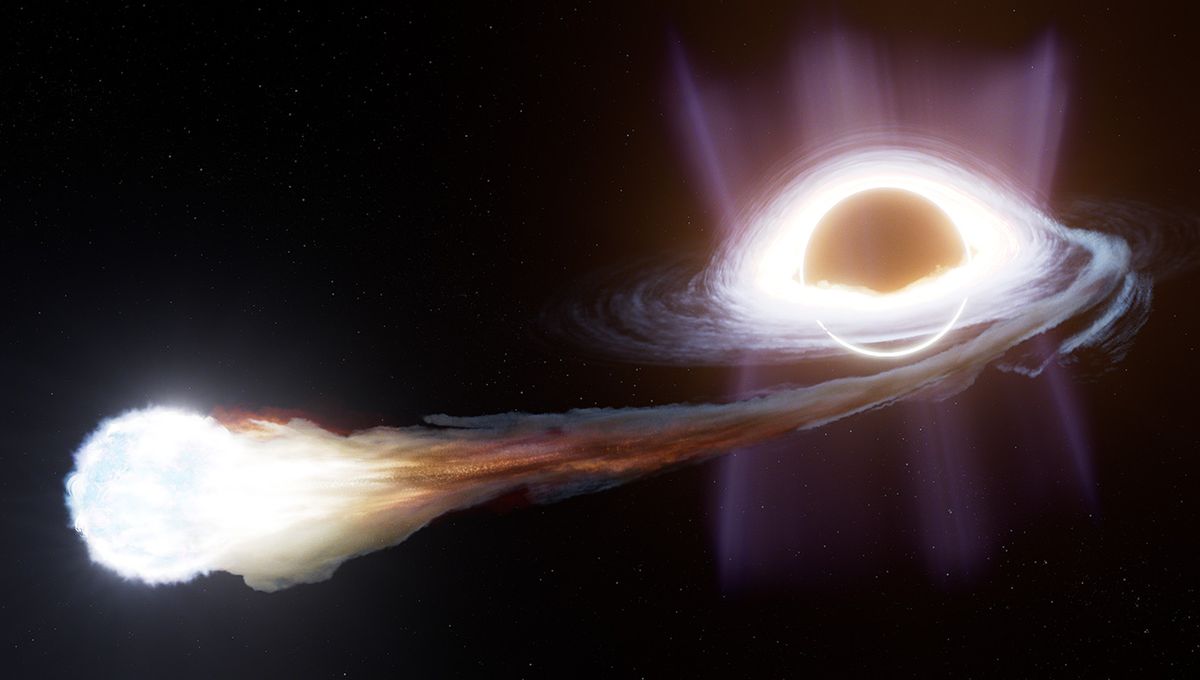
Spinning massive objects drag spacetime along with them. This curious phenomenon is an important prediction in general relativity, which has been confirmed from a variety of celestial bodies and events. The latest one comes from a supermassive black hole pulling a star apart.
You can imagine that a massive spinning object twists spacetime as it spins. This has been measured on Earth and around Jupiter with the Juno mission, and even around pulsars. A black hole weighing 5 million times the mass of the Sun, such as the one we’re talking about, will exhibit much stronger frame-dragging, as it is called, than our planet – but seeing it at a distance has not been easy.
Black holes are notoriously difficult to spot unless they are active, and one type of activity is the destruction of a star, which gives a temporary emission of light that can be used for a whole series of measurements. One such event has previously been used to measure frame-dragging as well as the spin of a black hole.
A different Tidal Disruption Event (TDE), as the stellar murders are called, has provided for the first time measurements of the frame-dragging around a black hole. AT2020afhd was visible in X-rays and radio waves with specific rhythmic changes. The defunct star formed a disk of plasma, and a jet of material was released from around the black hole.
Both of them were wobbling together, with a pattern repeating every 20 days. Within that pattern, the team was able to measure the small but clear effect that can be attributed to frame-dragging.
“By showing that a black hole can drag space time and create this frame-dragging effect, we are also beginning to understand the mechanics of the process,” co-author Dr Cosimo Inserra, from Cardiff University, said in a statement emailed to IFLScience.
“So, in the same way a charged object creates a magnetic field when it rotates, we’re seeing how a massive spinning object – in this case a black hole – generates a gravitomagnetic field that influences the motion of stars and other cosmic objects nearby.”
Frame-dragging, or more correctly, the Lense-Thirring effect, was first theorized by Einstein in 1913 and then mathematically defined by Lense and Thirring in 1918. While relativity has been passing all the tests we put it to, we know there are more out there. These tests are fundamental to help us better understand reality.
“This is a real gift for physicists as we confirm predictions made more than a century ago. Not only that, but these observations also tell us more about the nature of TDEs – when a star is shredded by the immense gravitational forces exerted by a black hole,” Dr Inserra explained.
“Unlike previous TDEs studied, which have steady radio signals, the signal for AT2020afhd showed short-term changes, which we were unable to attribute to the energy release from the black hole and its surrounding components. This is further confirmed the dragging effect in our minds and offers scientists a new method for probing black holes.”
The study is published in the journal Science Advances.

Source Link: Spacetime Vortices Spotted For The First Time As Black Hole Kills A Star
