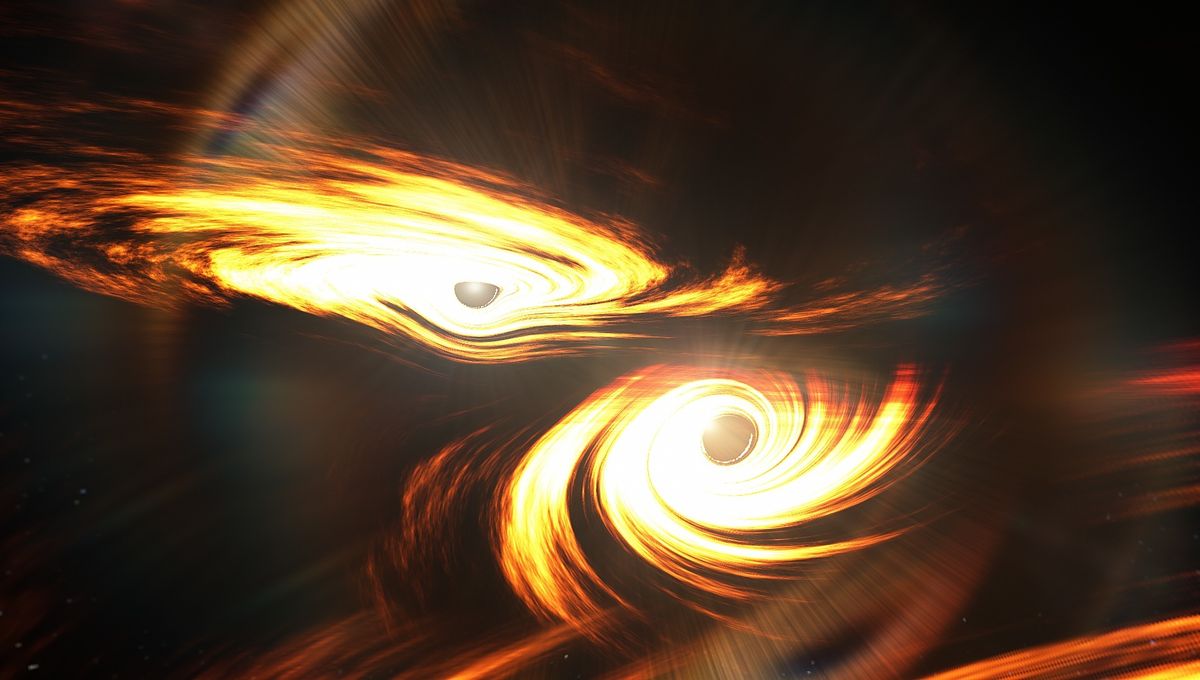
Thanks to gravitational wave observatories, we know that when two black holes merge, they create a third black hole. The final black hole is slightly less massive than the sum of its parents, as some energy has been lost as gravitational waves. This final black hole is also kicked away from its birthplace by the space-time warping interaction that created it. Scientists have now simulated just how fast this recoil can be.
Using 1,381 simulations, researchers looked at high-energy collisions between black holes and how they behave. They found that if conditions are just right, the newly merged black hole can be launched into the universe at a speed just shy of 28,600 kilometers (17,800 miles) per second. That is one fast black hole.
“We wanted to compute what was the maximum velocity that a newly formed black hole, the merger of the two colliding black holes, can acquire. We found a maximum that is about 10 percent of the speed of light, which is very fast for astrophysical standards,” co-author Professor Carlos Lousto from the Rochester Institute of Technology, told IFLScience.
Not every black hole will be shot from the collision at that great speed. The scientists realized that very specific requirements are necessary for that max velocity to be reached. The merging black holes in the simulation are assumed to be spinning, and they are spinning in exactly opposite directions.
They are also on their side with respect to the orbit they take around each other before colliding. Just like the Earth is at an angle compared to its orbit around the Sun, so are these simulated black holes. Our planet’s tilt is 23.5 degrees, while these theoretical black holes are at 90 degrees and pointing away from each other.
“The spins – how fast they are rotating on their axis – and also the orientation are the most crucial aspect,” Professor Lousto told IFLScience. “It seems to be crucial that [the direction of the spins] are in the same plane as the orbit. This maximizes the anisotropy because one spin is pointing in one direction the other spin has to be pointing in the other direction within the orbital plane. And this leads to the maximum asymmetric radiation which leads to this recoil.”
The emission of gravitational energy is what makes this recoil so great. The collisions between black holes are such dramatic events that some of the mass is turned into gravitational waves. To maximize the recoil, the emission needs to be asymmetric. However, the researchers were also curious as to the maximum value for how much energy you can get from a black hole collision.
Professor Lousto was able to share with us preliminary findings of their new work suggesting that under the right conditions (quite different from the maximum recoil) you can get up to 27 percent of the mass of the black holes being turned into gravitational waves.
This study has been accepted for publication in Physical Review Letters.

Source Link: Speed Limit Of Black Holes Recoiling From A Merger Estimated For First Time
