


Winds from the red giant R Doradus are not powerful enough to spread the molecules that make up rocky planets through the galaxy, a new study has found. Since R Doradus is considered a classic example of the type of star responsible for many of the components of Earth, the finding overthrows our ideas on how our planet came to be, but a replacement explanation has yet to be found.
It’s hard to find an astronomer who’d disagree with the combined wisdom of Carl Sagan and Joni Mitchell that we’re all made of star stuff or stardust. The elements beyond hydrogen and helium that make us up were formed in a previous generation of stars, without which we would not be here. However, the mechanism that has been thought to explain how that stardust disperses has now been shown to be flawed, and the team that made the discovery doesn’t have a coherent alternative to offer beyond, “It’s complicated.”
The universe’s heavier and rarer elements come from supernovae and kilonovae. These explosions give these elements a giant push, which can cause them to spread widely. However, although Earth contains traces of these, it is mostly made up of elements like oxygen, silicon, and aluminum. There are not enough exploding stars in the galaxy to provide the amounts of these we know are present, so it’s just as well that mid-mass stars that will never become supernovae form these elements late in their lives.
For planets like Earth to exist, however, we don’t just need factories where these atoms are forged, but a method for distribution, and this is where the problems now arise. It had been thought that starlight would push dust made of magnesium silicate (MgSiO3) and aluminum oxide (Al2O3) across the space between the stars to seed nebulae like the one from which Earth formed, but new observations throw a spanner in the works.
Red giant stars are known to have stellar winds far more powerful than those of the Sun. It was thought that the light these stars produce powered the winds, pushing grains of dust made up of carbon and silicon-rich molecules on their journey, but details were hard to see until recently.
“Using the world’s best telescopes, we can now make detailed observations of the closest giant stars. R Doradus is a favorite target of ours—it’s bright, nearby, and typical of the most common type of red giant,” said joint study lead Dr Theo Khouri of Chalmers University in a statement. A hundred and eighty light-years being “nearby” to an astronomer.
R Doradus’ light illuminates the dust it has emitted, and the polarization at different wavelengths indicates the size and composition of the grains. When Khouri and co-authors analyzed data collected by the Very Large Telescope, they found the dust rich in silicates and alumina.
The team then modeled the force of sunlight on particles this size. “For the first time, we were able to carry out stringent tests of whether these dust grains can feel a strong enough push from the star’s light,” said first author Dr Thiébaut Schirmer.
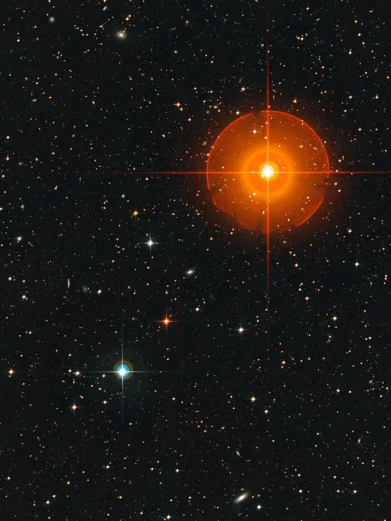
Its combination of size and relative closeness means R Doradus has the largest angular radius of any star as seen from Earth, beating Betelgeuse. And then there is the dust around it.
Image credit: ESO/Digitized Sky Survey 2/Davide De Martin
The molecules in the R Doradus’ dust matched expectations, but the size proved more of a problem. R Doradus’ photons aren’t strong enough to give dust with such a small surface area the speed it would need to disperse into the material that will become planets around future stars, the authors concluded.
“Dust is definitely present, and it is illuminated by the star,” Schirmer said. “But it simply doesn’t provide enough force to explain what we see.”
Some dust composed of iron-bearing silicates, such as MgFeSiO4, is of a size to gain sufficient acceleration, the authors found, but would overheat and turn to gas at critical stages of the journey, ruining the dispersion. The ratio of silicon gas to dust required for iron-rich silicates to be the prime dust disperser is also wildly inconsistent with observations.
That doesn’t mean we simply assume the idea that the oxygen we breathe and the silicon on which we stand come from some other source. It’s far more likely we depend on red giant stars for our existence, but something else did the dispersing.
“Even though the simplest explanation doesn’t work, there are exciting alternatives to explore,” said study co-author Professor Wouter Vlemmings. “Giant convective bubbles, stellar pulsations, or dramatic episodes of dust formation could all help explain how these winds are launched.”
The study is published in Astronomy and Astrophysics.


Source Link: Stardust Didn’t Reach The Solar System The Way We Thought, So How Did It Get Here?