• Email Us: [email protected]
  • Contact Us: +1 718 874 1545
  • Skip to main content
  • Skip to primary sidebar

Medical Market Report

  • Home
  • All Reports
  • About Us
  • Contact Us

Stellar “Demolition Derby” Leads To Never-Before-Seen Star Destruction

June 22, 2023 by Deborah Bloomfield

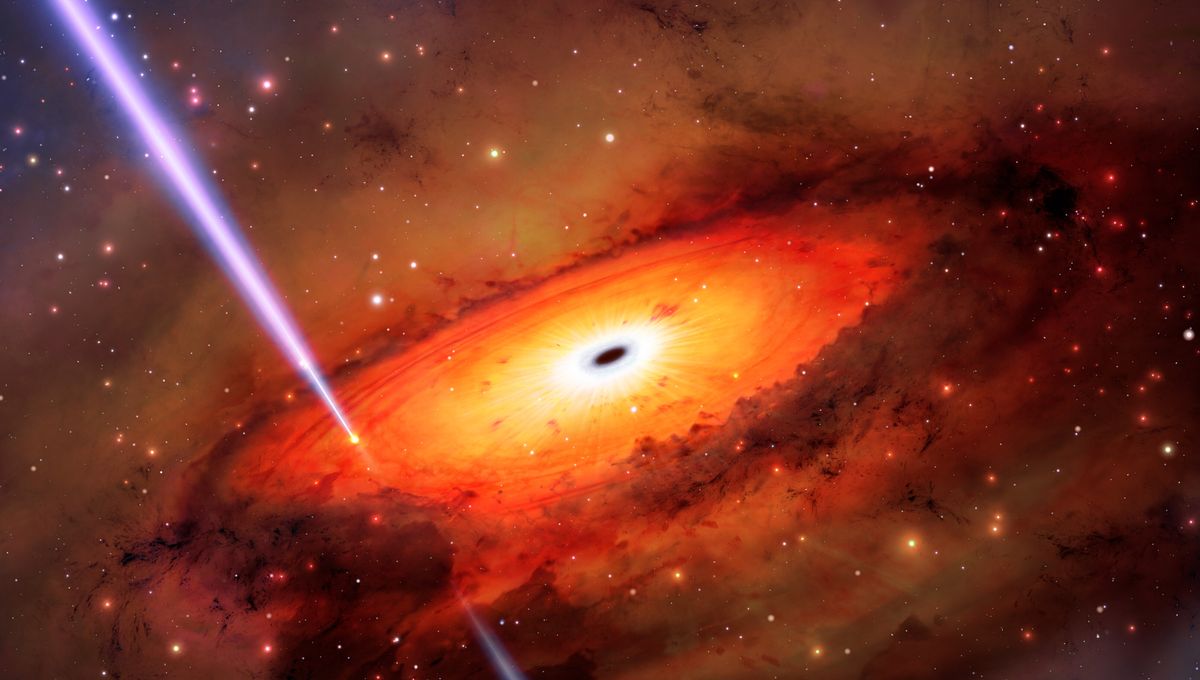
Stars have been seen to die in three ways. Small ones turn into white dwarfs after having exhausted their fuel and swelling up into red giants. Bigger ones explode in supernovae, forming black holes or neutron stars, or even leaving nothing behind. And then star and stellar remnants in binary systems can merge and go boom. Astronomers have finally seen a fourth way, which has long been suspected to exist: unbounded stellar objects crossing paths in a collision.  

A long-duration gamma-ray burst, GRB 191019A, which lasted for 80 seconds, was tracked to the regions around a supermassive black hole in a galaxy 3 billion light-years away. There, stars are packed tightly together and they end up interacting. In this case, in a demolition derby-style collision. 

Advertisement

“These new results show that stars can meet their demise in some of the densest regions of the universe where they can be driven to collide,” lead author Andrew Levan, an astronomer with Radboud University in The Netherlands, said in a statement. “This is exciting for understanding how stars die and for answering other questions, such as what unexpected sources might create gravitational waves that we could detect on Earth.”

The source of long-duration gamma-ray bursts (any burst longer than two seconds but less than 10,000) is usually a very massive star going supernova, but the region where GRB 191019A comes from is ancient. There shouldn’t be any stars capable of those explosions. For this reason, researchers looked for a dynamical explanation for the powerful flash of light.

Observations conducted with the Gemini South Telescope suggest the collision of two compact objects. The environment at the center of the galaxy is so packed with stars that their gravitational interactions can eventually push objects to cross paths in a fatal way.

“Our follow-up observation told us that rather than being a massive star collapsing, the burst was most likely caused by the merger of two compact objects,” said Levan. “By pinpointing its location to the center of a previously identified ancient galaxy, we had the first tantalizing evidence of a new pathway for stars to meet their demise.”

Advertisement

These events might be more common than previously thought, but the centers of galaxies are busy, dusty environments, so they might have gone unnoticed so far. The team hopes to find more of these events and even obtain observations with gravitational waves as well.

The study is published in the journal Nature Astronomy.

Deborah Bloomfield
Deborah Bloomfield

Related posts:

  1. Tennis-Scrappy Sakkari survives gruelling three-setter to beat Andreescu
  2. Cricket-NZ players reach Dubai after ‘specific, credible threat’ derailed Pakistan tour
  3. Accel, Tiger and Stripe’s COO back Mexico City-based Higo as it raises $23M for its B2B payments platform
  4. The Cat Flap Is Surprisingly Ancient, And Not The Work Of Isaac Newton

Source Link: Stellar "Demolition Derby" Leads To Never-Before-Seen Star Destruction

Filed Under: News

Primary Sidebar

  • Why Carl Sagan Was Way Ahead Of His Time And The Legacy He Left Behind
  • Why Were Pompeii Victims All Wearing Thick Woolly Cloaks In August?
  • We May Finally Know What Causes These Bizarre Bright Blue Cosmic Flashes
  • What’s The Biggest Rock In The World?
  • There Is A Very Simple Test To See If You Have Aphantasia
  • Bringing Extinct Animals To Life: Is Artificial Intelligence Helping Or Harming Palaeoart?
  • This Brilliant Map Has 3D Models Of Nearly Every Single Building In The World – All 2.75 Billion Of Them
  • These Hognose Snakes Have The Most Dramatic Defense Technique You’ve Ever Seen
  • Titan, Saturn’s Biggest Moon, Might Not Have A Secret Ocean After All
  • The World’s Oldest Individual Animal Was Born In 1499 CE. In 2006, Humans Accidentally Killed It.
  • What Is Glaze Ice? The Strange (And Deadly) Frozen Phenomenon That Locks Plants Inside Icicles
  • Has Anyone Ever Actually Been Swallowed By A Whale?
  • First-Known Instance Of Bees Laying Eggs In Fossilized Tooth Sockets Discovered In 20,000-Year-Old Bones
  • Polar Bear Mom Adopts Cub – Only The 13th Known Case Of Adoption In 45 Years Of Study At Hudson Bay
  • The Longest-Running Evolution Experiment Has Been Going For 80,000 Generations
  • From Shrink Rays And Simulated Universes To Medical Mishaps And More: The Stories That Made The Vault In 2025
  • Fastest Cretaceous Theropod Yet Discovered In 120-Million-Year-Old Dinosaur Trackway
  • What’s The Moon Made Of?
  • First Hubble View Of The Crab Nebula In 24 Years Is A Thing Of Beauty… With Mysterious “Knots”
  • “Orbital House Of Cards”: One Solar Storm And 2.8 Days Could End In Disaster For Earth And Its Satellites
  • Business
  • Health
  • News
  • Science
  • Technology
  • +1 718 874 1545
  • +91 78878 22626
  • [email protected]
Office Address
Prudour Pvt. Ltd. 420 Lexington Avenue Suite 300 New York City, NY 10170.

Powered by Prudour Network

Copyrights © 2025 · Medical Market Report. All Rights Reserved.

Go to mobile version