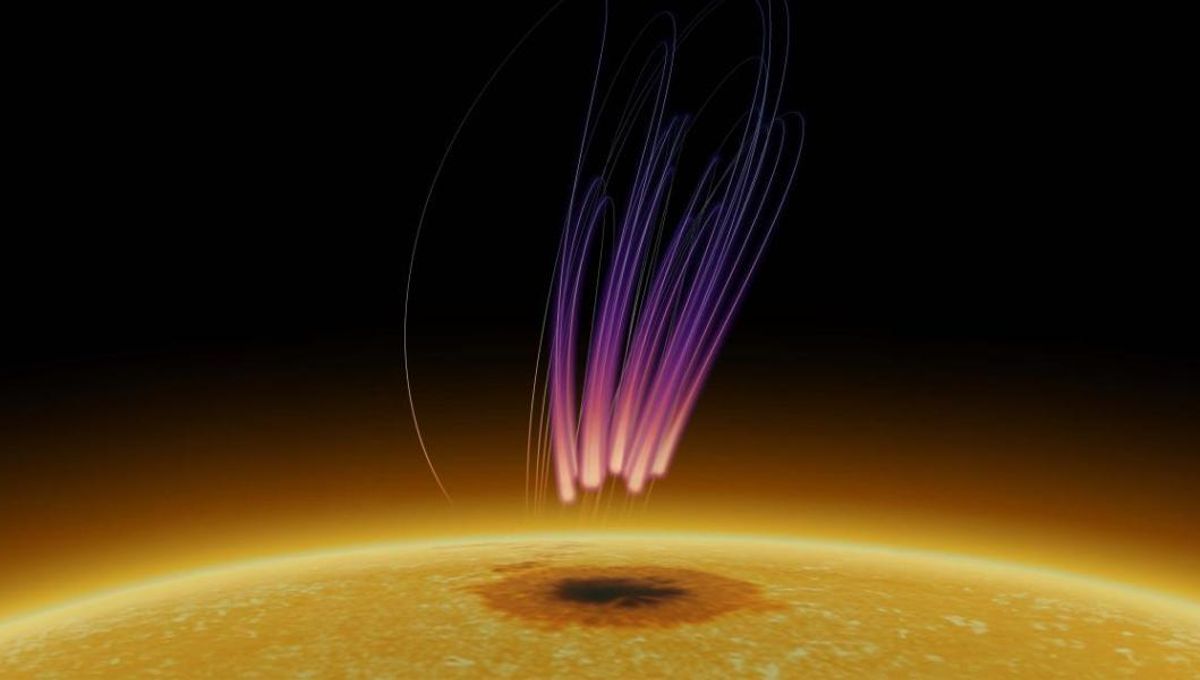
A long-lasting powerful radio burst emerging from the Sun in 2016 was highly circularly polarized and took place directly above a sunspot, a new study reports. The burst may shed light on possibly similar events detected on red and brown dwarf stars, although it is far weaker.
On April 9, 2016, astronomers turned the Karl Jansky Very Large Array (VLA) on the Sun to measure its activity between 1 and 4 Gigahertz with a much higher spatial resolution than is usually possible. They found a radio source in the solar atmosphere above a sunspot group broadcasting at frequencies of up to 1.7 GHz through the entire 4.5 hours of their observation.
“We’ve detected a peculiar type of long-lasting polarized radio bursts emanating from a sunspot, persisting for over a week,” said Sijie Yu of the New Jersey Institute of Technology in a statement. “This is quite unlike the typical, transient solar radio bursts typically lasting minutes or hours. It’s an exciting discovery that has the potential to alter our comprehension of stellar magnetic processes.”
The magnetic fields above sunspots are thousands of times stronger than those of the Earth, and as a result, the frequencies of the emissions observed were much higher than those seen on Earth – but Yu and co-authors think something similar is going on.
“The cooler and intensely magnetic areas of sunspots provide a favorable environment for the [electron-cyclotron maser] emission to occur, drawing parallels with the magnetic polar caps of planets and other stars and potentially providing a local solar analog to study these phenomena,” Yu said.
The emissions became much more powerful in bursts occurring an average of once every five minutes. Other instruments observing at the same time, but with lower resolution, also detected radio bursts of emissions at lower frequencies over a period of days. Curiously, these bursts didn’t coincide with flare activity, nor show the expected relationship with X-ray emissions.
The team studying the observations has explained what they saw as the product of: “Energetic electrons trapped in the large-scale magnetic loops anchored at the sunspot.” They note the parallels with auroras in the magnetic fields of Earth and Jupiter.
However, the more important comparison is probably with emissions seen coming from M-type (red dwarf) stars. These stars are too far away for us to be able to see whether the radio bursts are coming from the whole star or a specific region that might be heavy with star spots. They’re also hundreds or thousands of times more powerful than the ones the VLA spotted. Nevertheless, it is known that these types of stars have a lot of starspots (which can make it hard to detect planets around them) so a relationship is plausible.
Notably, not only are these dwarf star radio bursts also highly circularly polarized, but they can also occur in the absence of significant flares. Nevertheless, the authors think their explanation cannot apply to outbursts seen on the lowest-temperature dwarf stars, which lack sunspots.
“By understanding these signals from our own Sun, we can better interpret the powerful emissions from the most common star type in the universe, M-dwarfs, which may reveal fundamental connections in astrophysical phenomena,” added Professor Dale Gary.
The study is published in the journal Nature Astronomy

Source Link: Strange Aurora-Like Radio Emissions Spotted Emanating From A Sunspot
