Researchers have announced that they have constructed the current best map of the background of gravitational waves across the universe. They did so using the incredible MeerKAT radio telescopes in South Africa. But this map has an unexpected feature: there is a possible anomaly in the gravitational waves washing across our galaxy, linked to the merging of two black holes.
Any moving object with mass creates gravitational waves – even you moving your hand does that. Of course, those are too weak to be detected. The motion of planets, stars, and even supermassive black holes are also way too weak to be detected directly, but they all add up to the gravitational wave background. We are getting closer to having consistent detections of this sloshing of space-time across the universe, but it has not been easy. We had to use a detector spanning a large portion of our own galaxy, the Milky Way.
“Studying the background lets us tune into the echoes of cosmic events across billions of years,” Dr Matt Miles, a researcher at OzGrav and lead author of two of the new studies, said in a statement. “It reveals how galaxies, and the universe itself, have evolved over time.”
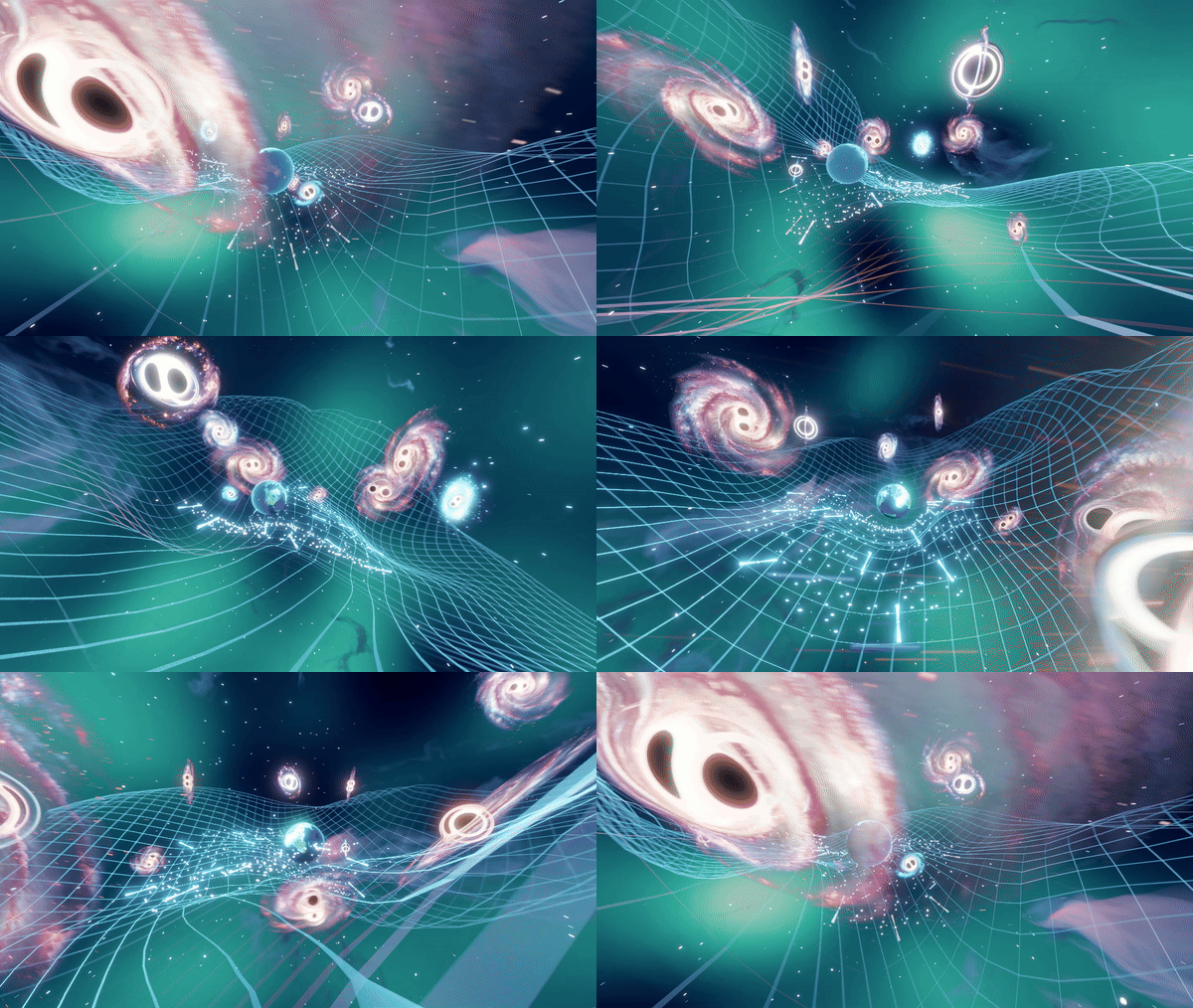
The gravitational wave background is passing through us at this very moment.
Image credit: Carl Knox, OzGrav, Swinburne University of Technology
A galaxy-sized detector might seem surprising. How can we have an observatory across the galaxy when the most distant human-made object (Voyager 1) is still less than one light-day away from Earth? The answer is that we use a phenomenal cosmic object to our advantage: pulsars.
Pulsars are a type of neutron star, the end product of certain supernovae. A subclass of pulsars, called millisecond pulsars, rotate hundreds of times every second, pulsating from our point of view. Their rotation is so regular that they can be as precise as atomic clocks on Earth. So, changes to this pulsation – as seen by us – imply that a gravitational wave has passed through. You need a lot of measurements of each pulsar and of a lot of pulsars to turn those signals into an actual detection of the background. This approach is called the Pulsar Timing Array.
The MeerKAT Pulsar Timing Array is the latest one in an international effort to determine the gravitational wave background, and the researchers argue that their measurement is stronger than other surveys conducted to this point – and they were able to do it in just one-third of the time. The map is highly detailed thanks to new approaches, which led to the discovery of a possible directional bias related to supermassive black holes.
“What we’re seeing hints at a much more dynamic and active universe than we anticipated,” Dr Miles, who’s at Swinburne University of Technology, added. “We know supermassive black holes are out there merging, but now we’re starting to ask: where are they, and how many are out there?”
The idea was that the gravitational wave background is uniform; there are supermassive black holes merging in so many different directions and distances that overall, they make up a consistent sloshing. But if these findings are correct, we might have a preferential source affecting our galaxy.
“The presence of a hotspot could suggest a distinct gravitational wave source, such as a pair of black holes billions of times the mass of our Sun,” said the lead author of the third study Rowina Nathan, from OzGrav and Monash University. “Looking at the layout and patterns of gravitational waves shows us how our Universe exists today and contains signals from as far back as the Big Bang. There’s more work to do to determine the significance of the hotspot we found, but this an exciting step forward for our field.”
More observations will be needed to verify and improve this dataset, and announcements in the past related to the gravitational wave background have been more tentative. Seeing the confidence is exciting, but it’s a young field, so we shall see how different observations shape the full results.
“In the future, we aim to understand the origin of the gravitational wave signal emerging from our data sets. By looking for variations in the gravitational waves across the sky, we’re hunting for the fingerprints of the underlying astrophysical processes,” added Kathrin Grunthal, a researcher from the Max Planck Institute for Radio Astronomy and a co-author of one of the studies.
The three papers with these results are published in the Monthly Notices of the Royal Astronomical Society and can be read here, here, and here.

Source Link: Surprise Anomaly In Gravitational Wave Background Hints At Supermassive Black Hole Collision
