“Keep absolutely still. Its vision is based on movement.” That’s the line delivered by a petrified Dr Alan Grant in a memorable sequence of Jurassic Park that sees the resident Tyrannosaurus rex, evidently no longer satisfied with tethered goat, escape its enclosure and set upon some stranded human guests.
Frozen, Grant and chaotician Ian Malcolm (why was he there, anyway?) evade detection by the snooping T. rex before swooshing torchlight from the neighboring car steals its attention. It makes for great cinema, but as is often the case in science *fiction*, it’s not exactly accurate. In fact, some of the first evidence to the contrary came out the same year as the sci-fi flick back in 1993.
The “DinoMorph” project was launched by University of Oregon research Professor Kent Stevens who set out to create digital models to explore their visual fields. It used a technique called inverse perimetry to estimate whether a particular object would be visible at various elevations with the aid of taxidermic eyes, a laser, and a glass plate.
At the same time, he also investigated the vision of several modern relatives of the T. rex for comparison: the alligator, ostrich, and eagle. The vision of these extant animals is specialized for different settings; alligators have good night vision, eagles have incredible daytime vision and ostriches are somewhere in between with some night vision and good daytime vision.
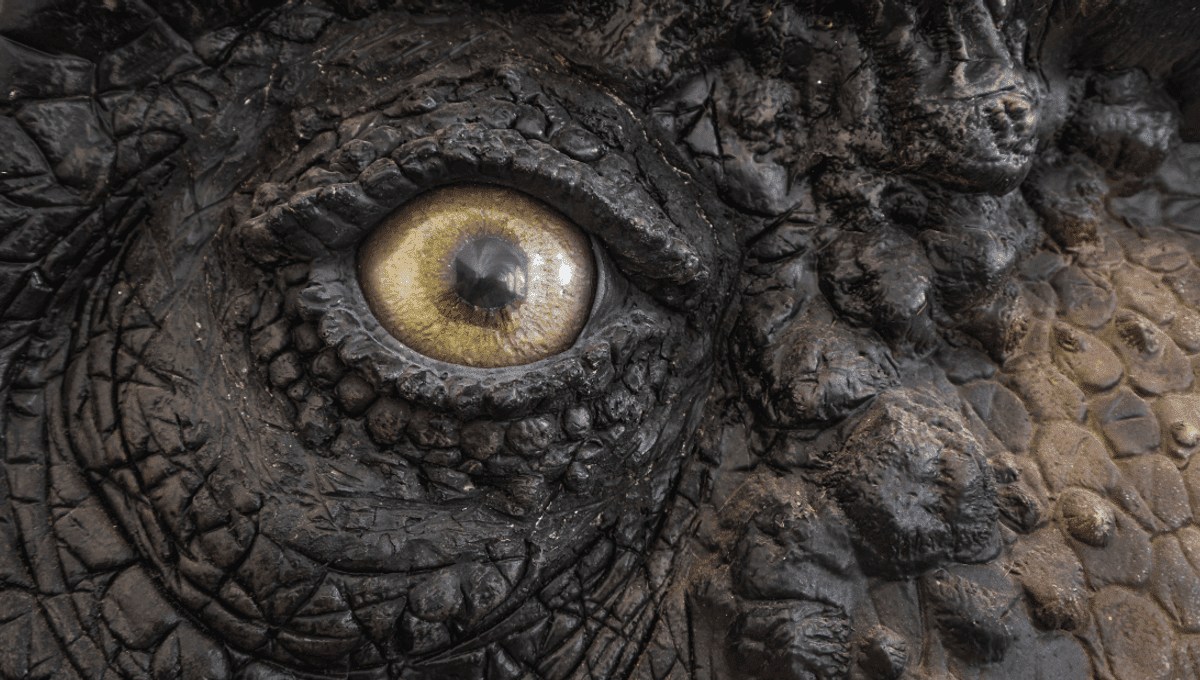
Stevens found that, in fact, T. rex would’ve had good vision that wasn’t based on movement, instead being comparable to that of hawks. If you’re wondering how good their vision is, examiners don’t watch students “like a hawk” for nothing.
Since this month is Jurassic Park’s 30th anniversary, we spoke to dinosaur researcher Dr Susie Maidment at the Natural History Museum London, and founder of Colossal Biosciences, Ben Lamm, about where the science stands on the possibility of bringing back dinosaurs 30 years on.
Steven’s early work is now equally old, but it was followed up by a 2006 paper that took DinoMorph one step further by “using sculpted life reconstructions” of dinosaur heads to study their binocular vision.
Binocular vision refers to the way certain animals can see with two eyes simultaneously, delivering a three-dimensional view of the world around them. It gives animals depth perception, as the overlapping fields combine visual information making it easier to see where things are in relation to each other, as well as things that are moving and things that are staying still.
The study into T. rex vision used sculpted life-size reconstructions of seven theropod dinosaurs to investigate how the world might have looked to them. Certain theropods, like Allosaurus and Carcharodontosaurus, were found to have likely had narrow fields of binocular vision due to the position of their eyes and snout shape.
Meanwhile, Tyrannosaurus alongside Daspletosaurus, Nanotyrannus, Velociraptor, and Troodon all had head and eye shapes and positioning that would’ve lent themselves to a greater field of binocular vision. The researchers concluded it was similar to that of modern raptorial birds whose front-facing eyes make them formidable predators with excellent binocular vision.
Anyone who’s ever watched an owl hunt will likely be aware of how badly it would go if a mouse simply tried to evade capture by standing perfectly still. Given the shape of T. rex’s snout and the position of its eyes, it’s likely the same strategy would’ve ended equally poorly for Dr Grant, too.

Source Link: T. Rex's Vision Wasn't Based On Movement, But It Was Cool In Jurassic Park Anyway
