


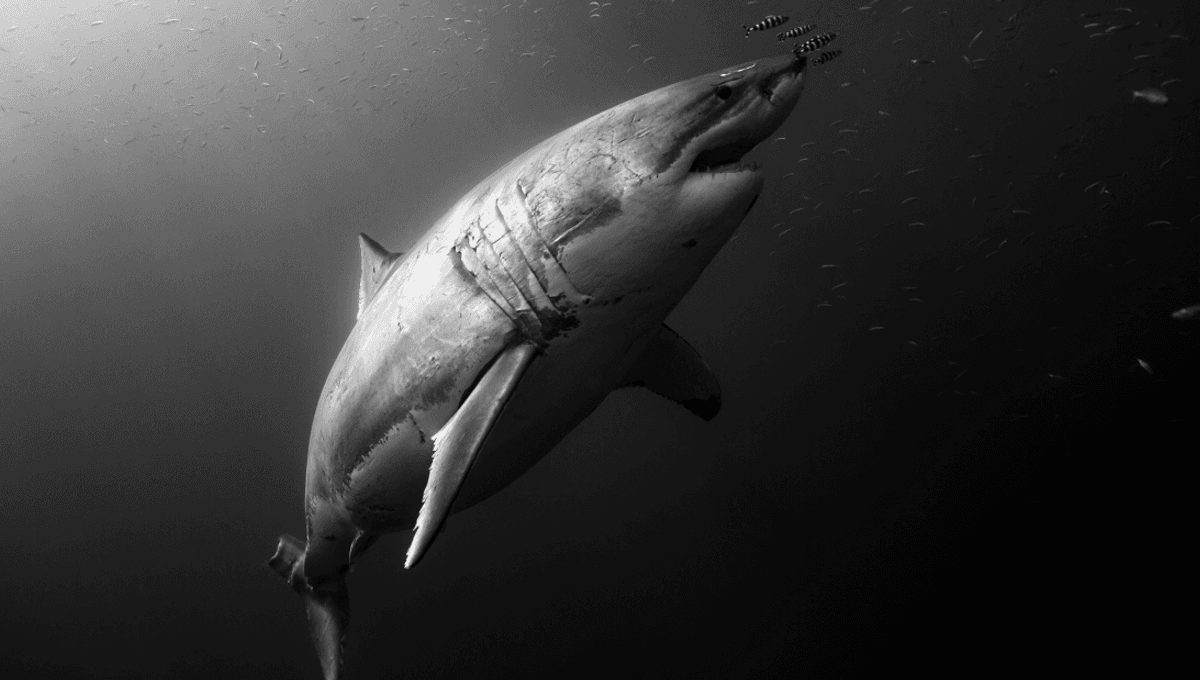
When and where did sharks first become so massive? The discovery of enormous shark remains from northern Australia has just changed everything we thought we knew about these supersized predators.
The rest of this article is behind a paywall. Please sign in or subscribe to access the full content.
We’ve long thought that gigantic lamniform sharks – which today are represented by comparatively smaller species like the great white – first evolved around 100 million years ago in the mid-Cretaceous seas of North America and Europe. Now, new research has pushed that origin back to around 115 million years ago and into the Southern Hemisphere.
Sorry, Australia. We really should’ve known.
Today some of the oceans’ greatest predators are lamniform sharks. Their evolutionary history is thought to span around 135 million years, in which time it’s churned out “The Meg”, Otodus megalodon, one of the most formidable predators in Earth’s history, and the “Ginsu Shark” Cretoxyrhina mantelli that – though smaller than the megalodon – was larger than any shark alive today.
Measuring living sharks is easy enough (provided you keep a safe distance from the business end) but figuring out how large extinct sharks were is a bit trickier. That’s because, as cartilaginous fish, they don’t leave much behind in the fossil record.

Teeth are common, but another thing we find is vertebrae and these can be used to estimate size. Of course, that depends on us finding the fossils to begin with.
Historic fossil finds have pointed towards North America and Europe as the waters of origin for large size in lamniform sharks, but the discovery of five fossil vertebrae from Australia says otherwise. The largest of the fossils is 12.6 centimeters (5 inches) in diameter, thought to be the vertebra of a massive Cardabiodontid shark.
The fossils were found in the Darwin Formation that dates back to the Upper Aptian of the Early Cretaceous, approximately 115 million years ago. Today that translates to the waters off Casuarina Beach near Darwin, Australia, and an entirely new timeline for gigantic lamniform sharks.
“Our results show that mega-body size is an ancient lamniform trait, with the Australian cardabiodontid being around 6–8 m [19.7-26.2 feet] and over 3 tons,” write the authors. “This rivalled some of the largest coeval marine reptiles and suggests that lamniforms invaded top-predator niches from an early stage in their adaptive evolution.”
Evidently, these sharks meant business. They likely filled the same ecological role as today’s great white and may have rivalled giant marine reptiles like Kronosaurus.
Curiously, fossils from the Darwin Formation so far include only mid-level predatory marine reptiles, suggesting these massive sharks may have hunted in different waters from the true sea monsters. If their paths ever did cross? Well, it would’ve been one hell of a fight.
The study is published in the journal Communications Biology.


Source Link: The Ancient Remains Of A 3-Ton Shark Indicate A New Point Of Origin For Gigantic Lamniform Sharks