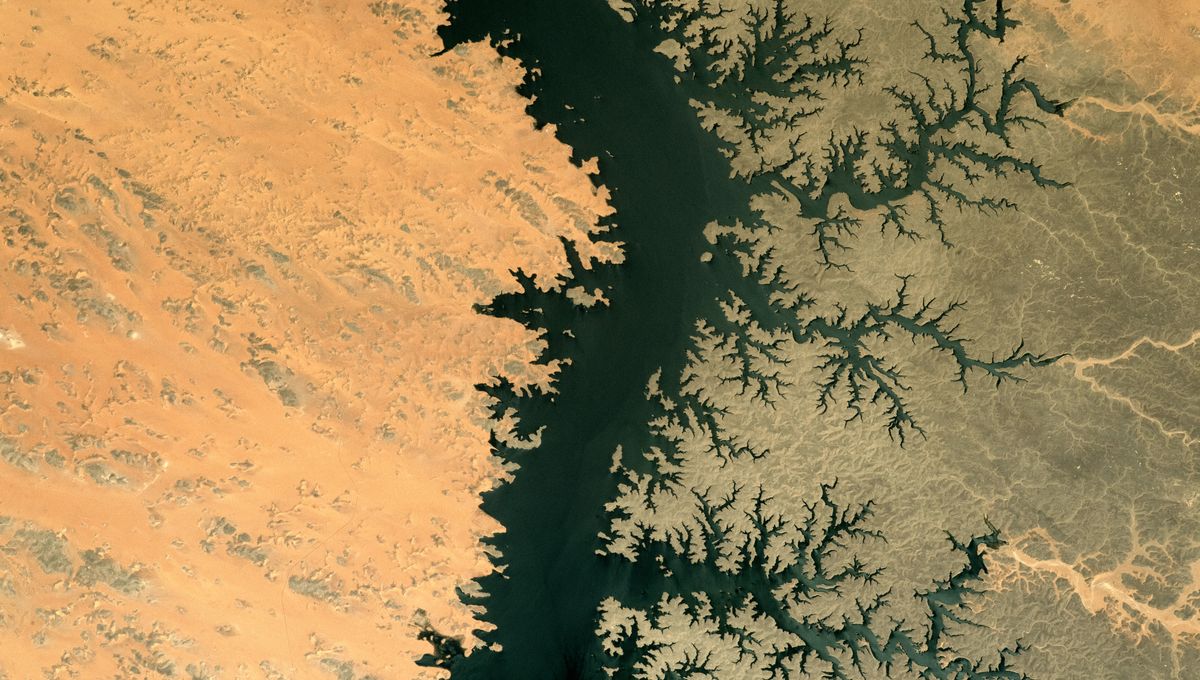
Stretching for almost 500 kilometers (300 miles) across Egypt and Northern Sudan, Lake Nasser is one of the largest human-made lakes in the world. The lake was formed as a result of the Aswan High Dam structure on the Nile, and the area’s interesting geology gives the east and west banks vastly different appearances.
Made in the 1960s, this vast body of water has a capacity of 168.9 billion cubic meters and a shoreline of 7,844 kilometers (4,874 miles). Despite having a shoreline double the distance from London to Cairo, the lake is surprisingly shallow, with an average depth of just 25 meters (82 feet).
The area is comprised of medium to coarse-grained sandstone, which causes the banks’ difference in color. The lake’s west bank contains lots of tan-colored sand covering the shore’s rocks, giving it a distinctly yellow hue.
As a result of weaker winds in the Nile Valley, sand is not transported across the lake to the neighboring bank. So, the eastern bank, in contrast, is free of this yellow sand, leaving exposed grey rocks that create a much darker appearance.
Adding to the differing appearances of the two banks, the west has a shallower shoreline that attracts wild animals. The east, however, is a rugged desert landscape with a less diverse ecosystem.
Due to its location on the Egypt-Sudan border, the lake is divided into two territories. The two-thirds that sit on the Egyptian side is called Lake Nasser after the country’s former president Gamal Abdel Nasser, who played a significant role in instigating the construction of the Aswan High Dam.
The remaining area in Northern Sudan is called Lake Nubia, named after the ancestral home of the Nubian people, whose farms and villages were flooded during the dam’s construction. Aswan High Dam displaced 90,000 Egyptians and Sudanese Namibian nomads who had to be relocated into the surrounding area.
The creation of the lake also threatened to displace a number of significant historical artifacts, including the temples of Philae and Abu Simbel. To save these structures, the Egyptian government enlisted the help of UNESCO to have the temples painstakingly dismantled and rebuilt in the surrounding area.
Working by impounding floodwaters from the Nile, the Aswan High Dam releases these waters when needed onto irrigated land to enable crop growth in the region’s dry and arid conditions. The water reaches an additional 324,000 hectares of irrigated land and has converted 283,000 hectares of land from having flood irrigation to having perennial irrigation, meaning the crops get a continuous supply of water via canal distribution.
In addition to the agricultural advances, the 111-meter (364-foot) high dam creates, it also generates an enormous amount of hydroelectric power using 12 turbines to create 10 billion kilowatt-hours annually.
Despite the seemingly beneficial results of the dam, its complete control of the Nile’s annual flooding is causing much of the river’s 40 million tons of fertilizing silt to be stored in reservoirs and canals, preventing it from being deposited in other areas of Nile farmland. As a result, Egypt uses around 1 million tons annually of artificial fertilizers to make up for the land’s depleted nutrient source.

Source Link: The Contrasting Colors Of The Gigantic Lake Nasser
