• Email Us: [email protected]
  • Contact Us: +1 718 874 1545
  • Skip to main content
  • Skip to primary sidebar

Medical Market Report

  • Home
  • All Reports
  • About Us
  • Contact Us

The Crab Hacker Barnacle Moves Into Crustaceans And Changes Their Sex

April 13, 2023 by Deborah Bloomfield

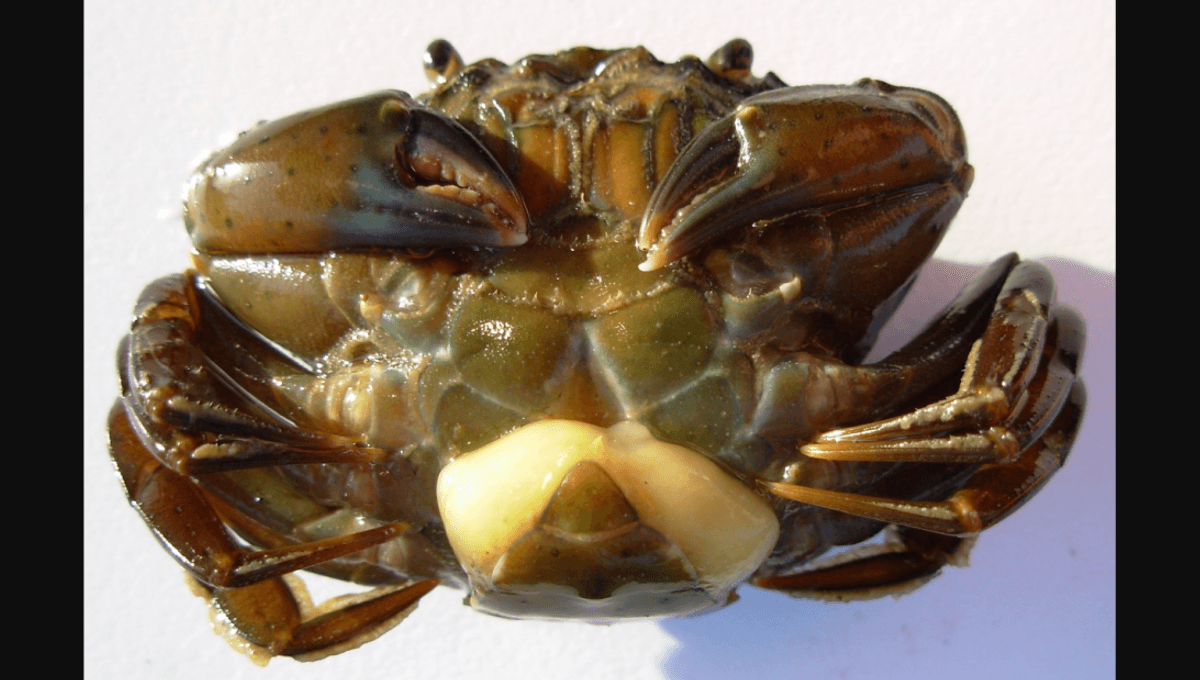
As hackers go it doesn’t get much more insidious than Sacculina carcini, the parasitic barnacle. In its adult form it’s barely recognizable as a barnacle, spending its life protruding from the underside of the crustaceans that unwillingly host it. 

It’s a bit of a bum deal for the host, as once the crab hacker barnacle has taken hold, its growing days are over. For females this means staying the same size as you lovingly nurture what you’re tricked into thinking is a brood of eggs. For males, this means undergoing a transition that seems to make them look like the opposite sex.

Advertisement

The crab hacker mostly targets Carcinus maenas, the green crab. This invasive species gets a lot of attention in the scientific field, discovering how they can feed through their gills and, more recently, what giving them little crab sex dolls can teach us about their capacity to reproduce when there’s lots of ship noise.

Having a specific host means the crab hacker’s range pretty much mirrors that of the green crab, which was once the upper European/North African coast but now has spread across much of the globe. The crab hacker may even extend beyond its host, as the University of Michigan Museum of Zoology reports that S. carcini has been introduced in areas to control C. maenas invasions.

In its larval form the hacker crab is similar to other barnacles, but everything changes as it develops. In its earlier adult form the female looks like a microscopic slug, but once locked onto a host it swells and sprouts tendrils that help it to feed from the unfortunate crab carting it around.

The female crab hacker eventually becomes an orb of nothing much but reproductive tissue, waiting for a male to come along that is comparatively tiny and pretty much only exists to fertilize and die. A limited life, but nothing on the grotesque transformation that sees anglerfish reduced to a pair of accessory gonads.

Advertisement

Where the crab hacker’s real party trick comes into play is what it does to its hosts. Females are tricked into tending to the growing lump of reproductive tissue as if it is an egg sac. This same ploy obviously wouldn’t work with males that don’t carry a brood, which is probably why the crab hacker has adapted a weird workaround.

When a male crab gets parasitized by S. carcini, it undergoes endocrine changes that make it start to look and behave like a female crab. Before long, it too is lovingly tending to a gelatinous blob fused to its underside that will sap it of most of the nutrients it so painstakingly forages for.

The crab hacker: truly the Jabba The Hutt of barnacles.

Deborah Bloomfield
Deborah Bloomfield

Related posts:

  1. Two people killed after gas blast hits apartment building in Russia -Ifax
  2. BMW, Daimler sued for refusing to tighten carbon emissions targets – Handelsblatt
  3. Exclusive: India plan for tighter e-commerce rules faces internal government dissent – documents
  4. Lufthansa gets strong investor backing for 2.1 billion euro cash call

Source Link: The Crab Hacker Barnacle Moves Into Crustaceans And Changes Their Sex

Filed Under: News

Primary Sidebar

  • US Just Killed NASA’s Mars Sample Return Mission – So What Happens Now?
  • Art Sleuths May Have Recovered Traces Of Da Vinci’s DNA From One Of His Drawings
  • Countries With The Most Narcissists Identified By 45,000-Person Study, And The Results Might Surprise You
  • World’s Oldest Poison Arrows Were Used By Hunters 60,000 Years Ago
  • The Real Reason You Shouldn’t Eat (Most) Raw Cookie Dough
  • Antarctic Scientists Have Just Moved The South Pole – Literally
  • “What We Have Is A Very Good Candidate”: Has The Ancestor Of Homo Sapiens Finally Been Found In Africa?
  • Europe’s Missing Ceratopsian Dinosaurs Have Been Found And They’re Quite Diverse
  • Why Don’t Snorers Wake Themselves Up?
  • Endangered “Northern Native Cat” Captured On Camera For The First Time In 80 Years At Australian Sanctuary
  • Watch 25 Years Of A Supernova Expanding Into Space Squeezed Into This 40-Second NASA Video
  • “Diet Stacking” Trend Could Be Seriously Bad For Your Health
  • Meet The Psychedelic Earth Tiger, A Funky Addition To “10 Species To Watch” In 2026
  • The Weird Mystery Of The “Einstein Desert” In The Hunt For Rogue Planets
  • NASA Astronaut Charles Duke Left A Touching Photograph And Message On The Moon In 1972
  • How Multilingual Are You? This New Language Calculator Lets You Find Out In A Minute
  • Europa’s Seabed Might Be Too Quiet For Life: “The Energy Just Doesn’t Seem To Be There”
  • Amoebae: The Microscopic Health Threat Lurking In Our Water Supplies. Are We Taking Them Seriously?
  • The Last Dogs In Antarctica Were Kicked Out In April 1994 By An International Treaty
  • Interstellar Comet 3I/ATLAS Snapped By NASA’s Europa Mission: “We’re Still Scratching Our Heads About Some Of The Things We’re Seeing”
  • Business
  • Health
  • News
  • Science
  • Technology
  • +1 718 874 1545
  • +91 78878 22626
  • [email protected]
Office Address
Prudour Pvt. Ltd. 420 Lexington Avenue Suite 300 New York City, NY 10170.

Powered by Prudour Network

Copyrights © 2026 · Medical Market Report. All Rights Reserved.

Go to mobile version