It’s barely perceptible, but from the morning after December 21 (or June 21 if you’re below the equator), the Sun starts to hang around for just a little longer each day. For most of us, that means we can start dreaming about the day that our morning commute doesn’t begin in complete darkness, but for Neolithic folk, the winter solstice was far more significant.
Relatively new to this whole sedentary lifestyle thing, prehistoric villagers depended on the annual rebirth of the Sun in order to ensure the continuation of their agricultural cycles. It’s unsurprising, therefore, that the Neolithic period saw the emergence of the earliest structures designed to track the movements of the Sun, Moon and other celestial bodies, with the solstices often the central focus.
Here’s a look at the oldest and most impressive solstice traditions from around the world.
Newgrange (Ireland)
Built around 3200 BCE, Newgrange is the most famous monument in County Meath’s Brú na Bóinne archaeological complex. Consisting of an earthen mound housing several burial chambers, this so-called passage tomb was constructed in perfect alignment with the winter solstice.
At sunset on the shortest day of the year, the Sun’s rays hit Newgrange at the exact angle needed to illuminate the central chamber and its impressive array of engraved artworks. Recent analyses of these designs have determined that the spiralling figures probably represent the shortening and lengthening of the Sun’s path across the sky as the year swings between the summer and winter solstices, underscoring the tomb’s connection with solar cycles.
It’s worth noting that the same effect has been observed at numerous other passage tombs across the British Isles, indicating that Newgrange was probably part of a wider, interconnected Neolithic tradition focused on the observation of the solstices. One particularly noteworthy example is Maeshowe in Orkney, off the north coast of Scotland, which is also aligned to allow the setting sun to illuminate its central chamber on the winter solstice.
El Castillo, Chichén Itzá (Mexico)
In the Americas, there was no official Neolithic period, and given that humans only reached the continent about 20,000 years ago, it’s understandable that things happened a lot later there than they did in Eurasia. Probably the most impressive winter solstice event can be seen at the famous Maya city of Chichén Itzá, where the central pyramid – known as El Castillo – is eerily lit up by the rising Sun on the shortest day of the year.
By late afternoon, the angle of the Sun’s rays is such that two sides of the pyramid are illuminated while the other two are plunged into darkness, creating a striking visual demonstration of the ancient Maya’s extraordinary astronomical precision.
Built around 550 CE, El Castillo is considerably younger than the likes of Newgrange and Stonehenge, and in fact it’s not even the oldest solstice-aligned structure in the Americas. Woodhenge, for instance, is located at the ancient site of Cahokia in Illinois, and was built around 1,000 years ago. Thought to have served as a type of astronomical observatory, Woodhenge probably held gatherings on the solstices, although the nature of these ceremonies remains the subject of speculation.
Stonehenge (England)
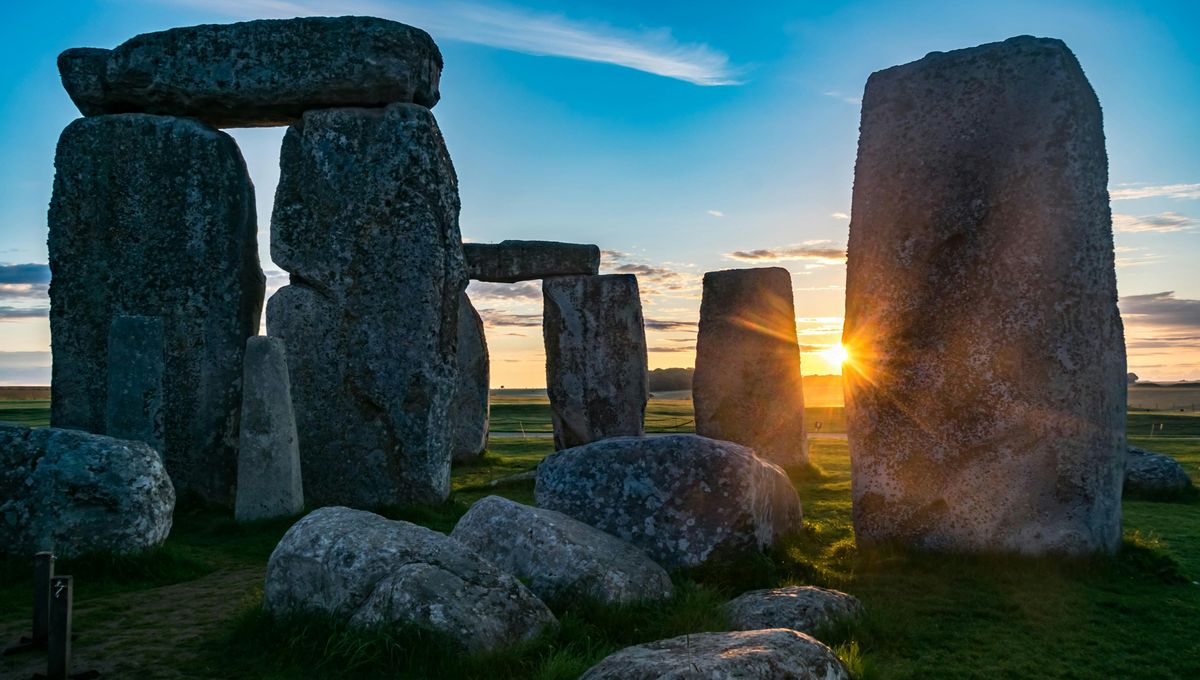
When it comes to solstices, you can’t not mention Stonehenge. Built in multiple stages beginning around 3000 BCE, the famous stone circle is aligned with the summer solstice sunrise to the east and the winter solstice sunset to the west.
It’s unclear exactly how these events were celebrated during Neolithic times, although the prehistoric residents of the nearby village of Durrington Walls – which housed the workers who built Stonehenge – are known to have slaughtered large numbers of animals around midwinter, all of which hints at massive solstice feasts.
However, while Stonehenge may be the most famous astronomically aligned stone circle, it is far from the oldest. The Almendres Cromlech in southern Portugal, for instance, is thought to have been constructed around 6000 BCE, making it way more ancient than Stonehenge. It’s unclear who placed these enormous boulders in a circular arrangement or what went on at the site, although archaeologists have noticed an alignment between the cromlech, a nearby standing stone called a menhir, and the sunrise on the winter solstice.

Source Link: The Earliest Winter Solstice Rituals Go All The Way Back To The Stone Age
