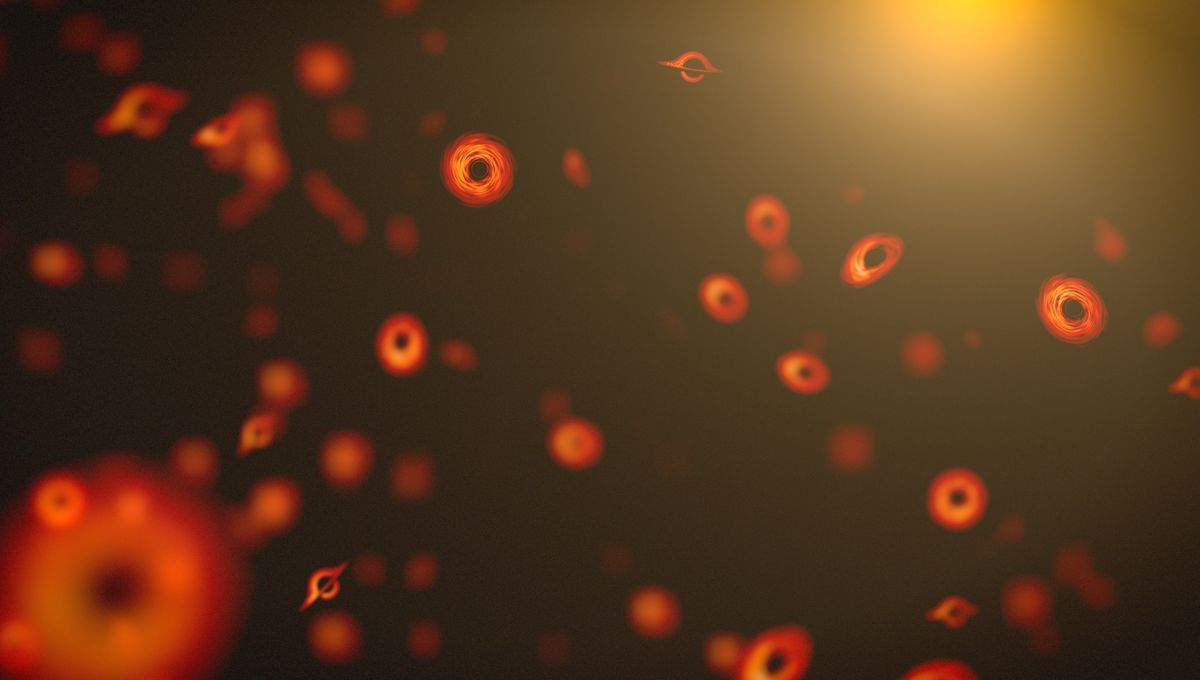
Physicists agree that an awful lot went on in the first few seconds after the Big Bang, a lot of it in incomprehensibly tiny units of time. The exact nature of that activity is far more debated, but a new model proposes not only near instantaneous black hole formation, but exotic boson and cannibal stars.
Unlike the Big Bang itself, the new model does not come from nowhere. Some existing models propose that the universe’s origin story includes what has been dubbed the Early Matter-Dominated Era (EMDE). This is thought to have occurred when the originally very hot particles arising from the inflationary period of the Big Bang cooled, so that the energy they radiated no longer exceeded their mass.
Dr Pranjal Ralegankar, Dr Daniele Perri, and Dr Takeshi Kobayashi of Italy’s International School for Advanced Studies attempted to explore how particles would interact in an EMDE, even though the nature of the particles at that time is a mystery. They have concluded the resulting formations would be quite varied, creating a complex universe that sadly no one was around to appreciate.
Without the capacity to observe it directly, let alone replicate it, we can’t be certain about the universe’s initial stages, but physicists do have some confidence in their models of certain phases. However, between inflation and nucleosynthesis of hydrogen and helium lies a gap that is less well understood.
“One intriguing possibility is that during this interval, matter temporarily dominated the universe,” the authors write, in contrast to periods when energy, including dark energy, has been dominant. If there was such an EMDE, it should have involved the formation of matter halos. The masses of these would have been small by the standards of the universe today – less than double the mass of the Earth, but in a vastly smaller universe, the mass would have been concentrated to a powerful extent.
If particles within these halos were capable of interacting with each other, they could combine to produce compact objects, including black holes, where matter was so concentrated as to bend space-time sufficiently. Given the planet-sized masses of the halos, the resulting black holes may have been of masses comparable to asteroids.
Although individually modest, so many of these holes may have been created in this period that the authors propose they could represent the dark matter astronomers are seeking. The authors do not discuss the implications for our safety of a universe dotted with such small black holes, which presumably sometimes run into planets. However, they do note that smaller black holes would have evaporated through Hawking Radiation, in many cases even before the universe formed hydrogen and helium, seconds or minutes after the EMDE, so the threat might not be so great.
We know enough about black holes, having photographed their silhouettes and detected the ripples of their mergers, that even non-physicists are familiar with the basic concept. Boson stars are less well known, although they have been proposed to still exist today. Theoretically composed of particles with spin 0 or 1, if the authors are right, these boson stars would briefly have lit up this newborn universe before collapsing into additional primordial black holes.
Cannibal stars sound even harder to envisage, since the name might suggest hungry consumers of other stars, a challenge before ordinary stars had formed. However, cannibal stars are the name given to objects that produce energy through the annihilation of matter and antimatter, rather than nuclear fusion. The annihilation process is far more efficient than fusion, which only turns a small proportion of its matter into energy, so cannibal stars have the potential to radiate much more powerfully. Nevertheless, the authors predict that if the mass halo around a cannibal star fed it, as they expect it would, the mass would rise to the point where it would collapse into yet another black hole.
Although the authors acknowledge the possibility that cannibal stars’ heat was sufficient to prevent them from accreting mass, and therefore saved them from becoming black holes, it’s almost surprising that in this model anything from the early universe avoided this fate. Yet something must have for us to be here today.
The study was published in Physical Review D.

Source Link: The First Black Holes May Be From 1 Second After The Big Bang, Before Atoms Existed
