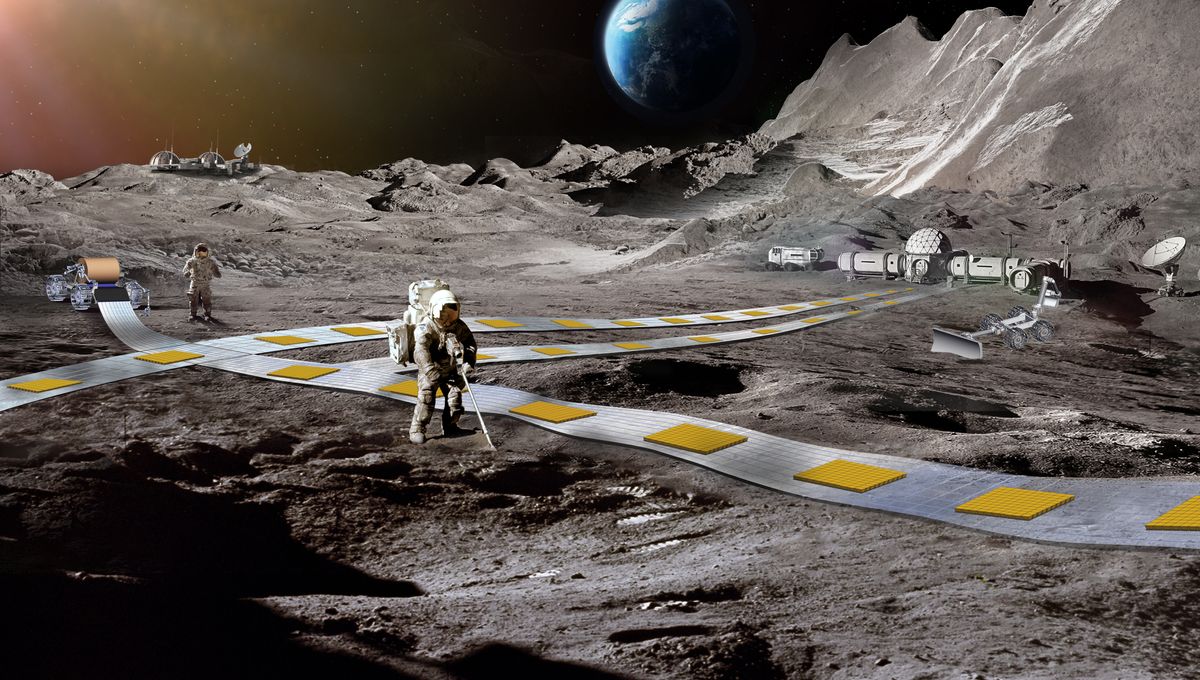
Having a permanent human presence on the lunar surface requires being able to use resources found on the Moon – not everything can be brought from Earth. But it is unlikely that the base will be on the hot spot of everything it needs. Some stuff will have to be transported. Cars (well, buggies) on the Moon are nothing new, but researchers are considering something quite different: A levitating railway system.
The project is called FLOAT, standing for Flexible Levitation On A Track. The goal is to provide payload transportation that is autonomous, reliable, and efficient. It aims to move payloads to and from spacecraft landing zones to the base, and transport lunar soil (regolith) from the mining location to the place where resources are extracted or where the soil is used for construction.
What’s exciting about the technology is that the tracks are not fixed. They are unrolled directly onto the lunar regolith, so FLOAT needs minimal site preparation. Levitating robots will move over the tracks, and not having wheels or legs is advantageous as they do not have to deal with the sharp regolith and its damaging power.
The flexible film track is made of a graphite layer that allows for diamagnetic levitation, while a flex circuit generates electromagnetic thrust. The third layer is actually optional, but it is a solar panel so that when in sunlight, the system doesn’t even require external energy. While the robots might have different sizes, the team estimates that 100 tons of material can be moved by multiple kilometers every day.
FLOAT is one of the six NASA Innovative Advanced Concepts (NIAC) that have moved to phase II. Others include a new propulsion system to send astronauts to Mars quickly and a liquid space telescope concept. For FLOAT, phase II will focus on designing and manufacturing a scaled-down version of the system to be tested on a Moon-analogous environment, as well as a better understanding of environmental impacts on tracks and robots, and what else is needed to turn this concept into a reality.
“These diverse, science fiction-like concepts represent a fantastic class of Phase II studies,” said John Nelson, NIAC program executive at NASA Headquarters in Washington, in a statement. “Our NIAC fellows never cease to amaze and inspire, and this class definitely gives NASA a lot to think about in terms of what’s possible in the future.”
These projects received $600,000 to continue investigating feasibility. The FLOAT leader is Ethan Schaler, from NASA’s Jet Propulsion Laboratory. If the system continues to show its capabilities, it might be a crucial infrastructure on the Moon as soon as the 2030s.
Phase I projects have also been announced and the proposals go from new telescope designs, technologies to make Mars less toxic, and even a swarm of tiny spacecraft that could travel to our nearest stars in a couple of decades.

Source Link: The First Railway On The Moon Might Happen Next Decade
