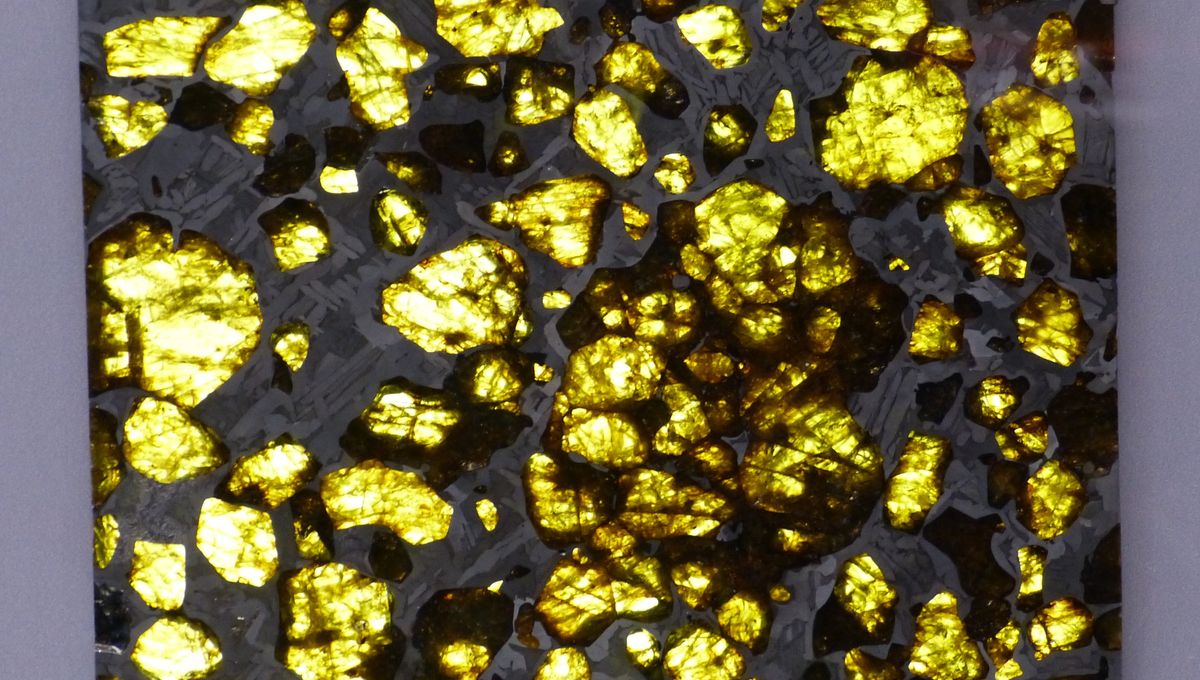
In 2000, a hiker was walking near the Fukang Mountains, China, when they stumbled on something spectacular. What is now known as the Fukang meteorite is an incredible stoney-iron meteorite rock packed with honeycomb-like crystals. It is now the most famous meteorite in the world, but what makes it special?
Pallasite meteorites
The Fukang meteorite belongs to a rare class of meteorites known as pallasites (which used to be called lithosiderites). They are characterized by networks of nickel-iron metal in which are set crystals of the silicate mineral olivine. When cut and polished, pallasites show off this impressive arrangement of translucent crystals that tend to be green in color, but they sometimes have distinct yellow, brown, or gold hues that result from weathering while on Earth.
These meteorites were originally named by Peter Simon Pallas, a German doctor and naturalist, who was the first to describe the Krasnojarsk pallasite in 1772. This strange mass of iron had been found by a blacksmith in Siberia earlier that century and was taken to St Petersburg for analysis.
Due to their striking and unusual appearance, pallasites are regarded as one of the first recognized and accepted extraterrestrial materials. They provide a unique and important glimpse into the deep interior of our Solar System, as they were formed some 4.5 billion years ago. The rocks are thought to have formed in differentiated asteroids (asteroids that have separated into two parts – a core and mantle – due to alterations caused by thermal processes).
According to O. Richard Norton, author of The Cambridge Encyclopedia of Meteorites, pallasites “can be thought of as an immiscible emulsion, like oil and water.” During differentiation, the crystals created through fractionalization separate the two main minerals of body, allowing the olivine mineral to accumulate deep within the asteroid. This may also account for why these meteorites are so unusual – pallasites make up less than 0.2 percent of all known meteorites on Earth.
The Fukang Meteorite’s story
The hiker who found the meteorite had seen it on previous occasions, but became curious about the strange crystals and metals that appeared to be sticking out of the 1,003-kilogram (2,211-pound) specimen. He eventually decided to send a sample of the rock for analysis. Since then, the meteorite has been divided into multiple slices, which revealed the extent of its extraordinary “stained glass” appearance. It is now one of the most sought-after and valuable meteorites on the planet.
In February 2005, a large part of the original specimen was put on display at the Tucson Gem and Mineral Show. In 2008, a large piece of the meteorite – weighing around 420 kilograms – was put up for auction in New York and was expected to fetch over $2 million. However, buyers decided to turn their discerning eye to some fossilized dinosaur poo instead. Then, in 2021, Christie’s announced that it had sold a smaller piece of the Fukang meteorite for $30,000.
These prices may seem to be alien to most of us, but given the age and splendor of these space rocks, its easy to see why they are desirable. You can learn more about identifying meteorites here, as well as other rare and unusual Earth minerals.

Source Link: The Fukang Meteorite – A Beautiful Rock That’s Out Of This World
