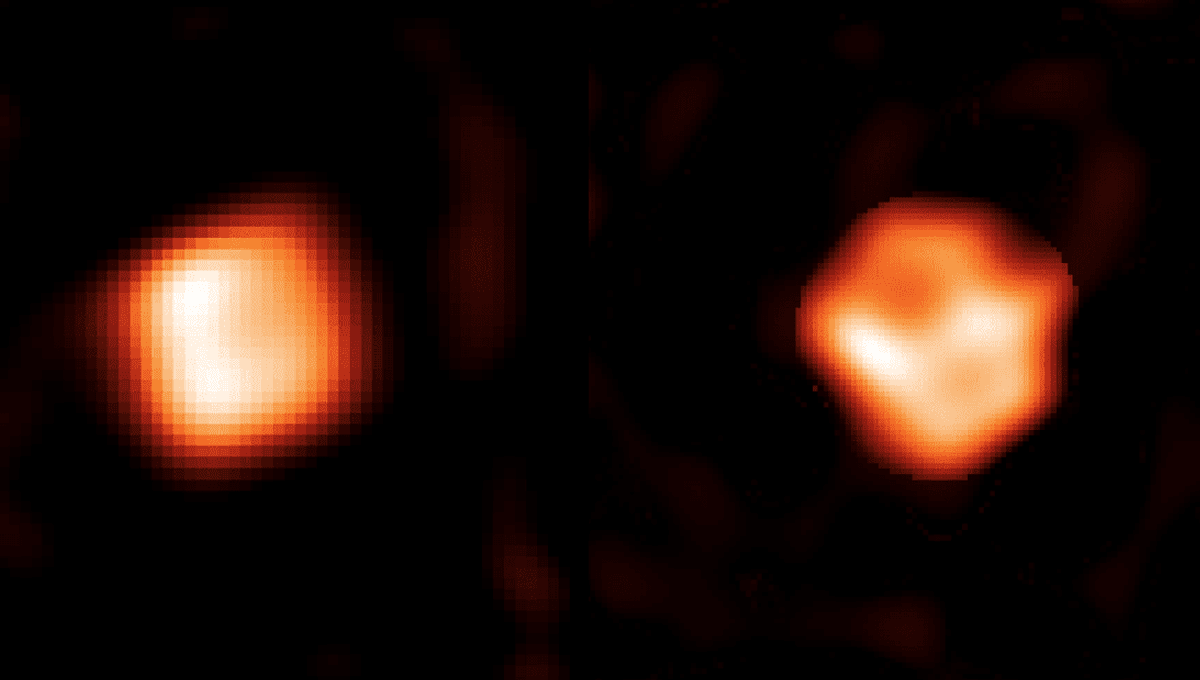
In 2022, an enormous star 16,000 light-years from Earth began mysteriously dimming. After follow-up observations in 2023, a team of astronomers believe they have an explanation.
When they aren’t creating green monsters or mysteriously vanishing without a trace, stars are generally pretty reliable constants in the sky. With lifespans of billions of years, you can usually expect to look at a star one day, and then return to it a few weeks, months, or years later and find it with roughly the same brightness and characteristics you observed last time.
But this is the universe, with billions of stars out there to observe, and sometimes it doesn’t work like that.
Stars have been spotted dimming, with a variety of explanations. Some light dips are due to exoplanets orbiting the star and obscuring our view of it. This is actually how we search for exoplanets, and dips of this kind are no huge mystery for astronomers.
Stars can also dim when they are about to go supernova. Betelgeuse has been dimming mysteriously on and off for years, with its pulsations suggesting that an explosion is not far off. When it does go supernova, it will be as bright as a full moon. It’s not clear when that will happen, and the star isn’t helping by throwing off clouds of dust that also dimmed the star from our point of view.
In 2022, RW Cephei presented a dimming mystery of its own. The “cool hypergiant” star is believed by a team at Georgia State University’s CHARA Array to be one of the largest known stars in the Milky Way. In the unlikely event our Sun was replaced by it, its outer layers would go further out than the orbit of Jupiter. Changes to brightness emitted by old stars like this one are usually small, so astronomers were pretty baffled when the star began to dim dramatically, in a similar manner to Betelgeuse.
“We made our first CHARA observations in December 2022, just before the winter weather closure,” Georgia State University astronomer Narsireddy Anugu said in a press release, “but the results were so remarkable we decided to pursue additional observations once the star was accessible again.”
The star had lost around a third of its usual brightness over the course of a few years. Observing it over 10 months using the CHARA Array – six telescopes spread across the mountaintop of Mount Wilson, California – the team found that the star wasn’t round, and that its appearance changed significantly, as it began to brighten again.
Georgia State University graduate student Katherine Shepard made observations of the star in wavelengths from visible to infrared, finding that the dimming was far greater in the visible spectrum. This suggested to the team that the dimming was caused by an ejection turning to dust.
“We suggest that the maximum light time may have corresponded to a particularly energetic convective upwelling of hot gas that launched a surface mass ejection event,” the team wrote in their paper. “This gas is now cooling to the point of dust formation, and the part of the ejected cloud seen in projection against the photosphere causes the darker appearance of the western side of the star. The duration of such dimming events may scale with stellar and dust cloud size, so that the timescale ranges from about a year in smaller Betelgeuse, through several years for RW Cep.”
The team suggests that the “Great Dimming” of RW Cep could just be the latest of a series of ejections over the last century.
“This one was special because the cloud was ejected in the direction of Earth,” CHARA Director Douglas Gies added, “so we were in the right place to witness the full effects of the cataclysm.”
The study is published in The Astronomical Journal.

Source Link: "The Great Dimming": In 2022, One Of The Largest Stars In The Galaxy Started Acting Strangely
