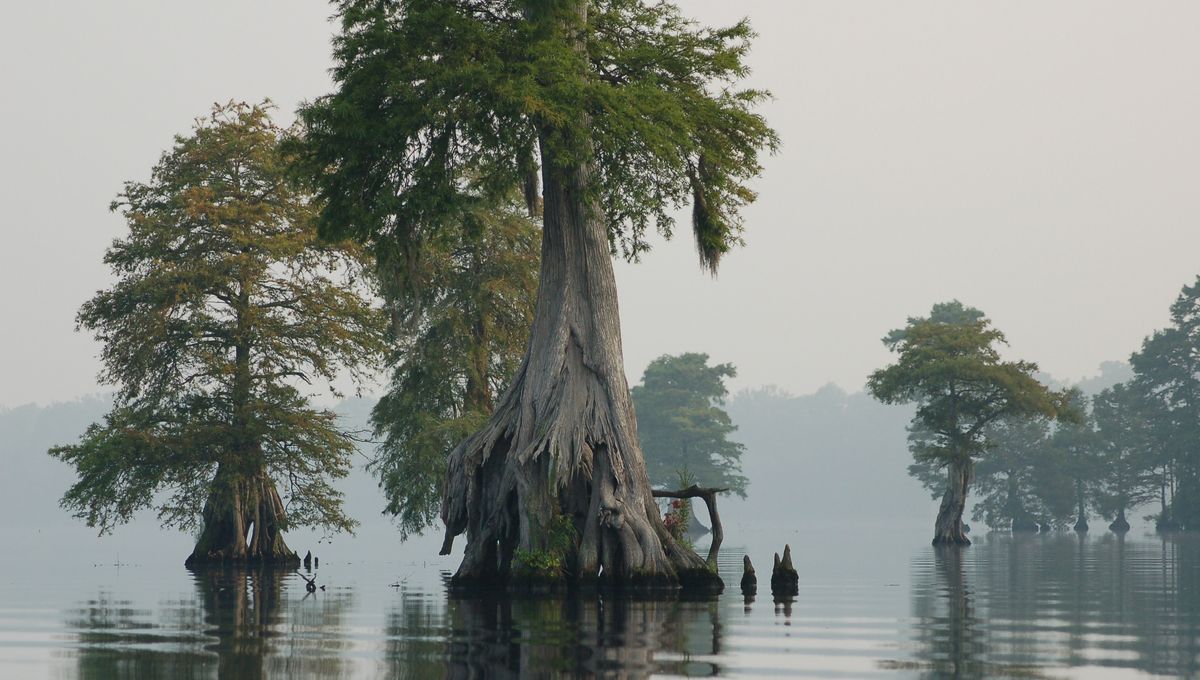
Joining southeastern Virginia with northeastern North Carolina, the Great Dismal Swamp is a stretch of forested wetland that, in hindsight, doesn’t really live up to the “dismal” part of its name. While its past is marked by some of the darker parts of American history, this swamp has long served as a refuge for both people and wildlife.
A refuge for people
ADVERTISEMENT
The Great Dismal Swamp is far from dismal today, but it’s worth pointing out that its past is entwined with that of colonization and slavery.
For thousands of years prior to colonization of the region, it’s thought that Indigenous peoples lived in and around the swamp, using it for hunting and farming.
However, come the arrival of European colonists, they would end up being joined by Indigenous peoples from further afield as they were driven from their own lands. Later, people escaping slavery also arrived at the swamp seeking refuge and became known as “maroons”.
In total, it’s thought that around 50,000 people lived in settlements formed here between the late 1600s to the time of the American Civil War.
Life in these settlements wasn’t necessarily easy, but as anthropology professor Dan Sayers explained to Smithsonian Magazine, it was better than the alternative.
“There were hardships and deprivations, for sure,” said Sayers. “But no overseer was going to whip them here. No one was going to work them in a cotton field from sunup to sundown, or sell their spouses and children. They were free. They had emancipated themselves.”
A refuge for wildlife
Prior to the Civil War, there had been attempts – including by a young George Washington – to turn the Great Dismal Swamp into a moneymaker. Despite some failures, commercial activity would end up taking off in the region, with much of the actual labor carried out by enslaved people.
Lumbering in the swamp would continue long past the time of war and emancipation, until, in the 1950s, much of its wood had disappeared. What was once more than 400,000 hectares (1 million acres) of forested wetland had become fragmented.
Today, however, the largest intact chunk of the Great Dismal Swamp is thriving with an abundance of wildlife. That’s because in 1974, after a series of land purchases by or donated to the federal government, it became officially protected. The Great Dismal Swamp National Wildlife Refuge was born.
It was established with the goal of “protecting and preserving a unique and outstanding ecosystem, as well as protecting and perpetuating the diversity of animal and plant life therein,” according to the government act that enabled its creation, and it’s safe to say that goal has been met.
ADVERTISEMENT
The refuge now covers around 45,700 hectares (113,000 acres), home to an array of both plant and animal life. That includes the more common bald cypress to the rare Atlantic white cedar in terms of plants, and among its animal residents, black bears, butterflies, and over 200 species of birds.
Dismal? Doesn’t sound like it.

Source Link: The Great Dismal Swamp: A Place That Doesn’t Live Up To Its Name
