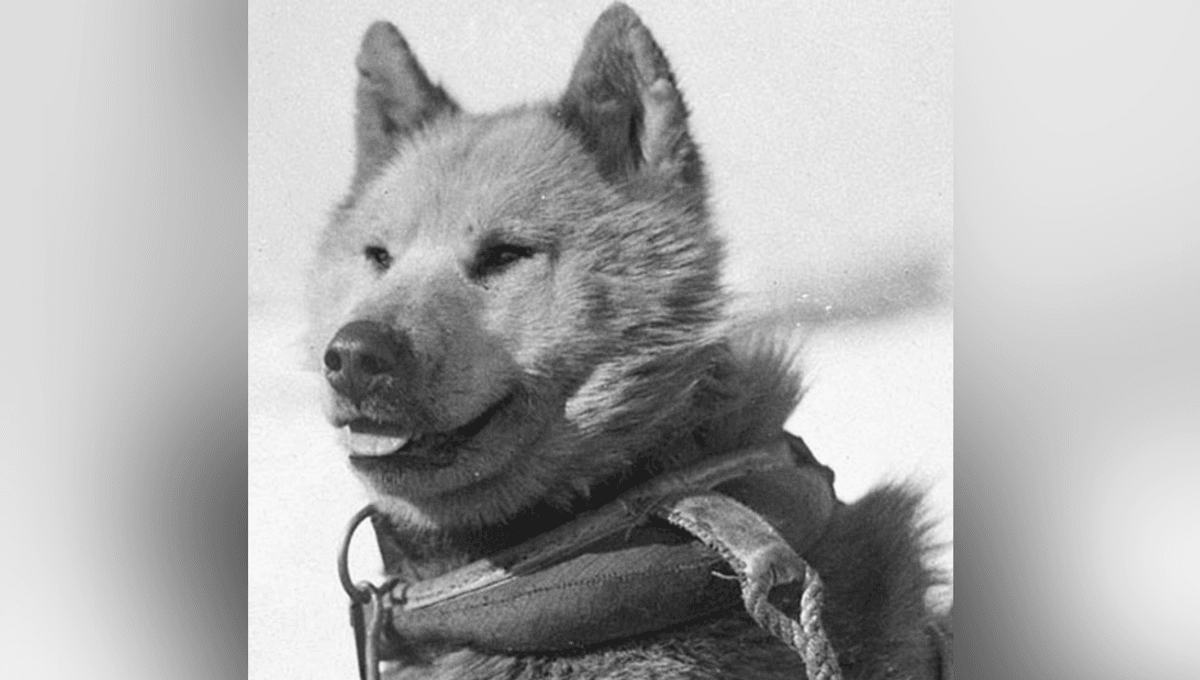
Dogs have played a pivotal part in the exploration of Antarctica, and have subsequently been used on the continent for nearly a century. But in 1994, the last dogs left the continent, and Antarctica has been paw print-free ever since.
The first time that we know dogs laid paws on the continent was in 1899, when Norwegian explorer Carsten Borchgrevink took 70 of them to spend the winter on the mainland of Antarctica. This was the first time that humans “overwintered” in the frigid cold, and dogs were there by their side.
Dogs played their part in the “Heroic Age” of Antarctic exploration. In 1911, Robert Falcon Scott’s expedition, and Douglas Mawson and the Australasian Antarctic Expedition took dogs to pull sleds on their journeys to the geographical South Pole, though Scott decided not to push on to the final leg of the journey using dogs after an incident where several dropped into a crevasse.
As well as pulling the sledges, the dogs also served as a source of food. While mapping the east of Cape Denison, Mawson, British Army officer Belgrave Ninnis, and Swiss champion skier Xavier Mertz met a hitch when Ninnis fell into a crevasse at least 50 meters (164 feet) deep, taking most of the group’s supplies and huskies with him.
Ninnis died, and with the supplies inaccessible, the remaining two explorers were left with a 30-day journey back to base and only 10 days’ worth of food. Fortunately for them (kind of), their transport, in extreme circumstances, could also be food.
“That night we ate George,” Mawson wrote of his experience in his journal, a potent reminder why you shouldn’t name dogs you might one day have to eat. It was not a fun experience, morally or culinarily.
“He was a very poor sample; chiefly sinews with a very undesirable taste. It was a happy relief when the liver appeared which, if little else could be said in its favour, could be easily chewed and digested.”
Though the liver was praised for being “not chewy”, it had more downsides than the sinewy meat, the main one being that it likely killed Mertz. Dogs’ livers are crammed full of Vitamin A, enough to be toxic to humans. On January 8, 1913, Mertz died, leaving Mawson to travel back to base alone and dogless.
In the rest of the 20th century, sled dogs remained present in Antarctica, used in expeditions and scientific research on the continent from the 1940s onwards. They were relieved of their “being food” duties, and as well as pulling sledges were a source of morale to scientists and explorers on long journeys to the continent.
But in 1994, after decades of exploration of Antarctica, dogs were relieved of all their duties by an international ban.
“Dogs shall not be introduced onto land or ice shelves and dogs currently in those areas shall be removed by April 1, 1994,” the Antarctic Treaty reads.
Non-native species had already been banned from being introduced to the continent in 1964, but dogs were exempt from the ban due to their use as sled dogs. Gradually, mechanical methods of transport took over from the work of the dogs, and they were no longer deemed necessary to support scientific work.
“We see the dogs as fulfilling a role in the wider context of morale and training,” David Drewry, the director of the British Antarctic Survey at the time, told New Scientist ahead of the 1994 ban. “But if I was asked are the dogs essential in support of our science, I would have to say no.”
Part of the reason for the ban was the potential risk to seals from disease, with canine distemper being transmissible to the marine mammals.
“The canine distemper virus is a morbillivirus that can cause disease in dogs, coyotes, wolves, and seals,” NOAA explains. “It is a common virus in dogs and most dogs are vaccinated against this virus. Seals can be infected with canine distemper virus and it has caused mortality in seals in the past.”
As well as this, there were concerns that dogs could attack or disturb the native wildlife, but in general, the dogs were not thought to be necessary for scientific work anymore.
“It was also thought to be inconsistent for the Protocol to have strict controls on the introduction of non-native species, but at the same time allow huskies to be bred and used in Antarctica,” the British Antarctic Survey explains.
The final dogs remaining in Antarctica left in February 1994, ahead of the ban. They have not returned since.

Source Link: The Last Dogs In Antarctica Were Kicked Out In April 1994 By An International Treaty
