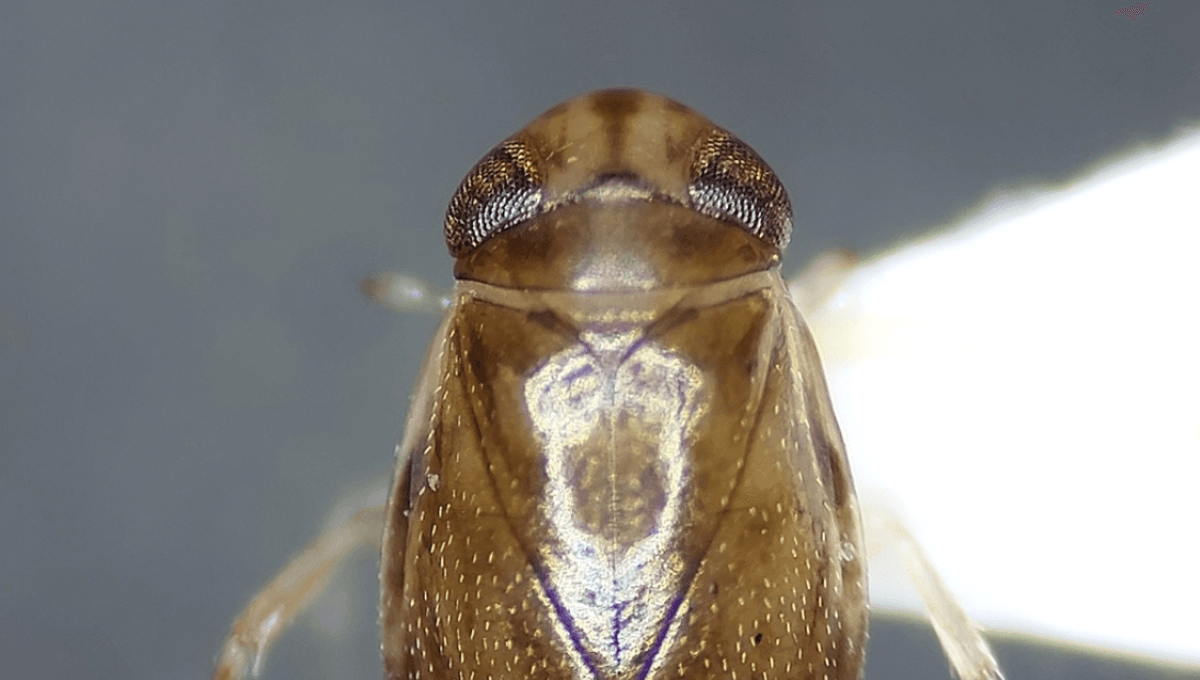
What do you think the loudest animal on the planet is? An elephant? An army of Taylor’s Swifties? Well, you’d be wrong if you took relative body size into consideration, because for that, the award goes to the tiny water boatman: Micronecta scholtzi. It was crowned in 2011 when a team of researchers presented their findings at the Society for Experimental Biology Annual Conference.
At little over 2 millimeters (0.07 inches) in size and looking like a flea and a stink bug had a baby, water boatmen don’t seem like much to shout about, but shout they will. Only, they’re not doing it with their mouthparts. Oh no. When the water boatman wants to turn heads, it gets its penis out.
The technical terminology for what the water boatman is doing is “stridulation,” which involves rubbing body parts together (more typically things like legs) to make a sound. The boatman takes this approach in an unusual direction in wielding its penis like the bow of a violin, and it’s a fitting analogy given the sound they make is equivalent to front-row seats in front of a loud orchestra.
But don’t take our word for it. Please, and we can’t stress this enough, you simply must watch this interview of a farmer trying to explain the evolutionary quirk in a 2019 interview with The Today Programme:
“It stridulates, which causes vibration by rubbing it’s – erm – penis against its forehead,” said farmer John Lewis-Stempel. “In doing this it can produce 99 decibels making it, size for size, the loudest pe-… loudest creature on the planet.”
Couldn’t have put it better ourselves.
A stridulating water boatman can reach 99.2 decibels, to be precise, and at a frequency of 10 kHz, it’s within range for human ears. In fact, people can hear it despite the aquatic habitat of these small insects.
“Remarkably, even though 99 percent of sound is lost when transferring from water to air, the song is so loud that a person walking along the bank can actually hear these tiny creatures singing from the bottom of the river,” said Dr James Windmill of the University of Strathclyde in a statement.
The song of the water boatman is used to attract mates, and while the sound is loud the space it uses to do so is tiny, about the width of a human hair. “We really don’t know how they make such a loud sound using such a small area,” added Windmill.
Ouch.
While an orchestra of water boatman might not blow you away, studying how tiny things make such a racket can have far-reaching implications across technology and biomimetics.
“Biologically this work could be helpful in conservation as recordings of insect sounds could be used to monitor biodiversity,” concluded Windmill. “From the engineering side it could be used to inform our work in acoustics, such as in sonar systems.”
So, fear not, water boatman. Your stage may have been described as “such a small area,” but your performance still puts on quite the show.
The 2011 study is published in PLOS ONE.

Source Link: The Loudest Animal Relative To Body Size Reaches 99.2 Decibels… With Its Penis
