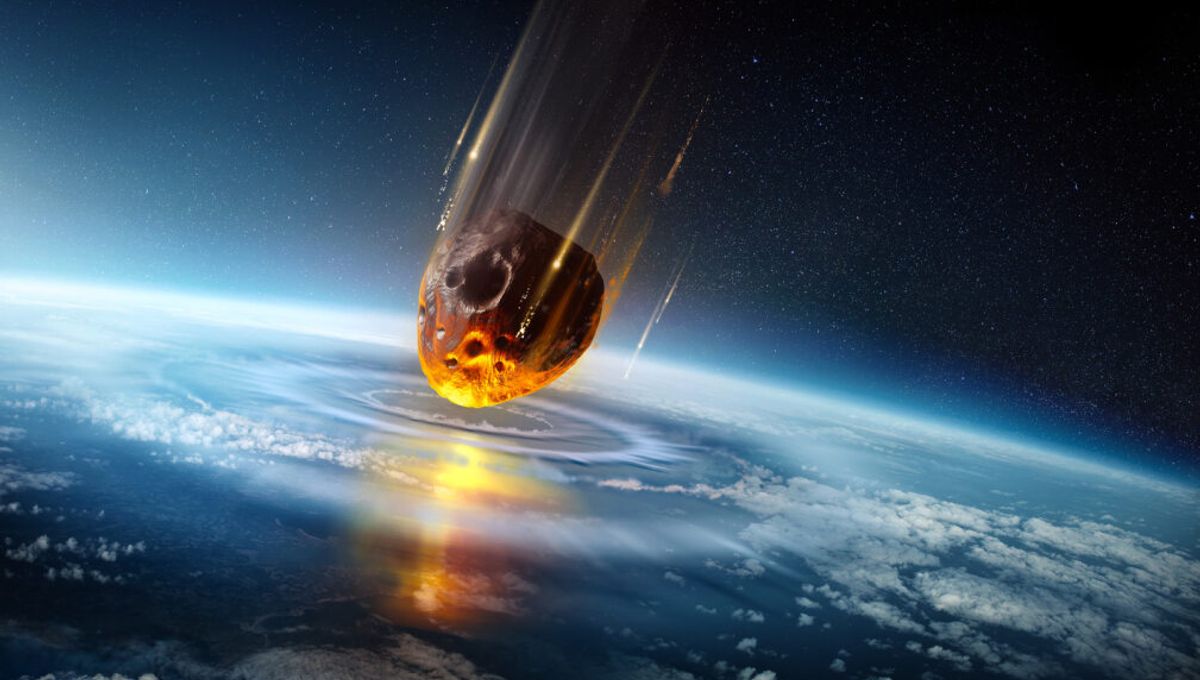
When it comes to protecting ourselves from asteroids, we remain poorly prepared. Big leaps have been made – we know where the planet-killing asteroids are and even how to deflect them thanks to DART. We have expanded the number of known objects a lot but there are too many that are discovered too late, in many cases by groups of amateurs.
Among these talented and dedicated people, there is the team behind the Northolt Branch Observatories who have been responsible over the years for the discovery of many near-Earth objects conducting tens of thousands of observations. The story of a very dangerous asteroid that never was started from their observations. It’s the meeting of diligent human work with automatic systems that crafted this very funny story.
Let’s go back to April 10, 2020. The pandemic continues to spread and many countries are in lockdown, the Northolt Branch Observatories located in London, England spotted an object moving across the sky. The observations were shared with the Minor Planet Center (MPC) which collects observations, calculates orbits, and more.
The mysterious object had been spotted before April 10 by automated surveys but it was not noticed. With this data, the MPC could calculate an orbit and give an official designation: 2020 GL2. And that kicked off something else.
NASA’s Jet Propulsion Laboratory has a system called Sentry that is capable of calculating the risk of future impact. It uses the latest catalog of observations, so if there is an orbit available Sentry will tell you how risky the asteroid could be. And 2020 GL2 was a risky one. It would have a 1 in 400,000 chance to hit the Earth in 2028.
Now, that may not sound like a high number, but the timeframe is short. There are asteroids with higher risks, but we understand their orbits so well that the risk extends into decades, if not into the next century, as with Bennu. We have time to address these risks if needed. Thus, 2020 GL2 appeared to be an object worth monitoring. That was the case until it wasn’t. It turned out not to be an asteroid at all, but rather the European Space Agency (ESA) mission BepiColombo.
BepiColombo was (and still is) on its way to Mercury. To get there with as little fuel as possible, it used planetary flybys to slow down and change orbit. On April 10, the spacecraft used Earth to do that when it was observed. But it won’t crash to Earth. By 2028, it will be studying Mercury in detail. Northolt Branch Observatories wrote a post about how they were suddenly announced as the ‘discoverer’ of this new object, but their mention of the object’s artificial nature had been lost in the process.
Once the error was discovered the official record of the dangerous 2020 GL2 was scrapped from the web, now existing only in the internet archive. It is not the first time that spacecraft are accidentally thought to be natural near-Earth objects. Rosetta (a.k.a. 2007 VN84) and Gaia (2015 HP116), both ESA missions got a tag.
And sometimes, it is important to assign these labels to artificial objects as they might become dangerous. Back in 2020, we had an artificial mini-moon called 2020 SO a piece of a rocket that came back around our planet until 2021. And WE0913A which was a piece of Chinese rocket that ended up forming a double crater on the Moon. The false alarm of BepiColombo shows that it is very important to keep many many eyes on the sky because it’s better to spot a fake dangerous asteroid than miss a real one.

Source Link: The Most Dangerous Asteroid That Never Was
