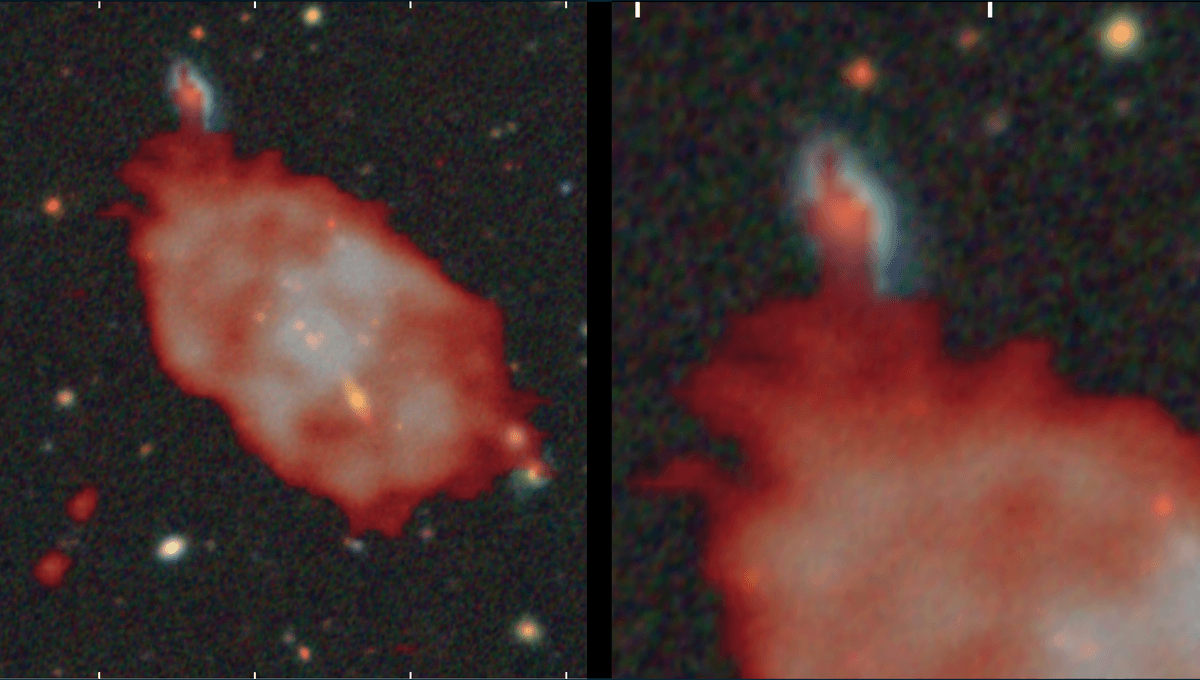
Astronomers have discovered a new odd radio circle (ORC) that is more powerful and distant than any discovered before. What is even stranger is that this object doesn’t appear to live up to its name, looking like a spread-out smudge, because two near-circular rings overlap like a Venn diagram.
ORCs are one of the completely unexpected phenomena that astronomers started turning up recently when they developed radio telescopes that combine power with wide fields of view. The first was discovered in 2019, but now that astronomers know what to look for, they’ve found six confirmed examples and several more suspects.
ORCs are vast but apparently diffuse structures that emit radiation only in the radio part of the spectrum. Their cause is still debated – some explanations have been offered, only to be met with skepticism from the wider astronomical community, but maybe an interlocking pair can provide the answers.
The new source, named RAD J131346.9+500320, is of the order of seven billion light-years away, so we’re seeing it when the universe was half as old as it is now. That makes it considerably more distant than the other ORCs, and it must be a more powerful source to be seen over such a distance.
“ORCs are among the most bizarre and beautiful cosmic structures we’ve ever seen – and they may hold vital clues about how galaxies and black holes co-evolve, hand-in-hand,” said Dr Ananda Hota of the RAD@home Astronomy Collaboratory in a statement.
RAD J131346.9+500320’s discovery was one of three made by citizen scientists poring through images taken by the LOFAR radio telescope for unexpected findings, which were then investigated by an international team led by astronomers from the University of Mumbai.
A process known as edge-enhancement reveals the elongated blob, despite looking a little like squashed insect with a fist at top left with one raised finger, as being composed of two overlapping rings around a single bright source.
Animation of a potential evolution of RAD J131346.9+500320’s rings, but we still don’t know if they are spheres or two-dimensional rings.
The entire system is more than a million light-years wide. A source of much fainter emissions stretches almost three times as far around it. Only one previously identified has a similar two-ring structure.
“If the two rings were viewed face-on and well-aligned,” the authors write in the new study, “they would appear as a single circular structure (O). In contrast, if they are seen exactly edge-on, it is unclear whether they would appear as two linear sources with the host galaxy in the center, or still as two distinct rings. If these structures are in fact hollow spheres or shells, they may resemble two rings from most viewing angles.”
Another anomaly RAD@home members flagged as a potential ORC is a galaxy 25 times larger than our own, with a jet that bends sideways before turning into a radio ring the size of the Milky Way. The opposing jet ends in a (relatively) small but bright hotspot. The third discovery is 1.4 million light-years wide and has a radio-emitting ring at the end of a giant jet, as if blowing a smoke ring. Each of these is far closer to us than RAD J131346.9+500320 and is thought to be respectively ten and four thousand times less powerful.
Most ORCs surround galaxies, and have previously been proposed to be the product of bursts of supernovae in quick succession, merging black holes, or the shockwave from a galaxy merger. All of these remain unconfirmed, particularly since some appear to sit in space with no visible source. The authors note the common factor between the three new discoveries is that each lies in an immense cluster of galaxies, whose thermal plasma is thought to shape the source of emissions. In RAD J131346.9+500320’s case, the authors think an intergalactic “superwind” may be playing a part.
Study co-author Dr Pratik Dabhade, of the National Centre for Nuclear Research in Warsaw, Poland, said: “These discoveries show that ORCs and radio rings are not isolated curiosities – they are part of a broader family of exotic plasma structures shaped by black hole jets, winds, and their environments.”
Dabhade noted that, “The fact that citizen scientists uncovered them highlights the continued importance of human pattern recognition, even in the age of machine learning.” Apparently, even some jobs that seem well-suited to AI are still done better by humans.
The study is published in Monthly Notices of the Royal Astronomical Society.

Source Link: The Most Powerful Odd Radio Circle’s Intersecting Rings Are Giving Us The Finger
