But if anywhere could escape their onslaught, it surely would be the South Pole. At least, that was the thinking of Jack Devlin, then a PhD student in entomology at the University of Kentucky, when he started investigating the situation in our planet’s most extreme continent: “I started reading about plastic’s effects on insects,” he explained in a statement earlier this month, “and [I] thought, ‘If plastic is turning up everywhere else, what about rare places like Antarctica?’”
But when he and a team of researchers set about looking for evidence, the answer was as depressing – and perplexing – as they had feared.
“We detected for the first time microplastic fragments inside the digestive tracts of wild midge larvae,” confirmed Elisa Bergami, an ecologist at University of Modena and Reggio Emilia and coauthor of a new study detailing the investigation. “Although ingestion was rare and detected in fewer than 7 percent of field-collected individuals, these findings confirm that plastics are reaching Antarctic soils.”
A midge on the edge
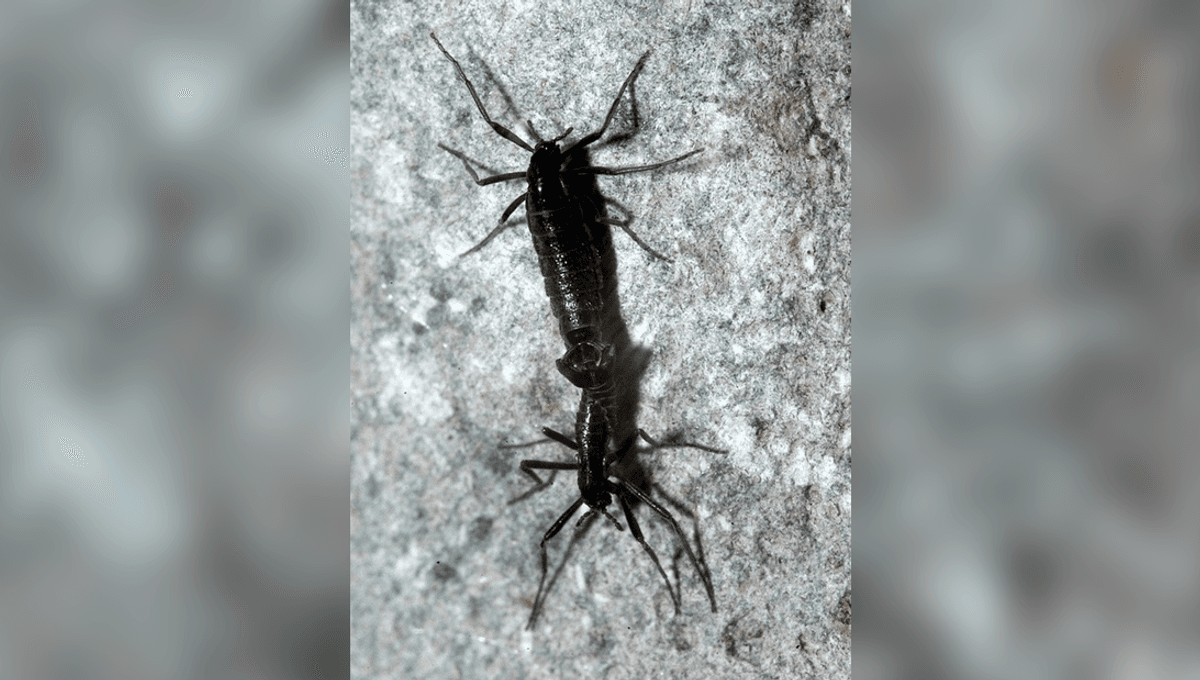
Belgica antarctica is a tiny little thing – just about the length of a grain of rice. It doesn’t bite, living instead on moss and algae, and despite being technically a type of fly, it doesn’t – it’s entirely land-bound.
In fact, despite its diminutive size, it’s actually the largest purely terrestrial animal native to the entire continent on which it lives – a feat which is primarily possible, frankly, because nobody else wants to live there. “They’re what we call poly-extremophiles,” explained Devlin. “They cope with intense cold, drying out, high salt, big swings in temperature and UV radiation.”
They’re also vital for pretty much all Antarctic ecosystems. As larvae, they feed on all sorts of vegetation and organic detritus – a process which releases vital nutrients back into the soil which would otherwise remain locked up in ever-increasing piles of waste. As the only insect endemic to Antarctica, it’s a big responsibility – and anything interfering with their ability to do so could therefore have outsized effects on the biome of the entire continent.
But here’s the worry: as comparatively pristine as Antarctica is, it’s not immune to the problem of microplastics. It “still has much lower plastic levels than most of the planet, and that’s good news,” Devlin said – but “they are getting into the system.” The question, therefore, is twofold: first, would those plastics affect the midges? And secondly – is it happening already?
A hardy boi
As small as Belgica antarctica is, it’s evidently strong. It can cope with being frozen and desiccated; with overwhelming UV radiation and with ephemeral food availability. But what about plastic?
That was “the big question,” Devlin said. “Does [their] toughness protect them from a new stress like microplastics, or does it make them vulnerable to something they’ve never seen before?”
It’s a complicated question, but fairly simple to investigate. Over ten days, the team exposed larvae of the bugs to soil contaminated with various concentrations of microplastics, and measured how much their survival, metabolic rate, and energy stores correlated with microbead ingestion. Their hypothesis: that as the concentration of microplastics in the soil increased, so too would the levels of ingestion – and so, in turn, the insects’ survival and health would fall.
At first, however, the results were surprisingly heartening. “Even at the highest plastic concentrations, survival didn’t drop,” Devlin said. “Their basic metabolism didn’t change either.”
But a closer look showed a more nuanced picture. While “on the surface, they seemed to be doing fine,” Devlin said, larvae exposed to higher concentrations were paying a hidden cost: lower fat reserves, crucial for survival during harsh Antarctic winters.
Precisely how much of a problem this might be is something the team don’t yet know, of course. It was a ten-day experiment, not a long-term field study – there are, let’s say, logistical challenges to doing such experiments in Antarctica. The fact that the midges eat so slowly, and live in such a cold environment, may act to limit the effect of even high exposure to the pollutants, suggested Devlin – without further study, we just can’t tell.
Nevertheless, it’s cause for concern, particularly if these little midges are already being exposed to the kinds of plastic concentrations the team concocted in the lab. Which raises another important question – namely: are they?
Rare, but there
It took a research cruise in 2023, stopping at 20 sites across 13 Antarctic islands, to answer the question of whether or not microplastics have made it into the continent’s only endemic insect. It also took some of the most advanced entomological techniques currently available: “[we] use[d] advanced imaging techniques, such as micro–Fourier Transform Infrared (FTIR) and Raman spectroscopy,” Bergami noted, along with analytical techniques only available at international centers of research such as Elettra Sincrotrone Trieste and the Central European Research Infrastructure (CERIC) Consortium.
After collecting 40 midge larvae from across the region and analyzing their gut contents, the team found good news – albeit couched in a caveat.
“We detected for the first time microplastic fragments inside the digestive tracts,” confirmed Bergami – “although ingestion was rare and detected in fewer than 7 percent of field-collected individuals.”
In total, the team found microplastics in the bellies of only two larvae. That’s a relief, no doubt – but it’s also a warning. “These findings confirm that plastics are reaching Antarctic soils,” stressed Bergami, and they are entering the ecological chain. With the added stress of a changing climate, the concern is what may happen long-term if the problem is allowed to grow.
“This started because I watched a documentary and thought, ‘Surely Antarctica is one of the last places not dealing with this’,” Devlin said. “Then you go there, you work with this incredible little insect that lives where there are no trees, barely any plants, and you still find plastic in its gut. That really brings home how widespread the problem is.”
While the midges may have brought a cause for relief for now, the greater issue is the extent of human pollution, he warned. With further research, and longer-term, specialized studies, perhaps we can find out just how much breathing room we have.
“Antarctica gives us a simpler ecosystem to ask very focused questions,” Devlin said. “If we pay attention now, we might learn lessons that apply far beyond the polar regions.”
The study is published in the journal Science of The Total Environment.

Source Link: The Only Bugs In Antarctica Are Already Eating Microplastics
