Mammals are vertebrates famous for, among other talents, having milk-producing mammary glands, having hair or fur, giving birth to live young, and being warm-blooded.
While these traits, along with having a complex neocortex in their brain, are generally found in all mammals, they are not universal rules. For obvious example, monotremes such as platypuses do not give birth to live offspring but continue to lay eggs, though they still produce milk for their young when they hatch.
In its long history, our planet has produced plenty of oddball mammals. For example Myotragus balearicus, a long-extinct species of goat, became stranded on the resource-poor Balearic Island now known as Mallorca, evolving in isolation for over 5 million years. There they effectively became a dwarf species, with their limbs, brain, and sensory organs becoming smaller.
Looking at the bones of the species, scientists found that it had characteristics in common with cold-blooded reptiles, suggesting that they were ectothermic, or that they relied on an external source of heat to regulate their body temperature.
That species went extinct around 5,000 years ago. But there is one odd little creature which, despite being mammalian, could similarly be considered “cold-blooded”, with a few caveats.
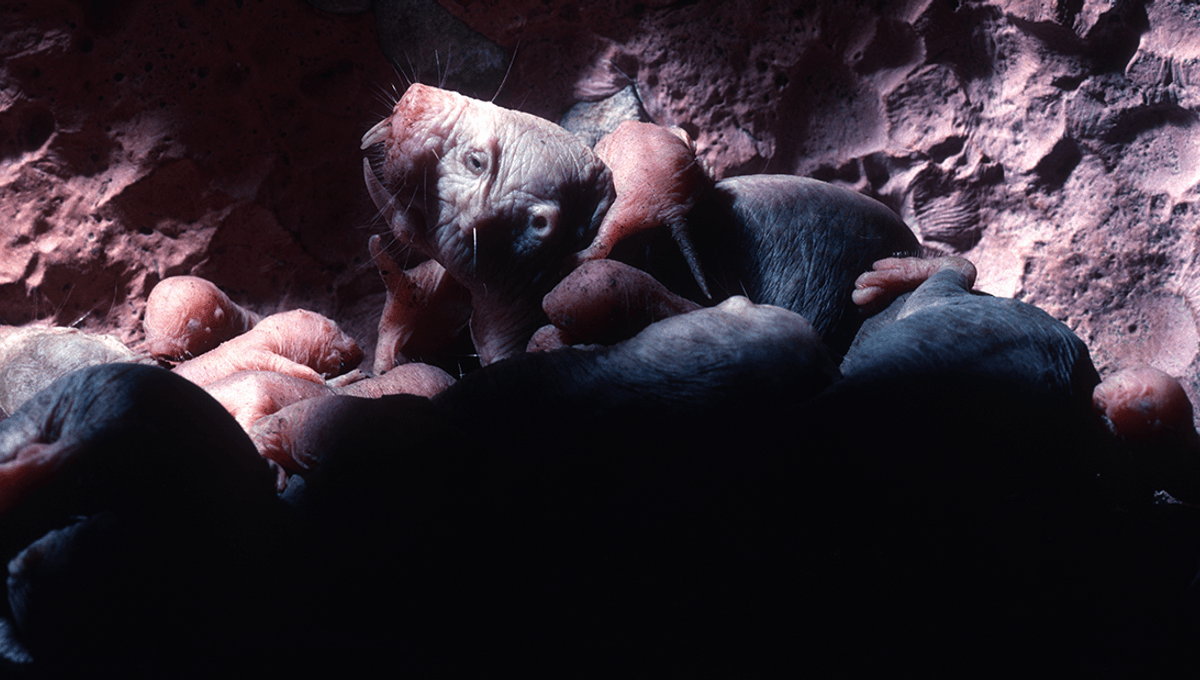
Heterocephalus glaber, better known by the name “sand puppy” and the far less flattering “naked mole-rat“, have a number of unusual characteristics adapted to their burrowing lifestyles. The nearly hairless rodents, native to east Africa, live together in colonies of up to 300 individuals, and appear to be highly social “eusocial” animals, with different individuals taking on different roles.
“Within each colony, reproduction is restricted to a single breeding female and 1-3 breeding males; all other colony members are reproductively suppressed and socially subordinate unless removed from the suppressive cues of the colony,” a study of the sand puppies explains.
“Due to their striking reproductive skew, naked mole-rats are often considered eusocial mammals. Consistent with this idea, there are behavioral specializations and at least some evidence for morphological distinctions within and between the breeding and non-breeding members of the colony. Importantly, naked mole-rats show plasticity in their behavioral phenotype whereby changes in the social environment influence expression of both type and amount of social behavior.”
That’s not to say that they are living in some sort of socialist utopia.
“The way naked mole-rats mate and socially organise is more akin to certain insect species than to mammals,” Ewan St. John Smith, University Senior Lecturer in Pharmacology, University of Cambridge, who set up a research group to study the animals, explains in a piece for The Conversation.
“Like some species of bees and ants, naked mole-rats are eusocial, living in 100-strong groups headed by a sole breeding female, the queen. But while insects command their colonies with pheromones, the naked mole-rat queen uses physical aggression to keep their groups digging tunnels, foraging, and defending entrances.”
These creatures are oddballs in other ways too, showing remarkable resistance to cancer, and being insensitive to chemical stimuli like capsaicin and acids. Living underground, digging around for roots, bulbs, and tubers to eat – as well as the feces of their comrades to improve the digestion of nutrients – they have found themselves in a temperature-stable environment. While nearly all mammals are endothermic, or “warm-blooded”, and eat a lot of food to keep themselves warm and “alive”, the naked mole-rat has found another way to thermoregulate.
“These eusocial rodents also cooperate to thermoregulate. Unlike most other mammals, they cannot maintain a steady body temperature. Their temperatures fluctuate with the ambient temperature, making naked mole-rats essentially cold blooded,” the Smithsonian’s National Zoo & Conservation Biology Institute explains.
“By huddling together in large masses, they slow their rate of heat loss. They also behaviorally thermoregulate by basking as needed in their shallow surface tunnels, which are warmed by the Sun.”
While sand puppies are largely ectothermic, it’s still not quite right to describe them as cold-blooded, though they certainly share a lot in common with cold-blooded animals.
“Through longitudinal molecular, thermal, metabolic, and behavioral measurements, we found that NMRs [naked mole rats] initiated non-shivering thermogenesis and elevated body temperature but could not sustain it due to excessive heat loss and limits to substrate availability. Our results suggest that NMRs represent a unique thermoregulatory category that doesn’t fit neatly into traditional classifications,” one preprint study of these oddballs explains.
“Our molecular, thermal, metabolic and behavioral findings demonstrated that NMRs could initiate robust non-shivering thermogenesis and elevate body temperature when exposed to cold. However, they failed to sustain this elevated temperature due to excessive heat loss through their skin,” the authors add.
“Notably, providing artificial insulation partially restored their ability to maintain homeothermy. This significant improvement in heat retention indicates that the primary challenge for NMR thermoregulation is not a lack of thermogenic capacity but rather their inability to prevent heat loss. This finding challenges previous assumptions about NMR thermoregulation and highlights the importance of considering both heat generation and retention in understanding their thermal biology.”
In short, they largely thermoregulate like cold-blooded animals, relying on external heat sources to keep themselves alive. But animals are complex, and these creatures defy classification, though their general classification remains mammalian.

Source Link: The Only Living Mammals That Are Essentially Cold-Blooded Are Highly Social Oddballs
