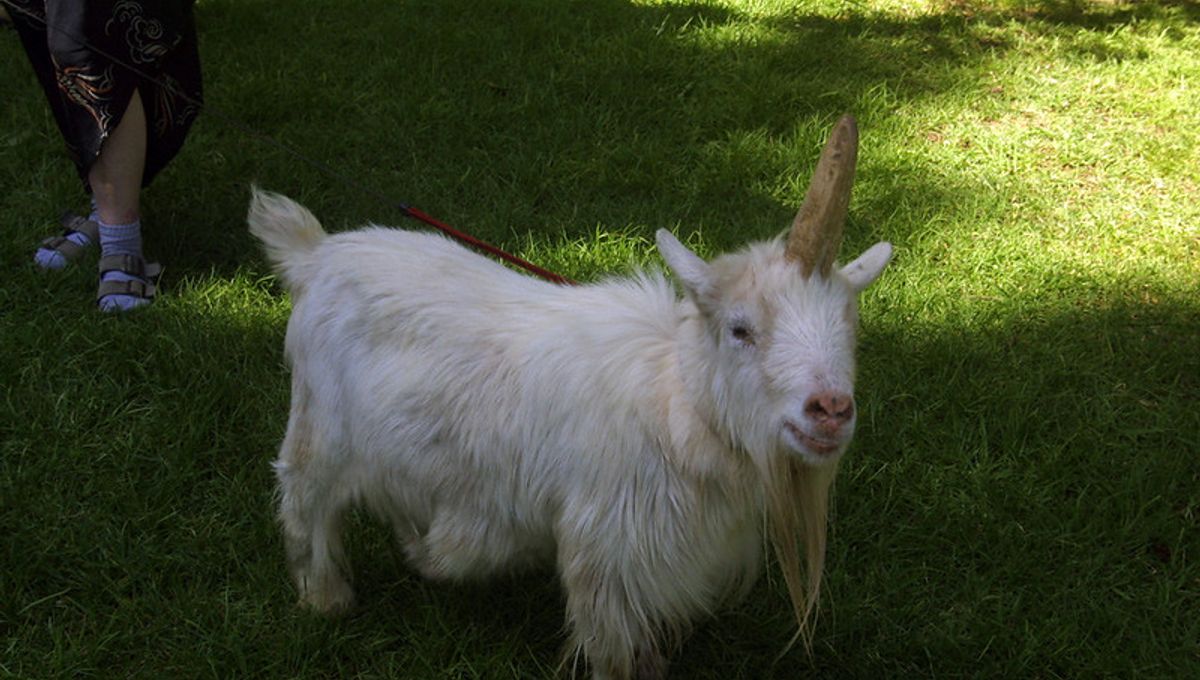
“The experiment was successful. The animal, now two and a half years old, bears upon the forehead the stamp of the once fabulous unicorn,” biologist Dr W. Franklin Dove wrote of a young bull in his 1936 research paper titled Artificial Production of the Fabulous Unicorn: A Modern Interpretation of an Ancient Myth. Although this Frankenstein-esque line sounds straight out of fantasy or science fiction, the quest to create these mythical creatures has led to very real – and very bizarre – experiments.
Dr Dove’s work focused on the horn buds of newly-born animals, with the hypothesis that their horns and skulls develop separately (intertwined with an evident fascination with myth and legend).
“Perhaps only a crude and literal-minded modern would lay hands on an object so endowed with sacred meanings as is the unicorn. To attempt to produce artificially the object of such a glorious myth may seem tantamount to the ridiculous, even to the profane,” he wrote.
“But a method by which the unicorn can be made may account for the ‘authentic’ observations and descriptions of unicorns that have been reported in every past century. It is possible that some of the descriptions in literature are truly authentic reports of living unicorns, unicorns who have been produced by actual manipulation.”
Dove cites other reported human-made unicorns in his paper. These include accounts (one by Pliny) of young ox having their two horns manipulated into one, and months-old lambs in Nepal having their sprouting horns branded with red-hot irons. In March 1933, Dove set out to create a unicorn of his own, using a day-old Ayrshire calf.
“The two horn buds were cut and pedicled so as to lie closely together over the frontal suture at the intersection of lines drawn from the occipital foramina and the original horn loci. The circular horn buds were trimmed flat at their point of contact so as to provide a larger fusion surface. The transplanted tissues were also placed in direct contact with the frontal bones – the frontal periosteum having been removed in order to insure subsequent attachment of the developing os cornu (bony spike of the horn) to the frontal bones,” he wrote.
“It was expected that the two horns would fuse together into one large horn solidly attached to the skull and located between and somewhat above the eyes, as is the horn of the unicorn.”
This experiment actually worked, producing a bull with “one exceptionally large and long horn molded into the skull bones of the forehead for support.” Waxing lyrical about his creation, Dove wrote that “Though he is an animal with the hereditary potentiality for two horns, he recognizes the power of a single horn which he uses as a prow to pass under fences and barriers in his path, or as a forward thrusting bayonet in his attacks. And, to invert the beatitude, his ability to inherit the earth gives him the virtues of meekness. Consciousness of power makes him docile.”
Dove’s experiments would then inspire Oberon Zell, a self-proclaimed “transpersonal psychologist, metaphysician, naturalist, theologian, shaman, author, artist, sculptor, lecturer, teacher, and ordained Priest of the Earth-Mother, Gaia” to create a unicorn flock of his own.
Using his college-level biology knowledge, Zell cross-bred Angora and Saanen goats to get the idea base for his horn-sculpting. “We wanted to reproduce the classic images of Unicorns as seen in the two sets of tapestries: ‘The Hunt of the Unicorn’ and ‘The Ladies and Unicorns’ (5 senses),” Zell told Ripley’s in 2019. “And we did so perfectly. Cloven hooves, velvet white coat, flowing mane, tufted tail, and – most telling – the beard (only goats have beards).”
“Raising and exhibiting unicorns was all [Oberon’s partner] Morning Glory and I did from 1978-1985.”
In fact, in 1984 Oberon (aka Timothy) was granted a patent for “a method of growing unicorns in a manner that enhances the overall development of the animal.”
Zell eventually struck a deal with traveling circus company Ringling Bros, who wanted to display the unicorn goats in their show. However, this deal did not allow Zell to discuss how he made them. Instead, circus spokesman Joe Gold told the Lodi News-Sentinel in 1985 that “It’s a living unicorn that appeared in Houston, Texas, in July. It wandered up to the tent.”
Nancy Blaney, a spokeswoman for The Humane Society of the United States, commented that “I can’t believe Ringling Bros has the nerve to insist it is a real unicorn.”
One of the unicorns, named Lancelot, was actually seized after animal rights activists claimed that the show violated a 1921 Florida law that “prohibits the display of malformed or disfigured animals if a price is charged to see them and also bans advertising such shows”. After being X-rayed and examined, Lancelot was released, with no charges resulting from the incident.
Zell stopped making unicorns by the 1990s. According to a 2014 article, Zell keeps the skull of his first creation in his house.

Source Link: The People Who Made Farm Animals Into "Real Unicorns"
