
Swearing was long dismissed as a topic of serious research because it was assumed to be simply a sign of aggression, weak language proficiency or even low intelligence. We now have quite a lot of evidence that challenges this view, prompting us to reconsider the nature – and power – of swearing.
Whether we are fans of swearing or not, many of us are likely to resort to it now and again. To estimate the power of swearing, and work out where it comes from, we recently carried out a review of more than 100 academic papers on the subject from different disciplines. The study, published in Lingua, shows that the use of of taboo words can deeply affect the way we think, act and relate to each other.
People often associate swearing with catharsis – the release of strong emotion. It is undeniably different from – and more powerful than – other forms of language use. Interestingly, for speakers of more than one language, the catharsis is nearly always greater when swearing in one’s first language than any languages learned subsequently.
Swearing arouses the emotions. This can be measured in autonomic responses such as increased sweating and sometimes increased heart rate. These changes suggest that swearing can trigger the “fight or flight” function.
Neuroscientific research suggests that swearing might be located in different parts of the brain from other speech regions. Specifically, it might activate parts of the “limbic system” (including features known as the basal ganglia and the amygdala). These deep structures are involved in aspects of memory and emotion processing which are instinctive and difficult to inhibit. This might explain why swearing can remain intact in people who have suffered brain damage and struggle to speak as a result.
Laboratory-based experiments also show cognitive effects. We know that swear words command more attention and are better remembered than other words. But they also interfere with the cognitive processing of other words/stimuli – so it seems swearing can sometimes get in the way of thinking, too.
This may, however, be worth it – at least sometimes. In experiments requiring people to submerse a hand in icy water, swearing produces pain relief. In these studies, vocalising a swear word leads to higher pain tolerance and higher pain threshold compared with neutral words. Other studies have found increased physical strength in people after swearing.
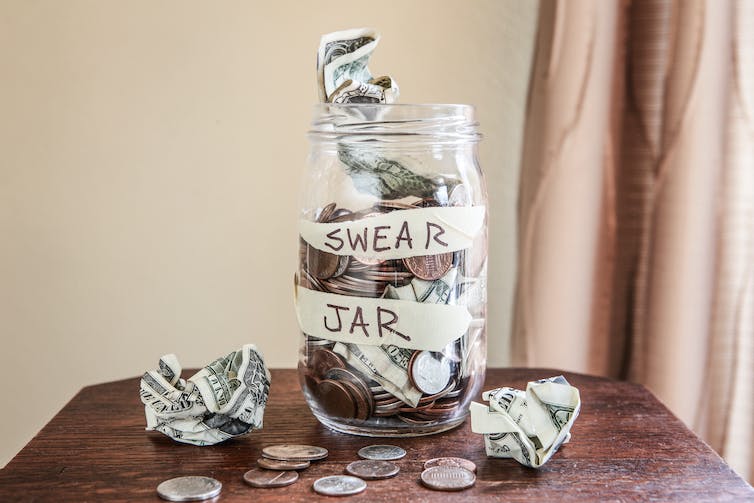
But swearing doesn’t just influence our physical and mental selves – it also affects our relationships with others. Research in communication and linguistics has shown an array of distinctive social purposes of swearing – from expressing aggression and causing offence to social bonding, humour and story-telling. Bad language can even help us manage our identities and display intimacy and trust as well as boosting attention and dominance over other people.
Digging deeper
Despite having such a noticeable effect on our lives, we currently know very little about where swearing gets its power. Interestingly, when we hear a swear word in an unfamiliar language, it seems just like any other word and will not produce any of these outcomes – there’s nothing particular about the sound of the word itself that is universally offensive.
So, the power does not come from the words themselves. Equally, it is not inherent in the word meanings or sounds: neither euphemisms nor similar sounding words have such a profound effect on us.
One explanation is that “aversive conditioning” – the use of punishment to prevent continued swearing – typically occurs during childhood. This may establish a visceral connection between language use and emotional response. While this hypothesis sounds correct, it is weakly evidenced by only a handful of studies that have investigated memories of childhood punishment for swearing. There are almost no empirical studies of links between such memories and adult responses to swearing.
To get to the bottom of why swearing has such a profound effect on us, we need to investigate the nature of people’s memories for swearing. What were their significant swearing incidents? Did swearing always bring about unpleasant consequences, such as punishment, or were there benefits too? What about people’s ongoing experiences of swearing throughout the lifespan? After all, our research shows that swearing can sometimes help people bond with one another.
We think it might be possible for swearing to show a similar memory pattern to that for music – we remember and like the songs best that we listened to during adolescence. That’s because, like music, swearing possibly takes on new meaning in adolescence. It becomes an important way to respond to the intense emotions we tend to have during this time, and an act that signals independence from parents and connection with friends. So, swear words and songs used during this time may become forever linked with important and highly memorable experiences.
Research also needs to examine whether there is a link between memories of swearing and the effects observed in experiments. This could show whether people with more positive memories respond differently to those with negative memories.
A final point to consider is whether swearing will start to lose its power if it becomes more socially acceptable and thus loses its offensiveness. For now, however, it certainly remains a faux-pas.
Karyn Stapleton, Senior Lecturer in Interpersonal Communication, Ulster University; Catherine Loveday, Neuropsychologist, University of Westminster; Kristy Beers Fägersten, Professor, Södertörn University, and Richard Stephens, Senior Lecturer in Psychology, Keele University
This article is republished from The Conversation under a Creative Commons license. Read the original article.

Source Link: The Power Of Swearing: How Obscene Words Influence Your Mind, Body, And Relationships
