There are a number of candidates for the title of the quietest natural place on Earth. It’s difficult to pinpoint the absolute quietest natural location, as it is highly variable due to the influence of, for example, noise produced by wind, wildlife, rustling vegetation, tourists and those goddamn aircraft flying overhead.
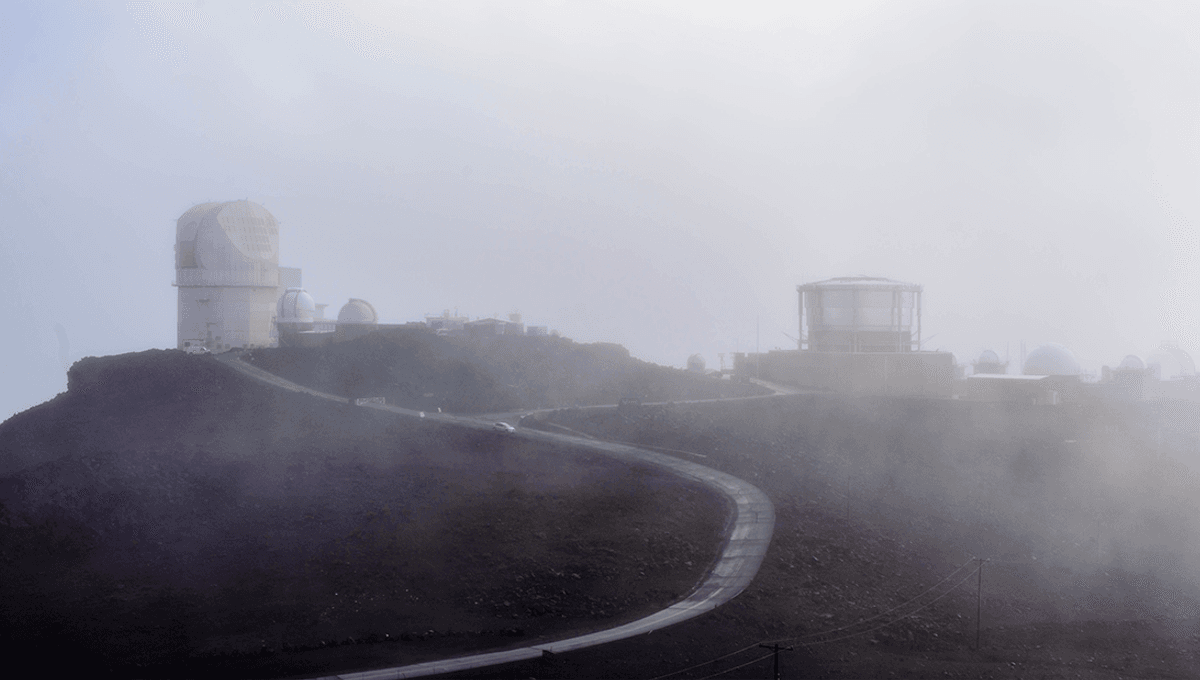
But a good candidate, thought to be the quietest National Park in the US at the very least, is the Haleakalā Crater found 3055 meters (10,023 feet) above the Pacific Ocean on the East Maui volcano, itself on the Hawaiian Island of Maui.
“Natural sounds, panoramic views, and dark night skies greatly contribute to Haleakalā’s unique sense of place,” the National Parks Service explains. “Ambient sound levels in the Haleakalā Crater are so low that they approach the threshold of human hearing.”
Here, the deep crater helps to keep the wind out, while the lack of vegetation in this arid landscape prevents the rustling of plants, and keeps animals from setting up home here. There, it can get very quiet indeed.
“Haleakalā’s natural soundscape is a fundamental resource of the Park as the Park’s low ambient sounds play a vital role in the health of Park natural ecosystems (NPS, 2015a). Both natural and existing acoustic conditions in the Park were measured in 2003 (Lee et al., 2016),” the National Parks Service explains in a separate document.
Median daytime natural ambient sound levels ranged from 21 dBA, A-weighted (dBA) in backcountry areas to 45 decibels (dBA) along the shoreline. The Haleakalā Crater is one of the quietest areas measured in the National Park System, with sound levels, at times, approaching the threshold of human hearing and as low as 10 dBA. The median daytime existing ambient (L50) sound levels exhibit similar variability as natural ambient conditions, ranging from 23 dBA in the backcountry to 46 dBA in the front country where visitors are more prevalent.”
While the noise levels vary, that’s very quiet, with visitors to the crater claiming that they are able to hear their own heartbeat. But in the quietest place on Earth, designed specifically to have low sound levels, has an ambient sound level measured at minus 24.9 decibels.
The anechoic test chamber at Orfield Laboratories in Minneapolis, Minnesota, takes the title for the quietest place on Earth overall. In fact, it has taken that title three times in its history.
“An Anechoic Chamber is defined as a room with high levels of sound absorption, absorbing 99.99% of sound. Located in Orfield’s NVLAP-Accredited Acoustic Laboratory, this anechoic chamber may be used fully anechoic, or with the addition of a reflecting plane on the floor. The approximate nominal dimensions of the chamber are as follows: 12’ x 10’ x 7-4,” Orfield Laboratories explains.
“Following Orfield’s initial accreditation (Lab Code 200248) in 1997, the lab submitted to Guinness for the low levels of sound recorded in the chamber (-9.4dB, -13.4dB, -24.9dB), resulting in three Guinness Records for being ‘The Quietest Place on Earth’ (2004, 2012, 2021). Since, the lab has operated as both a testing facility and an attraction for visitors interested in sensory deprivation.”
The chamber is designed to absorb as much sound as possible, using fiberglass and foam wedges to dissipate sound energy and prevent standing waves, as well as being built on vibrational dampeners to minimize sound seeping in from the outside.
There have been a number of legends which have sprung up around the chamber, without merit, for example stating that nobody has “survived” remaining inside the chamber for longer than 45 minutes. One New York Times reporter stayed inside the chamber for 3 hours to show that this wasn’t the case. While those rumors are not true, it can still be a disconcerting experience. Visitors have reported nausea and disorientation, as well as being able to hear their own blood move around their bodies through their veins and arteries, and even hearing themselves blink.
So, how can a sound be negative? Well, the answer is it can’t, but decibels, the unit we measure sound in, can be.
“Decibels are different from other familiar scales of measurement. While many standard measuring devices, such as rulers, are linear, the decibel scale is logarithmic. This kind of scale better represents how changes in sound intensity actually feel to our ears,” the National Institute on Deafness and Other Communication Disorders explains.
“To understand this, think of a building that is 80 feet tall. If we build up another 10 feet, the building will be 12.5 percent taller, which would seem just slightly taller to us; this is a linear measurement. Using the logarithmic decibel scale, if a sound is 80 decibels, and we add another 10 decibels, the sound will be ten times more intense, and will seem about twice as loud to our ears.”
Zero decibels was set at the threshold of human hearing, or the quietest sound that humans can hear. In one of these anechoic chambers, the ambient sound is even lower than that.

Source Link: The Quietest Place On Earth Has An Ambient Sound Level Of Minus 24.9 Decibels
