• Email Us: [email protected]
  • Contact Us: +1 718 874 1545
  • Skip to main content
  • Skip to primary sidebar

Medical Market Report

  • Home
  • All Reports
  • About Us
  • Contact Us

The “Sailor’s Eyeball” Blob Is One Of The Largest Single-Celled Organisms Ever Discovered

November 7, 2025 by Deborah Bloomfield

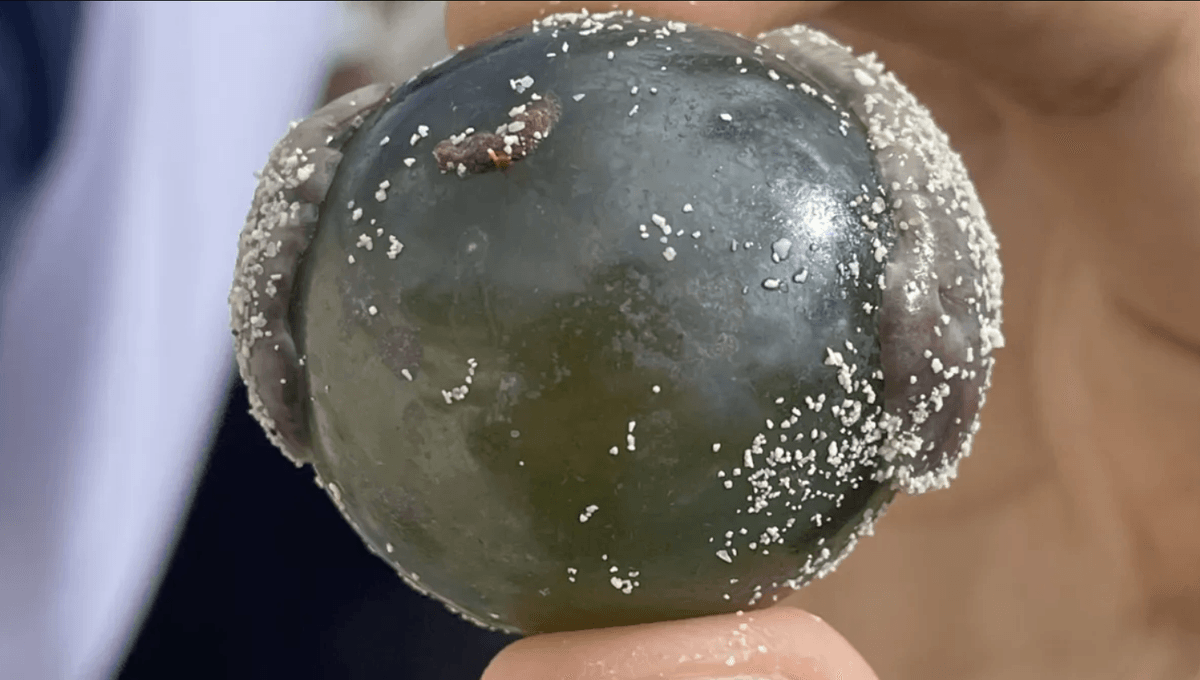
There are sailors’ eyeballs to be found at sea, that is, if you know where to look. Fortunately not the result of any gouging injuries, these curious blobs are a type of algae called Valonia ventricosa, and they’re one of the largest single-celled organisms on Earth.

The rest of this article is behind a paywall. Please sign in or subscribe to access the full content.

The size of sailors’ eyeballs can vary from a speck the size of a pinhead to, well, an eyeball. Just how big the blob gets all comes down to the contents of its vacuole – the space inside its cell wall. 

V. ventricosa is unicellular, but it can contain the nuclei of many cells. This is because they’re coenocytic organisms, meaning they’re made up of a mass of cytoplasm containing many cell nuclei that aren’t separated by a cell wall. They’re also loaded with chloroplasts, the organelle that conducts photosynthesis, providing the organism with energy from the sun. 

The unusual arrangement comes with a fun party trick. If you pop a sailor’s eyeball – the algal version– it can actually result in more V. ventricosa springing up as they only need one cell nucleus to grow into new organisms.


And hoo boy, are they poppable. The cytoplasm vacuole contains nuclei organized in lobes that radiate from its center, creating an internal anatomy the New Heaven Reef Conservation Program describes as “something like a Tesla plasma ball”.

Sailors’ eyeballs are also known as dead man’s eyeballs, bubble algae, sea grapes, and sea pearls. They are often spotted by divers drifting through coral reefs in tropical and subtropical regions of the world’s oceans. They can vary in color from bright green to black, and sometimes very silvery because of the unique structure of their cell walls’ cellulose crystals.  

The shimmering coloration is reminiscent of the NOAA Ocean Exploration’s “golden egg” mystery when they found an alien-like shiny orb on the seabed of Alaska. The shiny blob was spotted at a depth of 3.1 kilometers (2 miles), anchored to a rocky surface. Most curious of all, the mysterious object had a hole in it, inspiring one researcher to say during the live feed, “Something tried to get in… or to get out.”

Sailors’ eyeballs, on the other hand, are just trying to get on with their day, so don’t you go popping those weird jelly blobs now, will you?

An earlier version of this article was published in December 2023.

Deborah Bloomfield
Deborah Bloomfield

Related posts:

  1. The Taliban are lying, France’s foreign minister says
  2. Yahoo has built a new calendar app called Day, and it’s recruited the co-founder of Sunrise to design it
  3. You Can Watch The First-Ever Live Stream From Mars This Week
  4. Trench 94: The US Navy’s Nuclear Submarine Graveyard

Source Link: The “Sailor’s Eyeball” Blob Is One Of The Largest Single-Celled Organisms Ever Discovered

Filed Under: News

Primary Sidebar

  • Gravitational Lenses Confirm That Something Is Still Broken In The Universe
  • Adorable Camera Trap Footage Of Moms And Cubs Heralds Conservation Win For Sunda Tigers
  • Exercise VS Sleep: Which Is More Important When You Don’t Have Time For Both?
  • A Deep-Sea Mining Test Carved Up The Seabed. Two Years On, We’re Seeing Devastating Impacts
  • Enormous New Study Finds COVID-19 mRNA Shots Associated With 25 Percent Lower Risk Of Death From Any Cause
  • What Is The Best Movie Set In Space? We Asked Real-Life Astronauts To Find Out
  • Chernobyl’s Protective Shield Is Broken After A Drone Strike, Warns UN Nuclear Watchdog
  • Isaac Newton Was Born On Christmas Day – And January 4th
  • Why Is December The 12th Month Of The Year When Its Name Means 10?
  • Poor Sauropod Was Limping When It Made Curious 360° Looping Dinosaur Track
  • Inhaling “Laughing Gas” Could Treat Severe Depression, Live Seven-Arm Octopus Spotted In The Deep Sea, And Much More This Week
  • People Are Surprised To Learn That The Closest Planet To Neptune Turns Out To Be Mercury
  • The Age-Old “Grandmother Rule” Of Washing Is Backed By Science
  • How Hero Of Alexandria Used Ancient Science To Make “Magical Acts Of The Gods” 2,000 Years Ago
  • This 120-Million-Year-Old Bird Choked To Death On Over 800 Stones. Why? Nobody Knows
  • Radiation Fog: A 643-Kilometer Belt Of Mist Lingers Over California’s Central Valley
  • New Images Of Comet 3I/ATLAS From 4 Different Missions Reveal A Peculiar Little World
  • Neanderthals Used Reindeer Bones To Skin Animals And Make Leather Clothes
  • Why Do Power Lines Have Those Big Colorful Balls On Them?
  • Rare Peek Inside An Egg Sac Reveals An Adorable Developing Leopard Shark
  • Business
  • Health
  • News
  • Science
  • Technology
  • +1 718 874 1545
  • +91 78878 22626
  • [email protected]
Office Address
Prudour Pvt. Ltd. 420 Lexington Avenue Suite 300 New York City, NY 10170.

Powered by Prudour Network

Copyrights © 2025 · Medical Market Report. All Rights Reserved.

Go to mobile version