From the man who smuggled deadly parasite eggs into the US by injecting them before ejaculating them out upon his return to the doctor who saved lives by pumping hydrogen gas into his own anus, history is replete with heroes of science who went the extra mile for their work and conducted experiments on themselves.
ADVERTISEMENT
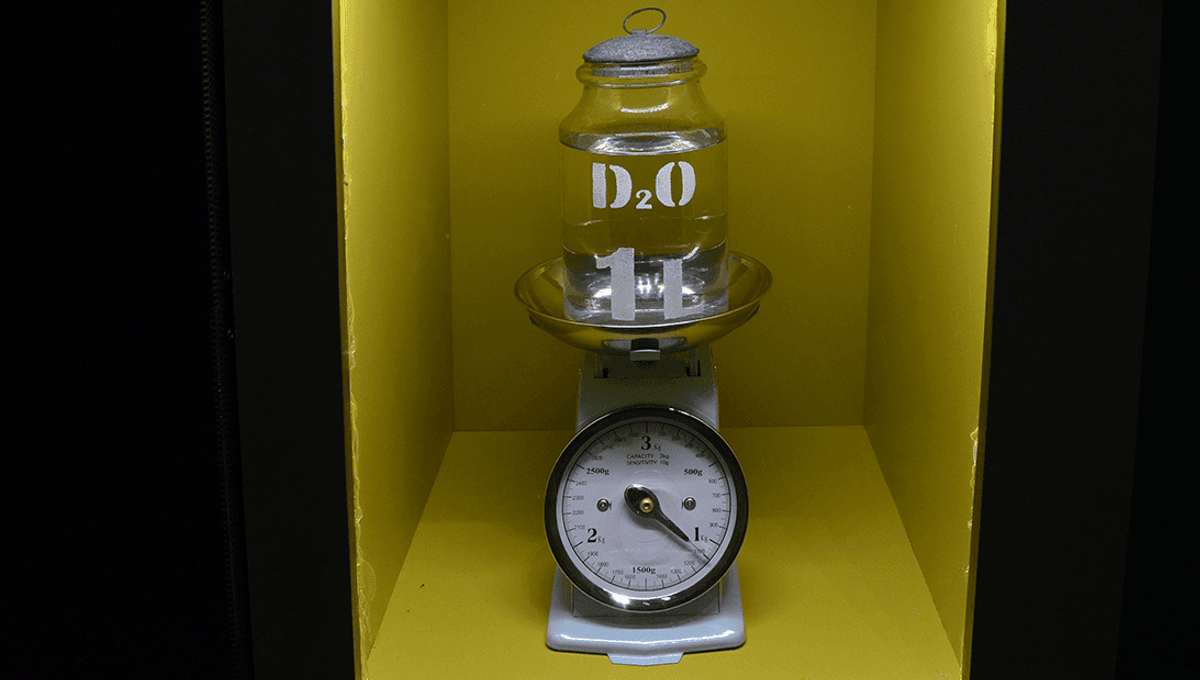
A few more examples that recently came to our attention are Klaus Hansen, the scientist who drank heavy water to test if it was safe for human consumption; and Harold Urey and Gioacchino Failla, who drank heavy water just to see what it tasted like.
First up, what is heavy water? Elements are defined by the number of protons in their nucleus, with hydrogen having one, helium having two, and uranium having 92 protons, for example. The number of neutrons can vary, with different elements needing different numbers of neutrons to be stable (or at least long-lasting). Many elements have several versions with different numbers of neutrons, known as isotopes.
In the 1920s, Ernest Rutherford hypothesized that a heavier isotope of hydrogen was possible; a hydrogen atom with the usual proton, plus a neutron. Soon after this, American physical chemist Harold C. Urey was able to prove its existence, winning a Nobel Prize for his efforts.
“In 1931 he devised a method for the concentration of any possible heavy hydrogen isotopes by the fractional distillation of liquid hydrogen: this led to the discovery of deuterium,” The Nobel Prize website explains. “Together with the late Dr. E.W. Washburn, he evolved the electrolytic method for the separation of hydrogen isotopes and he carried out thorough investigations of their properties, in particular the vapour pressure of hydrogen and deuterium, and the equilibrium constants of exchange reactions.”
This heavier isotope is now known as deuterium. Water (H20), as you are likely painfully aware from school, is an inorganic compound comprised of two hydrogen atoms and one oxygen atom. But Urey proved that it was possible to bond deuterium with oxygen to make what we call “heavy water” (D2O).
In fact, heavy water is found mixed with natural water, making up around 0.015 percent of it, which can be isolated through electrolysis. While similar to regular water, heavy water has useful properties, including some that are useful in nuclear reactors.
ADVERTISEMENT
“If graphite or heavy water is used as moderator, it is possible to run a power reactor on natural instead of enriched uranium. Natural uranium has the same elemental composition as when it was mined (0.7% U-235, over 99.2% U-238), enriched uranium has had the proportion of the fissile isotope (U-235) increased by a process called enrichment, commonly to 3.5-5.0%,” the World Nuclear Association explains.
“In this case the moderator can be ordinary water, and such reactors are collectively called light water reactors. Because the light water absorbs neutrons as well as slowing them, it is less efficient as a moderator than heavy water or graphite.”
But you aren’t here to learn about its nuclear uses. Like a few scientists back in the 1930s, you want to know what it tastes like. Fortunately, Klaus Hansen, a pharmacologist at Oslo University, has your back.
ADVERTISEMENT
While others had tried heavy water before him, his was the first dose in high concentration. Watched by a group of colleagues – waiting to resuscitate him if necessary – he took the first of a series of gulps of the liquid.
“I lifted the beaker to my lips. Immediately I felt a burning dry sensation in my mouth and then I could feel nothing. First my mind became excited and impressed with a feeling of crisis. I had some shock. Then I said to myself, ‘Be quiet—you are simply going through a minor experience.’ Then it was all over. I could see, hear, breathe, feel and walk just as before,” he said of the experience, per Time.
Hansen presumed – correctly – that high concentrations of heavy water would be fatal to humans and animals, though he did not know at what dose.
“Within the next few weeks, I shall either be seriously ill or able to tell what the effects are, for I intend to raise the dose by easy stages during the next fortnight to the final and testing drink of 100 grams.”
ADVERTISEMENT
Hansen survived his tests. But what of the flavor? According to Hansen, drinking came with a “burning dry sensation”, which sparked the curiosity of Urey, who organized a blind taste test.
“One of us kept each sample in his mouth for a short time to make sure of its taste, and then spat it out. The other repeated the same procedure, but swallowed the water. Neither of us could detect the slightest difference between the taste of ordinary distilled water and the taste of pure heavy water,” Urey and Failla wrote of the experiment. “It might be mentioned in this connection that one cubic centimeter of water is not too small an amount to taste properly, since both of us could detect plainly the characteristic ‘flat’ taste of distilled water in both cases. It may be concluded, therefore, that pure deuterium oxide has the same taste as ordinary distilled water.”
Heavy water can be absorbed into the body safely at low levels, and is often used in scientific studies on the human body – Yale School of Medicine notes that “Studies over more than 30 years have not shown any negative consequences of deuterium administration.”
However, when around 20 percent of the water in the body of a mammal is heavy water, toxic effects are likely – and at around 35 percent it can be deadly. That’s a hell of a lot of heavy water to consume, making accidental intoxication incredibly unlikely unless you started gulping down the stuff at a nuclear facility over the course of several days.
ADVERTISEMENT
Nevertheless, further analysis of heavy water has found that it has a distinctly sweet taste compared to ordinary water.

Source Link: The Scientists Who Drank Heavy Water To See What It Tasted Like
