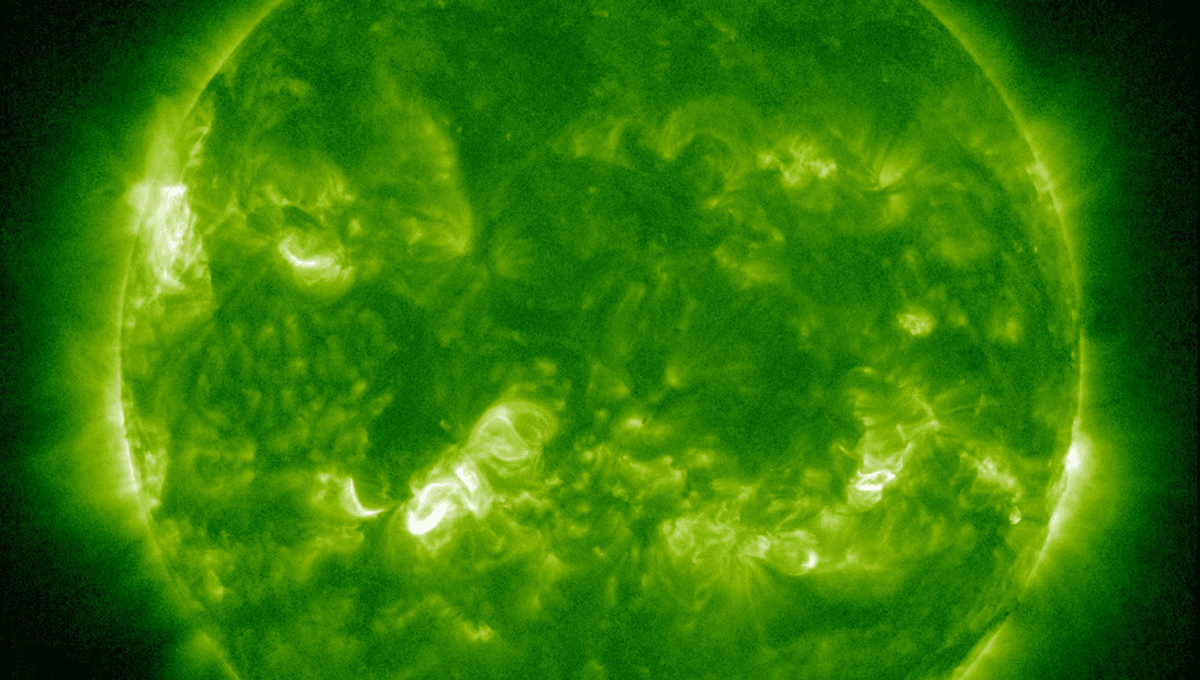
In case you’ve missed it, the Sun has been particularly active over the past year, unleashing powerful solar flares and causing radio blackouts on Earth. This is all part of an 11-year cycle of solar activity that also sees the Sun’s poles gradually reverse around its peak.
The Earth’s poles too can flip over the course of hundreds or thousands of years, and this can happen apparently at random, with intervals ranging anywhere from 10,000 years to 50 million years or more, with the flips occurring every 200,000 to 300,000 years on average.
The Sun’s activity, meanwhile, increases and decreases over an 11-year cycle known as the Schwabe cycle. From 1826 to 1843, German amateur astronomer Heinrich Schwabe observed the Sun, discovering that it rotates on its axis once every 27 days. He noticed that, over 11 years, the Sun goes from quiet periods where no sunspots can be seen, to the maximum phase where 20 or more groups of sunspots can be seen.
These sunspots are caused by changes in the magnetic field of the Sun, as the Sun’s equator rotates faster than the poles and stirs it all up.
“The Sun’s magnetic fields rise through the convection zone and erupt through the photosphere into the chromosphere and corona,” NASA explains. “The eruptions lead to solar activity, which includes such phenomena as sunspots, flares, prominences, and coronal mass ejections.”
The magnetic field of the Sun flips during the cycle’s peak, like a much more fluid version of the Earth. The cycle can be as short as eight years, or as long as 14, and is driven by sunspots.
“As sunspots emerge from the Sun’s interior in polar-opposite pairs, plasma flows rearrange their magnetic fields, stretching, weakening, and emphasizing the biases of their polarities,” the National Solar Observatory explains. “These weakened sunspot fields are carried by plasma flows towards the poles. The newly-arrived field tends to be of opposite magnetic polarity to the existing polar field, and when opposite polarities come into contact they destroy each other. This process comes to a head at the peak of the solar cycle, when enough opposite-polarity fields arrive at the poles, destroying the polar field, and replacing it with a new polar field of the opposite magnetic polarity.”
So where are we now in the cycle? Throughout the year, the Sun’s activity has been increasing. The peak is predicted between now and 2026, though we won’t know exactly when it took place until months after it has taken place.
However, one team believes they have a more accurate prediction by looking at something called “terminator events”. The team looked at magnetic “donuts” which form at 55 degrees of latitude on both hemispheres of the Sun. These formations migrate towards the equator where they meet and cancel each other out, which the team dubbed a Hale cycle terminator (a Hale cycle is two solar cycles, over which the magnetic poles flip and then flip again to their previous position).
This terminator event tends to happen up to two years after the minimum, and by focusing on these events, the team believed they could make better predictions about the solar cycles.
“If you measure how long a cycle is, not the minimum to minimum, but from terminator to terminator, you see that there is a strong linear relationship between how long one cycle is and how strong the next one is going to be,” NASA research scientist Robert Leamon told Space.com.
Using these methods, they predicted the magnetic field would flip in mid-2024, a few months before the NASA-predicted solar maximum.

Source Link: The Sun's Poles May Have Started To Flip This Year. Why Do They Do That?
