• Email Us: [email protected]
  • Contact Us: +1 718 874 1545
  • Skip to main content
  • Skip to primary sidebar

Medical Market Report

  • Home
  • All Reports
  • About Us
  • Contact Us

The World’s Biggest Iceberg Has Been Stuck Spinning For Nearly 8 Months

August 12, 2024 by Deborah Bloomfield

Imagine spending over 30 years grounded in the Weddell Sea, finally breaking free, only to get stuck again less than four years later – and this time, you can’t stop spinning. That’s the unfortunate reality for the world’s largest iceberg, A23a.

Advertisement

It was first declared in its “spinning era” by the British Antarctic Survey (BAS) earlier this year, after imagery captured by instruments aboard NASA satellites between December 2023 to February 2024 showed the iceberg beginning to rotate in place in early January.

ⓘ IFLScience is not responsible for content shared from external sites.

Since then, the 4,000 square-kilometer (1,500 square-mile) berg has remained trapped near the South Orkney Islands – but why?

A23a is the unfortunate victim of what’s known as a Taylor column, a rotating cylinder of water that can form when an ocean current – in this case, the Antarctic Circumpolar Current – meets a seamount – Pirie Bank in the Scotia Sea.

The prospect of A23a ending up stuck and spinning in such a way wasn’t entirely unpredictable – it’s happened to other icebergs traversing similar routes in the past. However, the berg’s giant size makes this a particularly unusual sight.

Advertisement

“You know, you can make these Taylor Columns quite easily in a rotating tank experiment in your lab,” Till Wagner, Assistant Professor in Ice and Climate Physics at the University of Wisconsin-Madison, told NPR. “But to see it on a geophysical scale like this is really rare.”
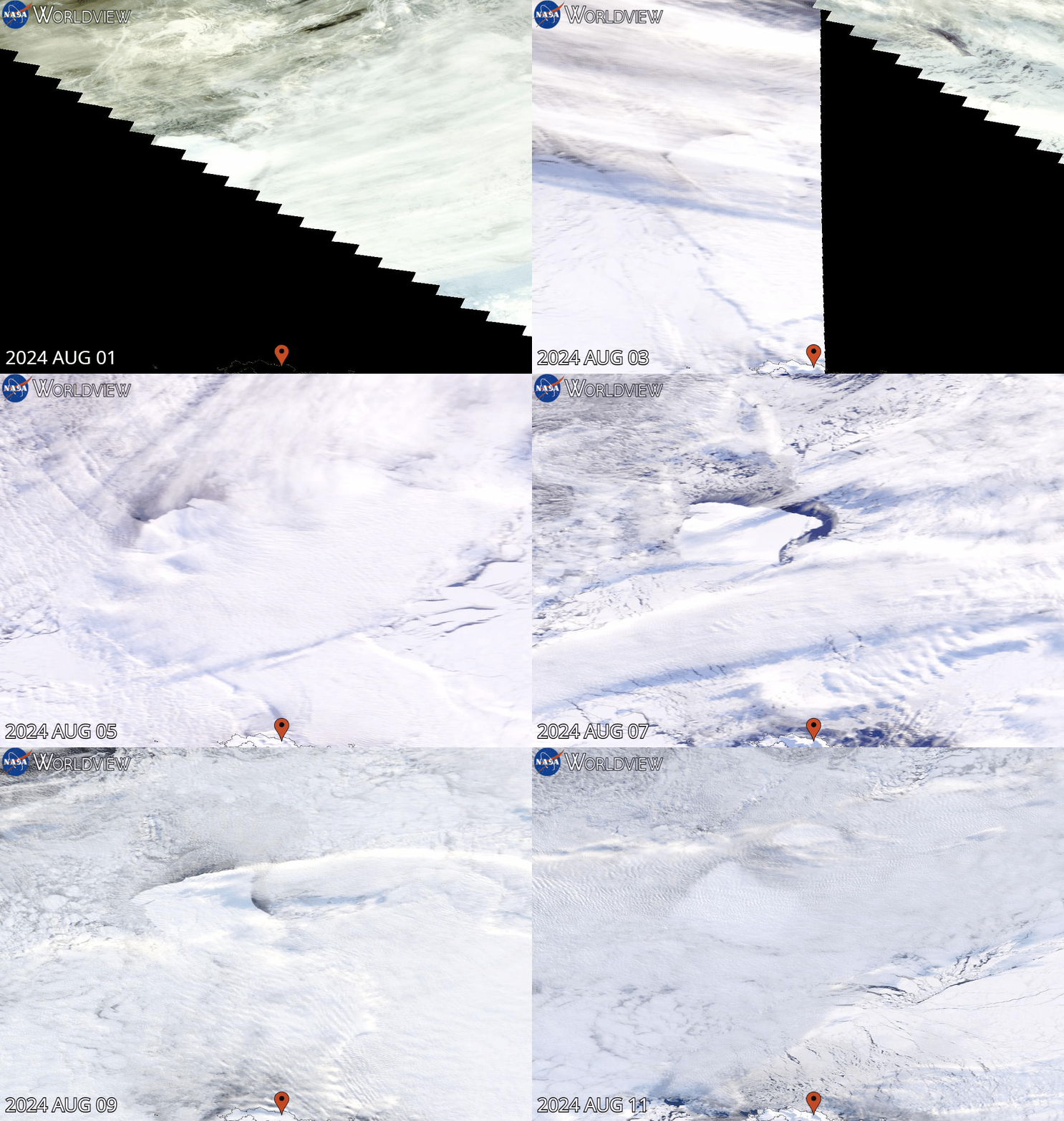
gif of satellite images of iceberg A23a between August 1 and August 11, 2024

A23a getting spinny with it this month so far.

Image credit: NASA Worldview

Though it might be fun to be the star of a rare event, if icebergs were sentient, we imagine A23a would be more than a bit fed up by now with its unexpectedly long journey away from its birthplace.

The berg, which is bigger than the state of Rhode Island, first calved off Antarctica’s Filchner–Ronne Ice Shelf back in 1986 – but became grounded on nearby seabed shortly after.

It took until 2020 for A23a to finally get moving again and start making its way out of the Weddell Sea, after which it briefly lost its title as “world’s biggest iceberg” to A76, though the competitor would eventually end up in pieces thanks to the extreme conditions of the Drake Passage.

Advertisement

Fast forward to today, and A23a is stuck once again, having been so for coming up to eight months. As for how much longer it’ll stay spinning before eventually breaking free and continuing its journey, that’s unclear – others have stayed like that for several weeks, so it’s already beating the odds.

ⓘ IFLScience is not responsible for content shared from external sites.

As Open University researcher and polar expert Professor Mark Brandon put it to the BBC: “Usually you think of icebergs as being transient things; they fragment and melt away. But not this one.”

“A23a is the iceberg that just refuses to die.”

Deborah Bloomfield
Deborah Bloomfield

Related posts:

  1. Lithuania to fence first 110 km of Belarus border by April
  2. China’s ICBC to restrict some forex and commodities trading
  3. Why Is Earth’s Inner Core Solid When It’s Hotter Than The Sun’s Surface?
  4. Dark Energy May Be Getting Diluted As The Universe Expands

Source Link: The World’s Biggest Iceberg Has Been Stuck Spinning For Nearly 8 Months

Filed Under: News

Primary Sidebar

  • Do Any Animal Species Actively Hunt Humans As Prey?
  • “What The Heck Is This?”: JWST Reveals Bizarre Exoplanet With Inexplicable Composition
  • The Animal With The Strongest Bite Chomps Down With A Force Of Over 16,000 Newtons
  • The Eschatian Hypothesis: Why Our First Contact From Aliens May Be Particularly Bleak, And Nothing Like The Movies
  • The Great Mountain Meltdown Is Coming: We Could Reach “Peak Glacier Extinction” By 2041
  • Comet 3I/ATLAS Is Experiencing A Non-Gravitational Acceleration – What Does That Mean?
  • The First Human Ancestor To Leave Africa Wasn’t Who We Thought It Was
  • Why Do Warm Hugs Make Us Feel So Good? Here’s The Science
  • “Unidentified Human Relative”: Little Foot, One Of Most Complete Early Hominin Fossils, May Be New Species
  • Thought Arctic Foxes Only Came In White? Think Again – They Come In Beautiful Blue Too
  • COVID Shots In Pregnancy Are Safe And Effective, Cutting Risk Of Hospitalization By 60 Percent
  • Ramanujan’s Unexpected Formulas Are Still Unraveling The Mysteries Of The Universe
  • First-Ever Footage of A Squid Disguising Itself On Seafloor 4,100 Meters Below Surface
  • Your Daily Coffee Might Be Keeping You Young – Especially If You Have Poor Mental Health
  • Why Do Cats And Dogs Eat Grass?
  • What Did Carl Sagan Actually Mean When He Said “We Are All Made Of Star Stuff”?
  • Lonesome George: The Giant Tortoise Who Was The Very Last Of His Kind
  • Bermuda Sits On A Strange, 20-Kilometer-Thick Structure That’s Like No Other In The World
  • Time Moves Faster Up A Mountain – And That’s Why Earth’s Core Is 2.5 Years Younger Than Its Surface
  • Bio-Hybrid Robots Made Of Dead Lobsters Are The Latest Breakthrough In “Necrobotics”
  • Business
  • Health
  • News
  • Science
  • Technology
  • +1 718 874 1545
  • +91 78878 22626
  • [email protected]
Office Address
Prudour Pvt. Ltd. 420 Lexington Avenue Suite 300 New York City, NY 10170.

Powered by Prudour Network

Copyrights © 2025 · Medical Market Report. All Rights Reserved.

Go to mobile version