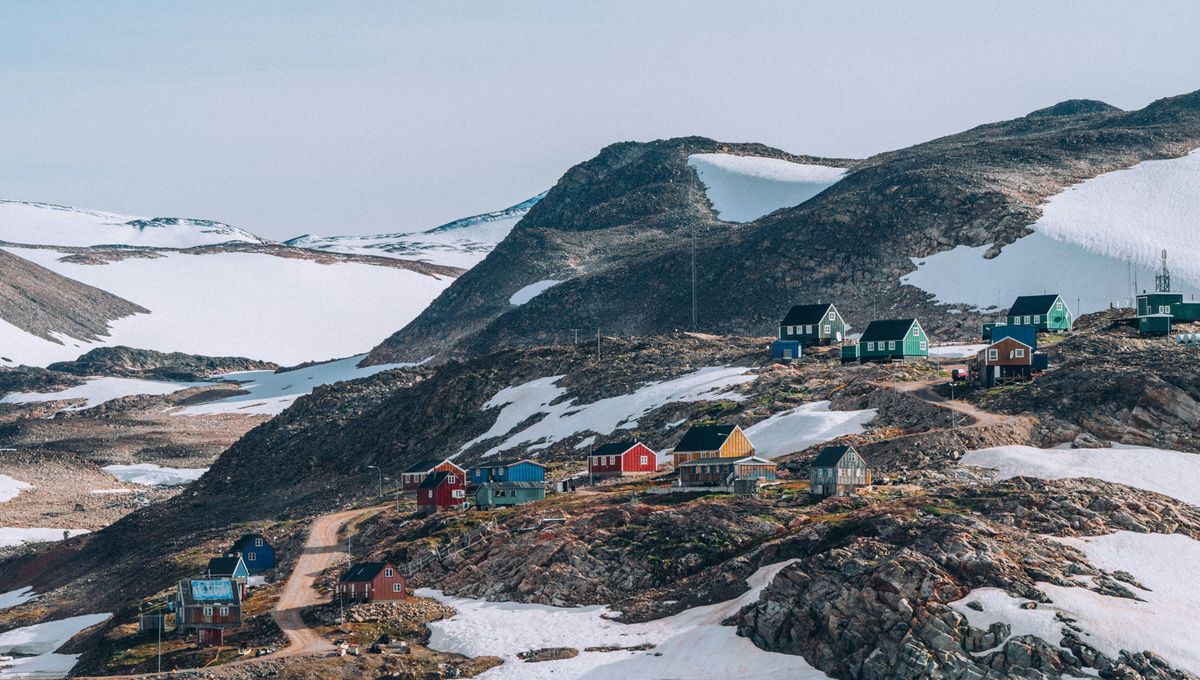
Greenland, the world’s largest island, is shrinking and shape-shifting. Since the peak of the last Ice Age about 20,000 years ago, the melting of its ice sheets has been easing pressure on the landmass, causing its tectonic plate and deep bedrock to deform.
The rest of this article is behind a paywall. Please sign in or subscribe to access the full content.
The end result is that Greenland has become ever so slightly smaller. However, the effect is not uniform across the island; some parts are shrinking and being pulled together, while others have been stretched out and expanded.
Due to this geological turmoil, Greenland is on the move, too. The researchers found that the island has moved northwestward over the past 20 years by about 2 centimeters (0.7 inches) per year.
“Overall, this means Greenland is becoming slightly smaller, but that could change in the future with the accelerating melt we’re seeing now,” Danjal Longfors Berg, lead author of the study and postdoc researcher at the Technical University of Denmark and NASA’s Jet Propulsion Laboratory, said in a statement.
“The ice that has melted in recent decades has pushed Greenland outward and caused uplift, so the area has actually become larger during this period. At the same time, we see movement in the opposite direction, where Greenland is rising and contracting due to prehistoric changes in the ice masses related to the last Ice Age and its end,” explained Berg.
Greenland is a 2.1 million square kilometer (836,330 square mile) island that lies on the North American tectonic plate. These plates are massive slabs of Earth’s crust that slowly move over the planet’s mantle, a layer of hot, semi-solid rock that flows very gradually over time, behaving more like a super-thick syrup than a rigid solid.
This dynamic helps explain why Greenland is literally changing shape today. As the ice sheets continue to melt, the enormous weight pressing down on the land is reduced. In response, the underlying crust and mantle slowly rebound, causing shifts in the physical landmass.
Depending on how much ice has melted and the composition of the bedrock, some parts of the island rise and stretch while others compress and sink, creating a patchwork of geological motion.
To uncover these movements, researchers at the Technical University of Denmark analyzed data from 58 GPS stations scattered along Greenland’s outer edges. These instruments tracked the island’s position, the elevation changes in its bedrock, and how the land itself has warped over time. This data was then plugged into a model that accounts for long-term geological movements over the past 26,000 years, with precise GPS measurements from the last 20 years.
“This means we can now measure the movements very accurately,” said Berg.
“There have not previously been such precise measurements of how Greenland is shifting. The assumption has been that Greenland is primarily being stretched due to the dynamics triggered by the ice melting in recent years. But to our surprise, we also found large areas where Greenland is being ‘pulled together,’ or ‘shrinking,’ due to the movements,” he added.
The new study is published in the Journal of Geophysical Research: Solid Earth.

Source Link: The World's Largest Island Is Shrinking And Shifting
