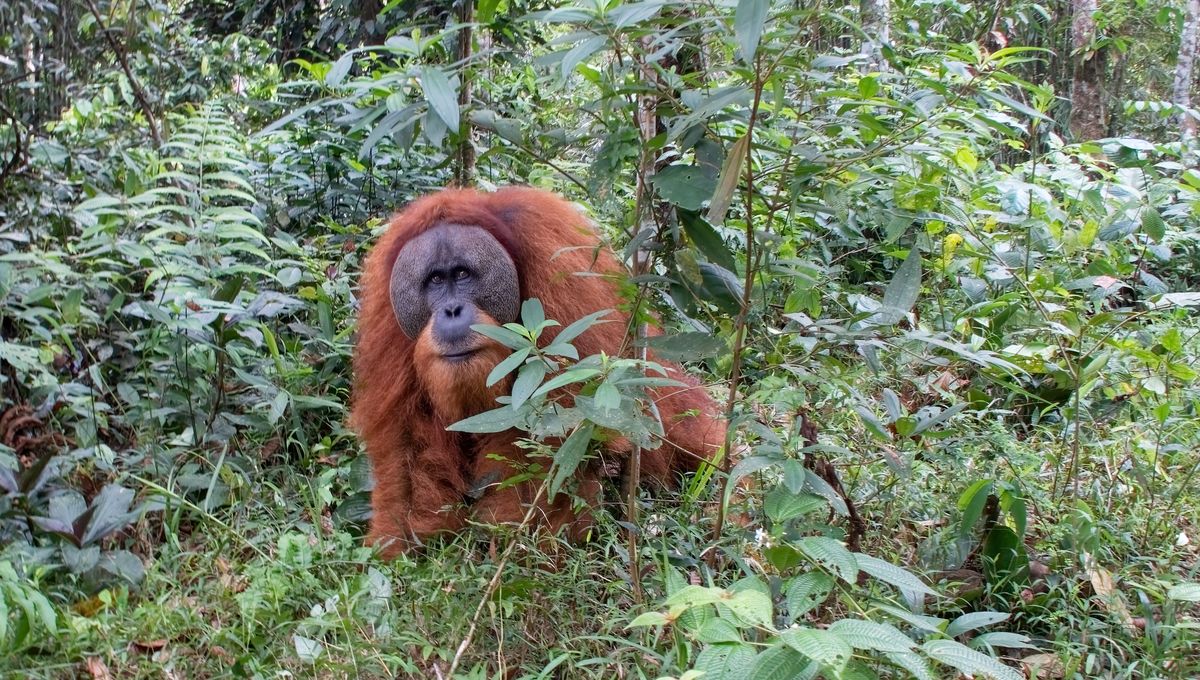
Critically endangered species live life on a knife-edge. Often with populations in the low hundreds, every individual is vital to continue to breed and maintain numbers. Unforeseen events, like climate-related extreme weather, can often further threaten this precarious balance, as is the case recently with the Tapanuli orangutan, the rarest great ape in the world.
Everything we know about Tapanuli orangutans (Pongo tapanuliensis) is from a small population in the Batang Toru region on the island of Sumatra. They were only discovered in 1997 and recognised as their own species, genetically separate from both Bornean and Sumatran orangutans, in 2017. It’s thought there are fewer than 800 of this species remaining, although thanks to Indonesia’s recent extreme flooding, that is likely significantly fewer now. These elusive great apes live in three population groups, known as the West, East, and South Blocks. Their main threat – as for all orangutans, which are only found on Borneo and Sumatra – is habitat fragmentation and degradation, due to palm oil plantations and logging.
However, in November Cyclone Senyar struck Sumatra, devastating the island and causing widespread flooding and landslides in the Batang Toru region. The event, which saw over 1,000 millimeters (39 inches) of rainfall occur across Northern Sumatra over a four-day period, killed 1,000 people and left many more without homes. The specific area was also thought to hold over 500 of the 800 population of Tapanuli orangutans. However, conservationists estimate up to as many as 54 orangutans were killed in the floods and resulting landslides.
In a new pre-print paper led by orangutan expert Prof. Erik Meijard, managing director of Borneo Futures in Brunei, scientists estimate the cyclone and rainfall impact “killed or severely impacted 6.2-10.5% of the Tapanuli orangutans in the West Block” in just a few days. It had previously been estimated that losing just 1 percent of the population a year would lead to the species’ extinction.
“It’s a total disaster,” Meijaard, who described the species, told The Guardian. “The path to extinction is now a lot steeper.”
Using satellite images, the team tried to quantify just how much of the forest had been destroyed during the cyclone. They focused their analysis on just the West Block of the forest. Their data suggested that 3,964 hectares (9,800 acres) of land had been swept away by the flooding, and that more than 2,400 further hectares (5,930 acres) were obscured by cloud cover in the images but are also thought to have been damaged. Given this information, the team thinks between 33 and 54 individuals could have been killed in the flooding, landslides, and tree falls. This could be the tipping point for the survival of the species, they say.
“The destroyed areas would have contained some 35 orangutans, and considering the violence of the destruction, it wouldn’t surprise us if they are all dead. That’s a major blow to the population,” Meijaard told BBC News.
These great apes are extremely slow to breed, typically only having offspring every six to nine years. Wiping out nearly 11 percent of the population in one go suggests a “critical demographic shock”, the team writes.
The intensity of the rainfall can be attributed to climate change, with a suggestion that La Niña and other negative conditions contributed to a 5-13 percent increase in intensity. Globally, further increases in high-intensity rainfall are predicted to increase, suggesting that even if the Tapanuli orangutans have survived this catastrophic event, more might be on the way.
The preprint, which has not yet undergone peer review, is available here.

Source Link: The World's Rarest Great Ape Just Got Even Rarer
