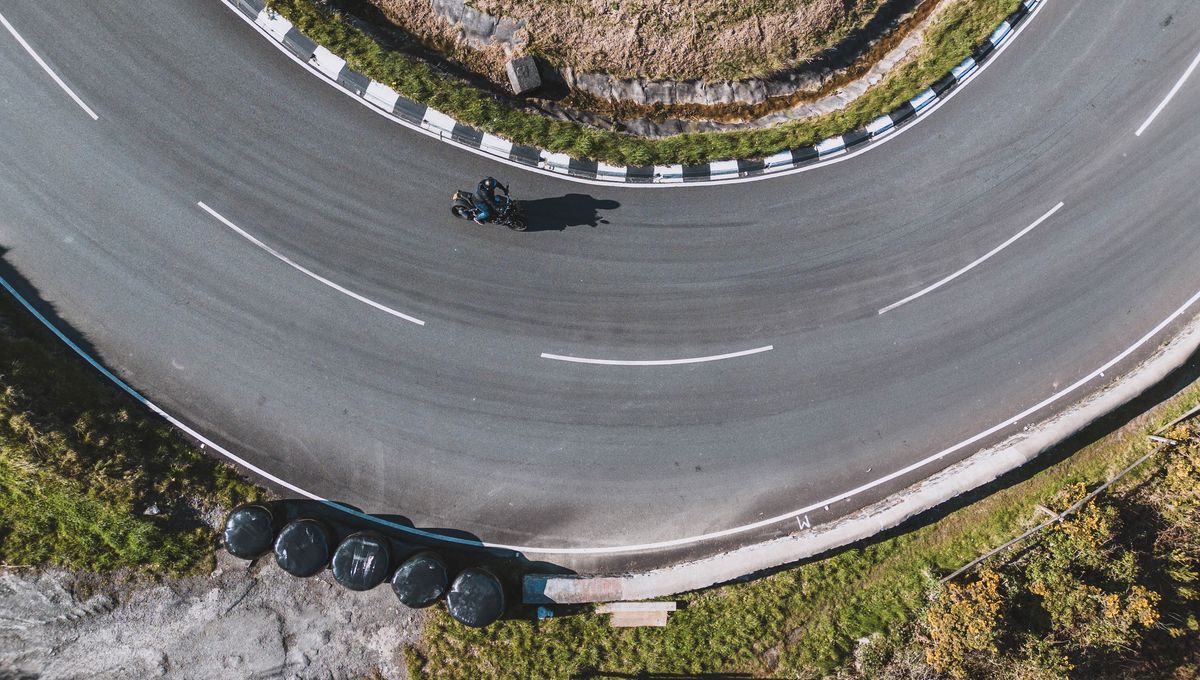
Car commercials always boast a top speed, and it’s always pointless. Who cares if your new wheels can reach 200 miles per hour? The fastest you can drive anywhere in the US is less than half that!
But what if you could top out your car? Really let it go as fast as possible, with no fear of getting a ticket or having your license revoked? Wouldn’t that be the dream?
Well, in two places – and two places only – it’s totally possible.
Man, oh Man
The Isle of Man is a small island, and it’s best known for extremely forgiving tax laws, motorsport, and being kind-of-but-technically-not-really part of a much more well-known and powerful nation.
Given all that, you might assume it’s somewhere, oh, in the Caribbean or Middle East, maybe – but it’s not. It’s in the Irish sea, a stone’s throw from the UK – and it has no national speed limit at all.
“We’re unique,” Allan Thomson, then a detective sergeant in charge of the Manx Constabulary’s Road Policing Unit, told Car and Driver in 2015. “You can get off the boat and go up onto the mountain course and be doing 180 mph within 15 minutes, without breaking the law.”
Now, this isn’t to say that there are zero speed limits anywhere on the island. Residential roads and built up areas typically have a default limit of 30 miles per hour – but out on what might generously be called the highways, anything goes.
Naturally, this can make policing the island’s roads… difficult. “You’ll never be as fast as some of the bikes,” Thomson admitted. “You can be driving at 100 mph with the lights and sirens on and there will be bikers whistling past you.”
It also makes the island a hotspot for motor vehicle deaths – especially motorcycle deaths. There are fewer than 85,000 people living on the Isle of Man, and each year, almost without fail, they bear witness to at least three or four road fatalities in two weeks alone.
Not just any old two weeks, mind. We’re specifically talking about the two weeks in May and June during which the Isle of Man Tourist Trophy, or TT, is held – the annual motorbike race, held across the entire island, which is arguably the most dangerous in the world.
But even when it’s not TT week, those roads are open for speeding – and if you go there, you’re going to want to be careful. The track isn’t for novices: it has hairpin bends, and bumpy roads with urban obstacles; the elevation varies from sea level to 422 meters (1,385 feet) high; added to all this is the fact that it’s situated halfway between Britain and Ireland, aka rain and drizzle central.
It all adds up to a serious road accident rate twice that of its neighbors – a figure which, almost unbelievably, is already half what it was around 30 years ago. But hey, at least you can go zoom, right?
Autobahn
When you think about places with reckless disregard for laws and limits, your first go-to probably isn’t going to be “Germany”. Strange, then, that alongside its reputation for rules and regulation, the country is famous also for its Autobahn – the vast, nationwide network of highways best-known for having no speed limit at all.
“The Autobahn in many people’s minds is a bucket list item,” David Tracy, co-founder and editor-in-chief of automotive news outlet the Autopian, told CNBC back in February. “Car enthusiasts love the idea of an unrestricted roadway.”
It’s certainly true that, on around 70 percent of the Autobahn, how fast you drive is really between you and your engine – but if you’re imagining some kind of lawless, permanently Mad Max-style racetrack experience, we fear you may be disappointed.
“The average travel speed of automobiles on unrestricted autobahns is 141.8 km/h (88 mph),” pointed out Franklin Mao, then an undergrad student at the University of Washington, back in 2023. That may be faster than most places, but it’s likely not the regular hundreds-of-miles-per-hour you had assumed.
Partly, that’s due to regular folks just not wanting to go all that fast – but it’s also because of more prosaic factors. Traffic is one: commercial vehicles have to obey speed limits, which necessarily bung up the system a bit. And so too is construction: the German government spends a lot of time and money maintaining the national road networks, and the Autobahn in particular needs higher standards of upkeep to cope with the potentially destructive speeds it’s subjected to.
Traveling on the Autobahn is also, perhaps surprisingly, very safe. “In a report by the German Federal Highway Research Institute (2021), 1.41 people were killed per 1 billion kilometers of vehicles traveled on motorways in Germany,” Mao noted, “compared to 3.45 in the U.S., 2.13 in France, and 3.66 in Italy in 2019.”
In other words: even without speed limits, German highways are significantly less dangerous than roads elsewhere that do have them – and it’s certainly safer than the Isle of Man. So what gives?
Well, turns out there’s a few things going on here.
Pass auf dich auf!
It takes work to keep the Autobahn from seeing the same kinds of danger as the Isle of Man. Partly, it’s an infrastructure issue. The German government spends a lot of time and money maintaining the national road networks – only last month, there was controversy in the country when it was revealed that almost a quarter of German roads were in need of repair or rebuilding, so goodness knows how they’d feel about the steady 43 percent of US roads that are in the same situation.
Autobahns in particular “are made of multiple layers of concrete and are regularly inspected to ensure that the road condition is good enough for high-speed traveling,” pointed out Mao, while “[o]pposite lanes are separated by landscaped green medians or guardrails, which disallow passing on the opposite lanes and prevent head-on collisions when both could lead to fatal accidents.”
It’s not just the roads that are well-maintained. Part of the psychological justification for the limit-free roads is as a signal of Germany’s superior automotive industry, Mao argued: “In the eye of international consumers, the autobahn brings a unique quality and irreplaceable reputation to German automobiles,” he wrote, “and in a broader perspective, it serves as a symbol of high-quality German engineering, a part of the identity that Germany is proud of.”
And even getting onto the Autobahn is tricky. Drivers’ licensing standards in the US vary by state, but none of them include a mandatory eight-hour first aid course, a minimum of 37 hours of instruction, theoretical exams that are actively trying to trick you, and a cost of more than $2,000. After all that, jeopardizing it all with reckless driving probably seems a little foolhardy.

Source Link: There Are Just Two Places In The World With No Speed Limits For Cars
