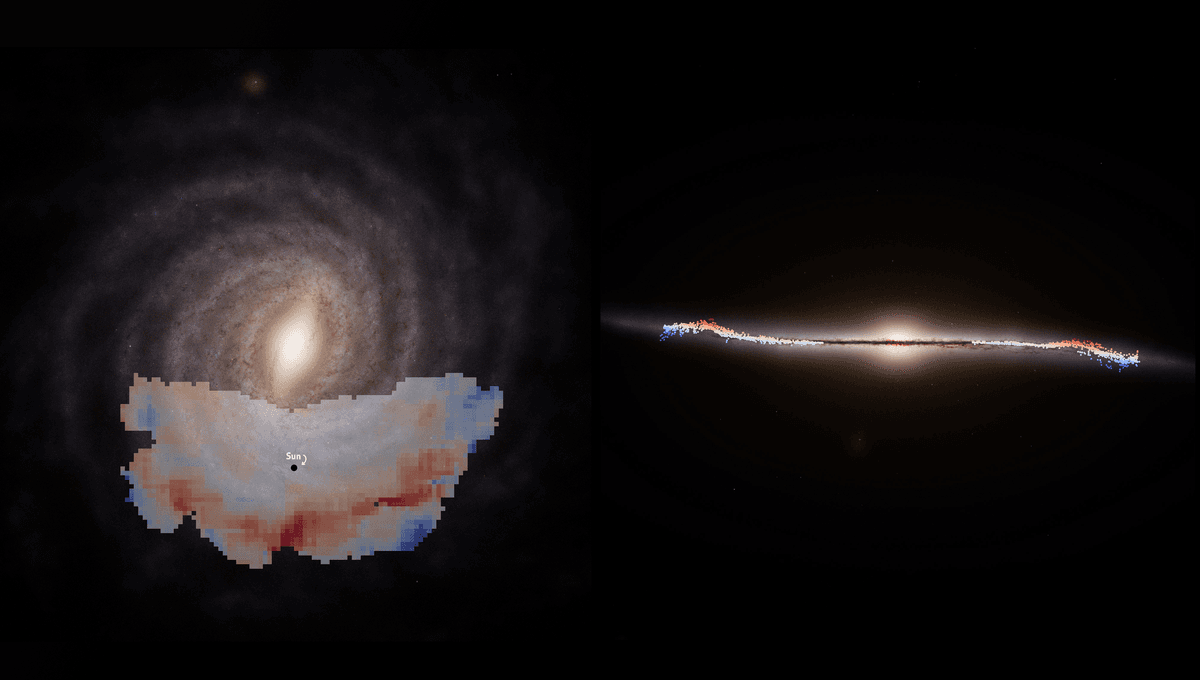
Astronomers have found more evidence that there is a massive ripple traveling through the Milky Way. They have found evidence that stars at the edge of the galactic disk are moving like people doing “the Wave” in a stadium. By tracking the motion of two types of stars, researchers have measured the property of this wave.
We cannot see the Milky Way from the outside. Everything we know comes from mapping the stars around us with such precision that we can tell several things about our galaxy: we live in a spiral galaxy; the core of our galaxy is shaped like a bar rather than a spherical distribution of stars; the spiral arms are located in a thin disk, but the disk is not exactly flat.
Since the 1950s, we have known that the disk is warped. Observations over the last several years with the European Space Agency’s Gaia observatory have expanded our understanding of this warp, which is most likely due to the interaction between the Milky Way and another galaxy. That is not all. Just like a sheet of corrugated metal showing bumps and valleys, the detailed observation shows small ripples in the disk. The Great Wave is among them.
“Our galaxy is warped and corrugated: this additional ripple that we see is a corrugation of the disk,” Dr Eloisa Poggio, from the Italian National Institute for Astrophysics (INAF), told IFLScience. “With Gaia, we had the opportunity to study these two features with unprecedented precision. We are also able to characterize these features in detail, like their exact location in the disk, their amplitude, all these kinds of things.”
The team measured the position and movement of about 17,000 young giant stars as well as 3,400 classical Cepheids, variable stars that can be used as standard candles – so we can work out their position with great precision. The stars appear to have been shifted vertically by up to 650 light-years. The thin disk is about 1,000 light-years, so this is a significant bump.
This wave might be a ripple vertically, but horizontally it extends for a wide distance, at least 30,000 light-years, but possibly up to 65,000 light-years. The Great Wave is not the first ripple spotted by Gaia; the Radcliffe Wave is much closer (500 light-years away) and smaller (9,000 light-years across). The two may or may not be related.
Understanding what caused the ripple might allow us to understand if these features are related or not. The team has not investigated that yet, but a likely hypothesis is an interaction between our galaxy and another one.
“We don’t know yet because this paper was just showing what we are looking at in the galaxy,” Dr Poggio explained to IFLScience. “One reasonable scenario is that a satellite galaxy generated these ripples and corrugations. Indeed, in n-body simulations, we can see similar features generated by satellite galaxies.”
As Dr Poggio stressed, more work is necessary to test that hypothesis, and the Milky Way is always ready to throw us curveballs and surprise us.
“The more we study our galaxy, the more we learn how complicated and fascinating it is. There’s so much more to study. I think this is very intriguing, very interesting, and inspiring too,” Dr Poggio told IFLScience.
Gaia ended its operations just a few months ago after producing the most accurate map of the Milky Way revealing the positions and motions of billions of stars. However, the best is yet to come, as more data from the observatory is being analyzed, which will lead to even more precision and insights.
“The upcoming fourth data release from Gaia will include even better positions and motions for Milky Way stars, including variable stars like Cepheids. This will help scientists to make even better maps, and thereby advance our understanding of these characteristic features in our home galaxy,” Johannes Sahlmann, ESA’s Gaia Project Scientist, said in a statement.
The study is published in Astronomy & Astrophysics.

Source Link: There Is A Great Wave Traveling Across The Milky Way, Shifting Stars By 100s Of Light-Years
