• Email Us: [email protected]
  • Contact Us: +1 718 874 1545
  • Skip to main content
  • Skip to primary sidebar

Medical Market Report

  • Home
  • All Reports
  • About Us
  • Contact Us

These Siberian Horses Rapidly Evolved To Thrive At −70°C

February 6, 2024 by Deborah Bloomfield

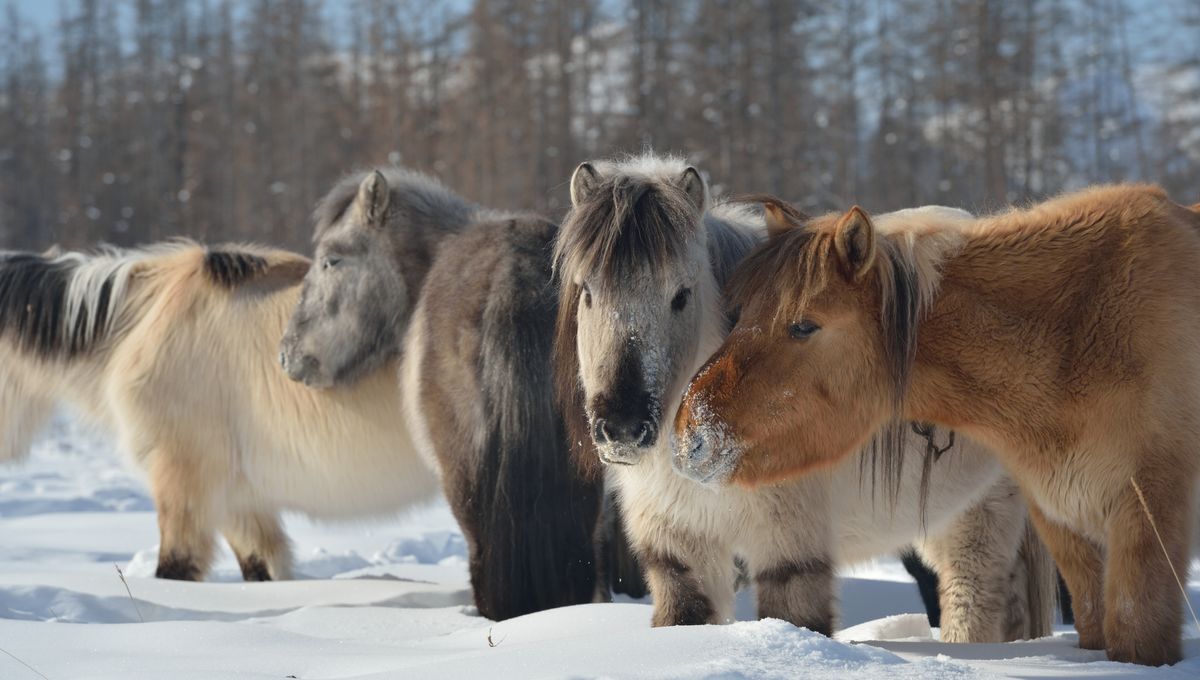
The Yakut region in Northern Siberia is one of the coldest places on Earth, and yet some hardy horses can survive, even thrive, there. With their thick winter coats, squat bodies, and stubby limbs, native Yakutian horses are adorably well adapted to their frosty climes – but they also have another handy trick up their sleeve.

To cope with the often sub-zero conditions – the Siberian Far East can reach lows of -70°C (-94°F) in the winter – they have evolved the ability to reduce their metabolic rate and lower their core body temperature, as some hibernating animals such as arctic ground squirrels are known to do. 

Advertisement

The difference is that hibernating animals are inactive during this period of torpor, whereas Yakutian horses continue going about their business, leading researchers to call it “standing hibernation”. No other horses are known to do this.

Equally as impressive is the speed at which the horses developed their metabolic, anatomical, and physiological adaptations: It “represent[s] one of the fastest cases of adaptation to the extreme temperatures of the Arctic,” write the authors of a 2015 study describing the horses’ rapid evolution. 

They analyzed the genomes of present-day Yakutian horses, plus specimens dating to the early 19th century and around 5,200 years ago, before comparing them with the genomes of Late Pleistocene and modern Przewalski’s horses. 

Their findings suggest that “contemporary Yakutian horses do not descend from the native horses that populated the region until the mid-Holocene.” Instead, they “were most likely introduced following the migration of the Yakut people a few centuries ago.” 

Advertisement

A group of Turkic-speaking horse-riders migrated to the region, alongside their horses, between the 13th and 15th centuries, which means these adaptations arose in just a few hundred years – a very short amount of time, evolutionarily speaking.

The researchers also found evidence of convergent evolution among Yakutian horses, native human populations, and woolly mammoths – which is when species occupying similar ecological niches adapt in similar ways in response to their environment. This, the researchers add, suggests “that only a few evolutionary strategies are compatible with survival in extremely cold environments”.

Basically, Yakutian horses have smashed it. According to a recent study on the genetic diversity of native horse breeds in Russia, they are the “most cold-resistant indigenous breed”. Thanks to their hair, stature, and squirrel-esque metabolism, they stay toasty as temperatures around them plummet.

The 2015 study is published in the journal PNAS.

Deborah Bloomfield
Deborah Bloomfield

Related posts:

  1. Paris ramps up security as jihadist attacks trial starts
  2. Cricket-‘Western bloc’ has let Pakistan down, board chief says
  3. Ancient Bison Found In Permafrost Is So Well Preserved Scientists Want To Clone It
  4. Where Inside Us Do We Feel Love?

Source Link: These Siberian Horses Rapidly Evolved To Thrive At −70°C

Filed Under: News

Primary Sidebar

  • US Just Killed NASA’s Mars Sample Return Mission – So What Happens Now?
  • Art Sleuths May Have Recovered Traces Of Da Vinci’s DNA From One Of His Drawings
  • Countries With The Most Narcissists Identified By 45,000-Person Study, And The Results Might Surprise You
  • World’s Oldest Poison Arrows Were Used By Hunters 60,000 Years Ago
  • The Real Reason You Shouldn’t Eat (Most) Raw Cookie Dough
  • Antarctic Scientists Have Just Moved The South Pole – Literally
  • “What We Have Is A Very Good Candidate”: Has The Ancestor Of Homo Sapiens Finally Been Found In Africa?
  • Europe’s Missing Ceratopsian Dinosaurs Have Been Found And They’re Quite Diverse
  • Why Don’t Snorers Wake Themselves Up?
  • Endangered “Northern Native Cat” Captured On Camera For The First Time In 80 Years At Australian Sanctuary
  • Watch 25 Years Of A Supernova Expanding Into Space Squeezed Into This 40-Second NASA Video
  • “Diet Stacking” Trend Could Be Seriously Bad For Your Health
  • Meet The Psychedelic Earth Tiger, A Funky Addition To “10 Species To Watch” In 2026
  • The Weird Mystery Of The “Einstein Desert” In The Hunt For Rogue Planets
  • NASA Astronaut Charles Duke Left A Touching Photograph And Message On The Moon In 1972
  • How Multilingual Are You? This New Language Calculator Lets You Find Out In A Minute
  • Europa’s Seabed Might Be Too Quiet For Life: “The Energy Just Doesn’t Seem To Be There”
  • Amoebae: The Microscopic Health Threat Lurking In Our Water Supplies. Are We Taking Them Seriously?
  • The Last Dogs In Antarctica Were Kicked Out In April 1994 By An International Treaty
  • Interstellar Comet 3I/ATLAS Snapped By NASA’s Europa Mission: “We’re Still Scratching Our Heads About Some Of The Things We’re Seeing”
  • Business
  • Health
  • News
  • Science
  • Technology
  • +1 718 874 1545
  • +91 78878 22626
  • [email protected]
Office Address
Prudour Pvt. Ltd. 420 Lexington Avenue Suite 300 New York City, NY 10170.

Powered by Prudour Network

Copyrights © 2026 · Medical Market Report. All Rights Reserved.

Go to mobile version