• Email Us: [email protected]
  • Contact Us: +1 718 874 1545
  • Skip to main content
  • Skip to primary sidebar

Medical Market Report

  • Home
  • All Reports
  • About Us
  • Contact Us

These Siberian Horses Rapidly Evolved To Thrive At −70°C

February 6, 2024 by Deborah Bloomfield

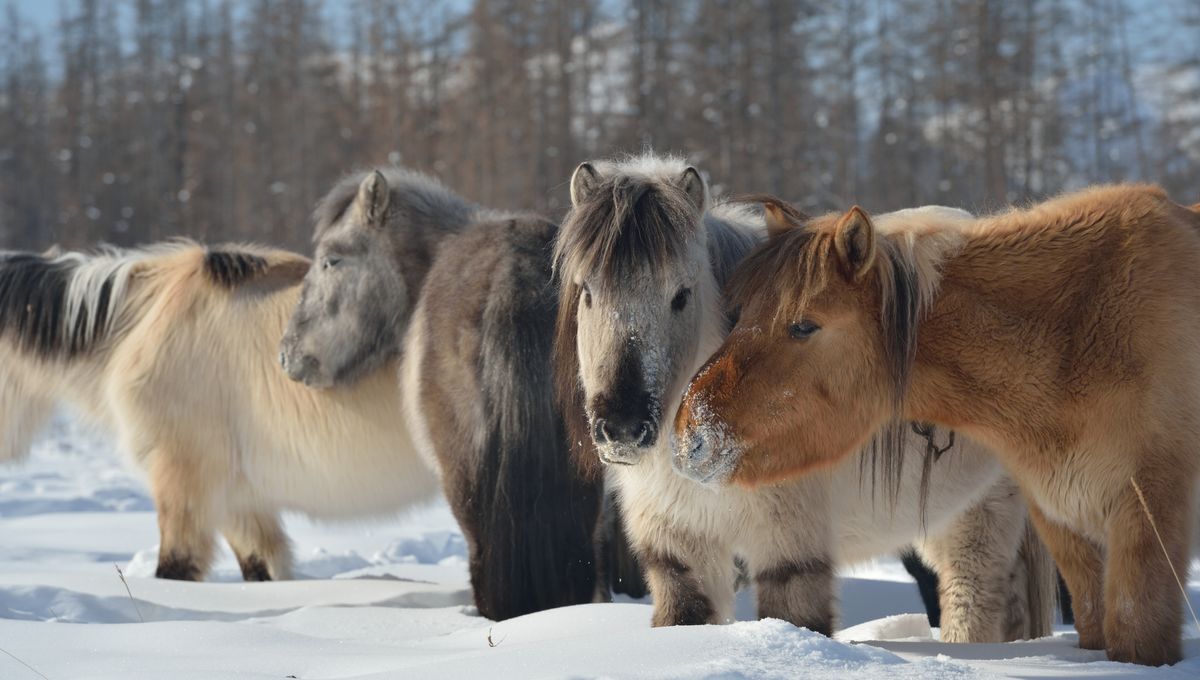
The Yakut region in Northern Siberia is one of the coldest places on Earth, and yet some hardy horses can survive, even thrive, there. With their thick winter coats, squat bodies, and stubby limbs, native Yakutian horses are adorably well adapted to their frosty climes – but they also have another handy trick up their sleeve.

To cope with the often sub-zero conditions – the Siberian Far East can reach lows of -70°C (-94°F) in the winter – they have evolved the ability to reduce their metabolic rate and lower their core body temperature, as some hibernating animals such as arctic ground squirrels are known to do. 

Advertisement

The difference is that hibernating animals are inactive during this period of torpor, whereas Yakutian horses continue going about their business, leading researchers to call it “standing hibernation”. No other horses are known to do this.

Equally as impressive is the speed at which the horses developed their metabolic, anatomical, and physiological adaptations: It “represent[s] one of the fastest cases of adaptation to the extreme temperatures of the Arctic,” write the authors of a 2015 study describing the horses’ rapid evolution. 

They analyzed the genomes of present-day Yakutian horses, plus specimens dating to the early 19th century and around 5,200 years ago, before comparing them with the genomes of Late Pleistocene and modern Przewalski’s horses. 

Their findings suggest that “contemporary Yakutian horses do not descend from the native horses that populated the region until the mid-Holocene.” Instead, they “were most likely introduced following the migration of the Yakut people a few centuries ago.” 

Advertisement

A group of Turkic-speaking horse-riders migrated to the region, alongside their horses, between the 13th and 15th centuries, which means these adaptations arose in just a few hundred years – a very short amount of time, evolutionarily speaking.

The researchers also found evidence of convergent evolution among Yakutian horses, native human populations, and woolly mammoths – which is when species occupying similar ecological niches adapt in similar ways in response to their environment. This, the researchers add, suggests “that only a few evolutionary strategies are compatible with survival in extremely cold environments”.

Basically, Yakutian horses have smashed it. According to a recent study on the genetic diversity of native horse breeds in Russia, they are the “most cold-resistant indigenous breed”. Thanks to their hair, stature, and squirrel-esque metabolism, they stay toasty as temperatures around them plummet.

The 2015 study is published in the journal PNAS.

Deborah Bloomfield
Deborah Bloomfield

Related posts:

  1. Paris ramps up security as jihadist attacks trial starts
  2. Cricket-‘Western bloc’ has let Pakistan down, board chief says
  3. Ancient Bison Found In Permafrost Is So Well Preserved Scientists Want To Clone It
  4. Where Inside Us Do We Feel Love?

Source Link: These Siberian Horses Rapidly Evolved To Thrive At −70°C

Filed Under: News

Primary Sidebar

  • The Man Who Fell From Space: These Are The Last Words Of Cosmonaut Vladimir Komarov
  • How Long Can A Bird Can Fly Without Landing?
  • Earliest Evidence Of Making Fire Has Been Discovered, X-Rays Of 3I/ATLAS Reveal Signature Unseen In Other Interstellar Objects, And Much More This Week
  • Could This Weirdly Moving Comet Have Been The Real “Star Of Bethlehem”?
  • How Monogamous Are Humans Vs. Other Mammals? Somewhere Between Beavers And Meerkats, Apparently
  • A 4,900-Year-Old Tree Called Prometheus Was Once The World’s Oldest. Then, A Scientist Cut It Down
  • Descartes Thought The Pineal Gland Was “The Seat Of The Soul” – And Some People Still Do
  • Want To Know What The Last 2 Minutes Before Being Swallowed By A Volcanic Eruption Look Like? Now You Can
  • The Three Norths Are Moving On: A Once-In-A-Lifetime Alignment Shifts This Weekend
  • Spectacular Photo Captures Two Rare Atmospheric Phenomena At The Same Time
  • How America’s Aerospace Defense Came To Track Santa Claus For 70 Years
  • 3200 Phaethon: Parent Body Of Geminids Meteor Shower Is One Of The Strangest Objects We Know Of
  • Does Sleeping On A Problem Actually Help? Yes – It’s Science-Approved
  • Scientists Find A “Unique Group” Of Polar Bears Evolving To Survive The Modern World
  • Politics May Have Just Killed Our Chances To See A Tom Cruise Movie Actually Shot In Space
  • Why Is The Head On Beer Often White, When Beer Itself Isn’t?
  • Fabric Painted With Dye Made From Bacteria Could Protect Astronauts From Radiation On Moon
  • There Used To Be 27 Letters In The English Alphabet, Until One Mysteriously Vanished
  • Why You Need To Stop Chucking That “Liquid Gold” Down Your Kitchen Sink
  • Youngest Mammoth Fossils Ever Found Turn Out To Be Whales… 400 Kilometers From The Coast
  • Business
  • Health
  • News
  • Science
  • Technology
  • +1 718 874 1545
  • +91 78878 22626
  • [email protected]
Office Address
Prudour Pvt. Ltd. 420 Lexington Avenue Suite 300 New York City, NY 10170.

Powered by Prudour Network

Copyrights © 2025 · Medical Market Report. All Rights Reserved.

Go to mobile version