While the mention of blood might conjure up images of a crimson red liquid, it turns out the animal world isn’t keen to stick to just the one color (or any color at all) when it comes to this particular body fluid. In fact, scuttling about the forests of New Guinea and the Solomon Islands is a group of skinks with blood so green, it could rival the Hulk’s.
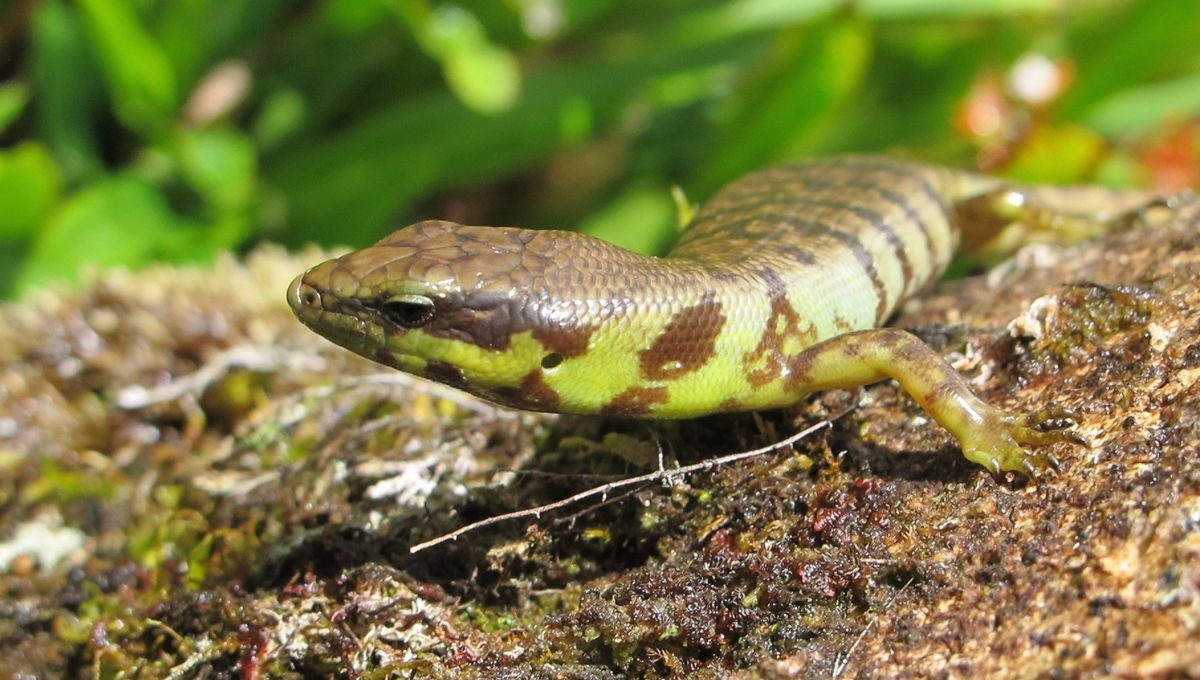
The skinks in question are the Prasinohaema, a genus of lizards that live up in the trees, snacking on insects. From the outside, they look much like you’d expect a skink to look – long and scaly, with little limbs. But inside, they’re the only amniotes that have green blood, and scientists still don’t really know why.
Well, they know what makes it that color, at least. Prasinohaema skinks have an abundance of a green pigment called biliverdin in their blood – the highest concentration measured in any organism, in fact. This ends up affecting the rest of their bodies too. “The bones are green, the muscles are green, the tissues are green, the tongue and mucosal lining is green,” reptile and amphibian biologist Christopher Austin told NPR.
When we ask why their blood is green, we’re doing so from an evolutionary standpoint. What benefit does green blood have for these lizards? It clearly has some, because, far from an evolutionary fluke, it appears to have evolved independently at least four times and has stuck around. But that doesn’t make sense as, by all accounts, these skinks really should be dead as a doornail.
Biliverdin is produced during the regularly scheduled breakdown of red blood cells, and it’s a waste product that, in humans, you don’t want to be having a lot of. The buildup of biliverdin can lead to a condition called jaundice; this causes a characteristic yellowing of the skin and can end up being fatal.
And yet, Prasinohaema skinks are running around happy as Larry with a plasma concentration of biliverdin 40 times greater than that of jaundiced humans. So, what gives?
The answer may lie in their genome, and earlier this year, scientists from Brigham Young University got one step closer to solving the mystery by assembling and annotating the first Prasinohaema genome from scratch.
They did so using a 20-year-old museum sample of what they first assumed to be Prasinohaema flavipes, the common green tree skink, but now suspect to be a possible new, closely-related species.
While more work needs to be done, they identified a gene that potentially encodes an extensively altered version of a protein called alpha-fetoprotein (AFP) that could provide an explanation as to how the skinks are able to survive their green blood. “It is plausible that AFP is capable of binding biliverdin,” the researchers write in the study describing their findings, “allowing the toxic bile pigment to remain in the bloodstream without cellular damage.”
Exactly how this arose remains unclear, they explain, but that “understanding the genomic background for [the high concentrations of biliverdin] will provide a strong foundation for answering these ecological and evolutionary questions and we believe that a high-quality reference genome is an excellent first step toward that goal.”

Source Link: These Strange Little Lizards Have Toxic Green Blood, And No One Knows Exactly Why
