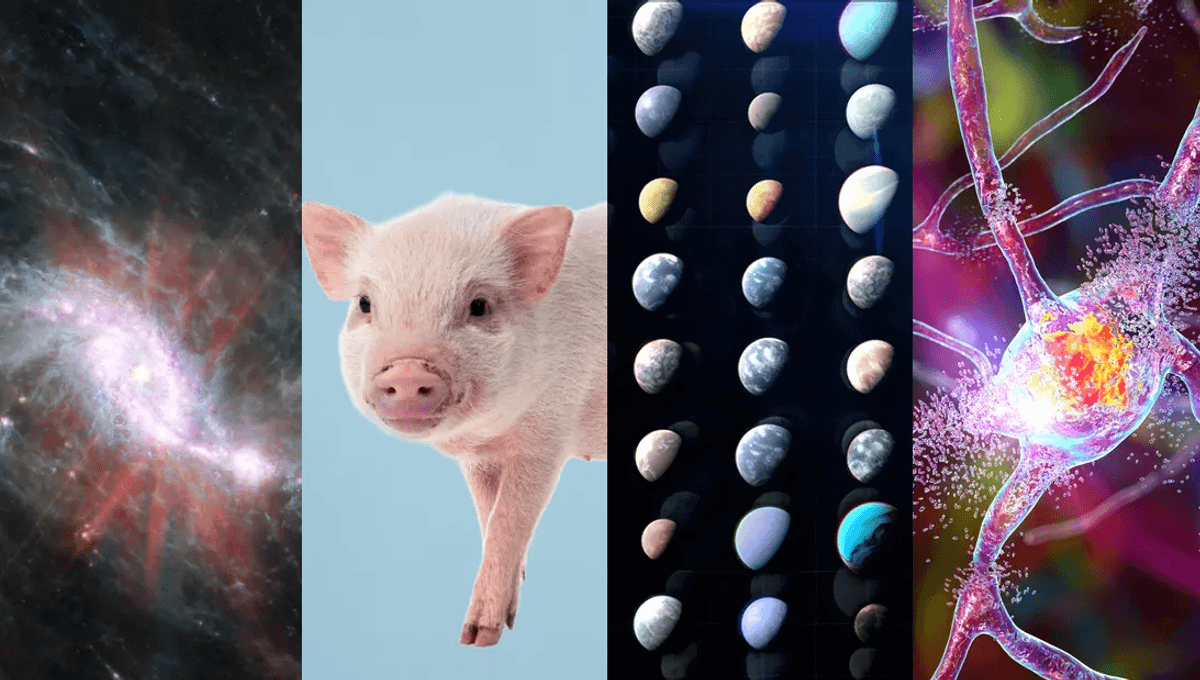
This year has seen significant progress across the fields of Space and Physics, as well as Health and Medicine. In this curated selection of some of the most important experiments of 2025, IFLScience’s Space & Physics Editor, Dr Alfredo Carpineti, and Health & Medicine Editor, Laura Simmons, put forward their picks for the most important advances in their respective fields.
Space and Physics
Dr Alfredo Carpineti: As the Space & Physics Editor of IFLScience, it is my great honor and pleasure to select what I believe to be the three most important studies of the year in physics and astronomy for 2025.
It is very difficult to pick just a handful for two reasons. We are lucky that there has been so much incredible science this year, and picking the most significant comes with a little prediction of what will continue to be relevant in the future, and predictions can be dangerous. Here are my top three.
Our Model Of The Universe In Crisis
The Standard Model of cosmology has been challenged for the last several years – the crisis is known as the Hubble Tension. Now, new independent pieces of evidence suggest that maybe dark energy might not be a constant in the universe; it might be getting weaker.
We Are Mastering Antimatter
We do not know why the universe is made of matter and not antimatter. Experiments around the world have been trying to get to the bottom of it. To help, CERN is testing ways to move antimatter without losing it, but the big show of how well we can manipulate antimatter: researchers created a quantum bit using an antiproton for the first time.
Exoplanets As We Have Never Seen Before
This year, we reached 6,000 confirmed exoplanets and there are maybe 10,000 more to confirm, with new ones detected regularly. Among the many great discoveries this year, one that was particularly impressive was the first 3D map of the weather of an exoplanet. The world is a hot Jupiter orbiting its star in just 30 hours. We do not have a world like this in the Solar System, but the new weather map is telling us a lot about this weird and wonderful class of planets.
Special guest star (comet)
And last but not least, I’m sneaking in a fourth because it was the year of interstellar comet 3I/ATLAS – stealing the headlines, the focus of multiple missions, and our hearts as it crossed the Solar System! Not an experiment we could have predicted but one we are now much more prepared for.
Health and Medicine
Laura Simmons: It’s been a busy year for me as your resident Health & Medicine Editor, but I can think of no better way to round it off than sifting through some of the incredible stories we’ve told. Selecting just three studies to highlight was no easy task, but here are my top picks for 2025.
5 Years Of COVID-19
We couldn’t let the anniversary of the start of the COVID-19 pandemic pass by without a mention. March 11 marked five years since the World Health Organization officially declared the disease a pandemic, the beginning of a period of time that would see lives changed in unfathomable ways and, sadly, a lot of loss. My first pick, therefore, is a study that sought to quantify the impact of COVID in direct and indirect ways, using data from 18 European countries.
World-First Gene Therapy For Huntington’s Disease
In more hopeful news, September saw an announcement that sent shockwaves through Huntington’s disease community. For the first time, an experimental treatment had shown success in slowing the symptoms, with patients seeing 75 percent less disease progression. Hailed as “a historic advance” and potentially a “major breakthrough”, the phase I/II results – though still preliminary – are reason for optimism that a true treatment for this disease might be on the horizon at last.
First Living Recipient Of A Donor Liver From A Pig
Xenotransplantation – the science of transplanting organs from non-human animals into humans – is a fascinating field that’s advancing rapidly, as this case report from October illustrates. It details the story of a man in China who became the first-ever living recipient of a donor liver from a pig. With a complex clinical situation leaving no chance of a human transplant, an experimental xenotransplant was the only option left on the table.
While the initial surgery was a success, complications down the line meant the organ had to be removed, and the patient sadly died within six months of the procedure – but it’s a step towards a future in which xenotransplants might be available more widely, helping to relieve the shortages of donor organs that see people missing out on lifesaving transplants every day.
And one more thing…
To round off this year with a personal highlight, I had the honor and pleasure of speaking with vaccinologist Dr Florian Krammer for an episode of IFLScience’s podcast The Big Questions, in which we delved deep into the scientific quest to develop a universal flu vaccine. Just how close are we to this breakthrough – and, more importantly, why did I come away from this episode with a newfound mistrust of ducks? You’ll have to listen to find out.

Source Link: These Were Some Of The Most Significant Scientific Experiments Of 2025
