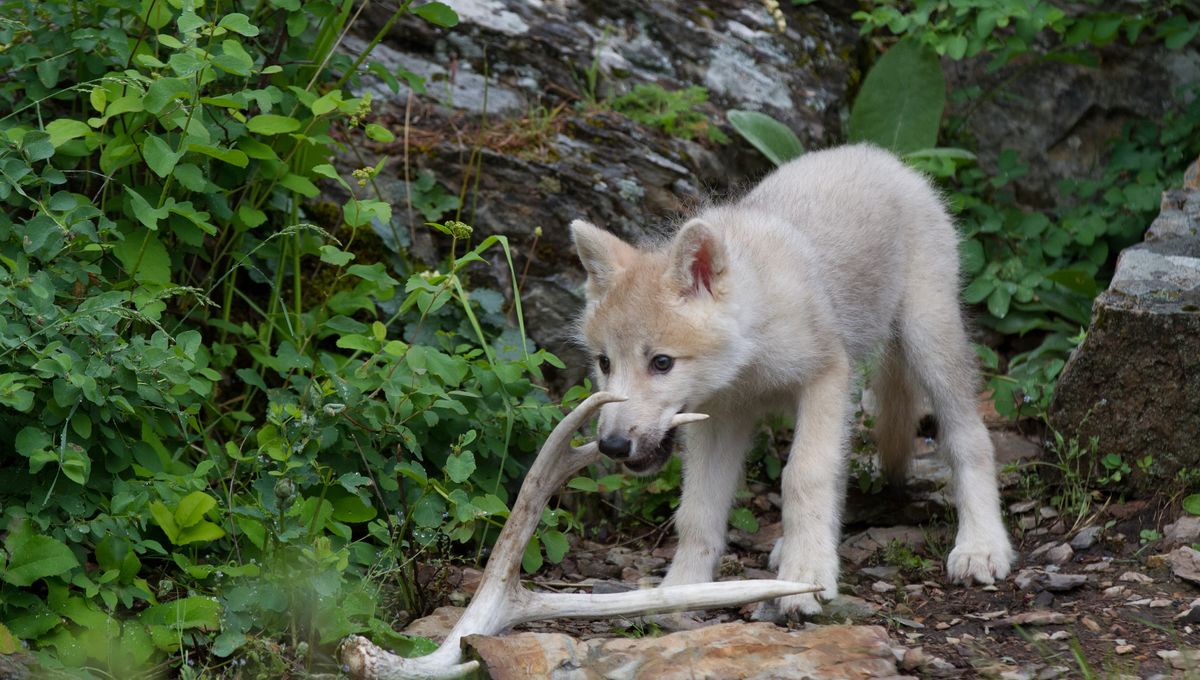
Nature, as majestic as it is, can be extremely cruel – especially to stepchildren. Lions that take over an existing pride make infanticide the first order of business; dolphins kill off unrelated calves specifically so they can mate with the mother; heck, even in humans, a new partner is more likely than the biological parent they’re replacing to kill or seriously injure a child.
But among all this rampant child-murder, there’s one species that stands out as particularly good parents – and it may not be who you’d expect. “Wolves accept foreign pups,” says Jeremy SunderRaj, a biological technician at the Yellowstone Wolf Project. “When a dominant male dies or is kicked out by an intruding male [the] new lead male will usually adopt young pups.”
“It definitely happens,” he tells IFLScience. “Although it’s rare.”
It takes a pack
Wolves have a certain reputation. We have, historically, used them as a benchmark for cruelty: they’re the ruthless killers of fairytale protagonists; the cunning hunters of ancient fables that steal children’s sheep. Even among their own kind, we’re taught that they live a cruel life, with “alphas” ruling the pack and betas, sometimes even omegas if the mythology extends that far, having to put up with it or else.
But all that? It’s totally fake. There’s not really any such thing as an “alpha wolf” – and, far from being heartless brutes, the animals are evidently vying for nature’s “parent of the year” award.
We know now that wolf “packs” are really more like family units – and what we used to call the “alpha” male and female are really just mom and dad. But while they’re the parents by blood, everyone pitches in to pup-rearing: “alloparental care” – that is, care for pups that comes from adults other than the parents – “is really important for the survival of a pack,” explains Giselle Narváez Rivera, wolf curator at the International Wolf Center in Ely, Minnesota.
Pack size is one of the most important factors in the social dynamics of wolves.
Jeremy SunderRaj
This extended family structure is why we see non-breeding adult wolves bringing meat to the pups once weaned – in fact, they literally regurgitate it out of their stomachs to feed them, which none of our aunts and uncles ever did for us. Before that, they bring the food to the mother wolf, to sustain her while she cares for the newborns; later, helper wolves will even babysit the pack’s pups, playing with them and teaching them to hunt.
Of course, maybe it’s not so surprising that a pup’s second-degree relatives also have an interest in seeing the children survive. After all, “pack size is one of the most important factors in the social dynamics of wolves,” SunderRaj points out. “Larger packs typically win territorial battles (which are the leading cause of death for wolves in Yellowstone National Park), are more successful hunting bison, and have resistance against sarcoptic mange, amongst other things.”
But what’s really surprising is just how far this caring instinct extends – not just to their siblings’ offspring, but to pups they’ve never met before at all.
The logic of adoption
Wolf societies are complex – “way more complicated than most people believe,” per SunderRaj. Nevertheless, there’s one constant that seems to cut through the hierarchies: you care for pups.
It’s such a strong instinct that, sometimes, it can override pack loyalty itself. Packs will, “in very specific circumstances,” SunderRaj says, adopt in pups from rival families, accepting them for all intents and purposes as their own offspring.
“They usually aren’t second tier,” SunderRaj confirms. “All pups, adopted and not, are the same.”
For those more familiar with the cut-throat family politics of, say, lions, it might sound unbelievable. But it works, and the reason why “is actually pretty interesting,” SunderRaj tells IFLScience. “The big difference between wolves and lions is that lionesses will come into heat as soon as their cubs are killed. Therefore, it’s in the intruding male’s best interest to kill the cubs so he can breed and produce his own offspring.”
But “wolves are different,” he explains. “They only breed once a year, typically in mid to late February in Yellowstone.”
Killing off your rival’s pups, therefore, is a losing game. Keep them alive, on the other hand, and you do two things: first, you increase your pack’s size and strength; second – and remember, this is a situation where only one pair has the right to breed and most everyone around is related to each other in some way – you help keep the gene pool fresh.
“Wolves avoid breeding with close relatives,” SunderRaj tells IFLScience, “and an intruding male can usually breed with the female pups eventually.”
“Physiology plays a role”
Helping pups flourish, even when they’re not yours, makes obvious logical sense. But it’s more than just a tactical decision for the adoptive pack: put simply, the wolves just can’t help but look out for the new little ones. “Physiology plays a role,” Narváez Rivera tells IFLScience. “Wolves secrete a hormone called prolactin that is very helpful for triggering those nurturing behaviors towards pups.”
“The hormone is at its peak right around pup-rearing season in early spring through summer when they are busiest caring for pups,” she explains – and “all pack members will experience this surge in prolactin.”
Put together, it’s more than just an adorable quirk. In the wild, the phenomenon most often occurs when a new breeding male takes over a rival pack – but under the guidance of conservationists, the instinct can be exploited to help struggling species recover and thrive.
In our experience, adults are very nurturing and accepting of those pups as part of their pack.
Giselle Narváez Rivera
Called “cross-fostering”, it involves taking pups from a litter bred in captivity and popping them into the litter of a wild pack. It has to happen early – like, before the pups are ten days old – and requires a lot of planning and some slightly smelly preparations to ensure the newcomers are welcomed in. But in Narváez Rivera’s experience, it’s usually a success: “It is a long process,” she admits, “but we take advantage of prolactin secretion and in our experience, adults are very nurturing and accepting of those pups as part of their pack.”
The result is a boon for both the wolves individually, and the species as a whole. The pups are brought up learning wild habits, protected by a successful pack and living in a natural environment; in return, the pack receives increased genetic diversity and, frankly, improved raw numbers for species that are often struggling.
“When you put that pup in the den and walk away, you know you’ve done something serious for the conservation of the Mexican wolf,” said Jim Devos, Mexican wolf coordinator for the Arizona Game and Fish Department, back in 2023.
Taken to an extreme, wolves don’t even have to be faced with their own species for their nurturing instinct to take over. At least, that’s the lesson from history: the cases are extremely isolated, yes, but there’s more than one story of human children being raised by wolves.
It’s vanishingly rare, however. Even among other canids, “I have not heard of other species being adopted by wolves in Yellowstone,” SunderRaj tells IFLScience. Evidently, there is a limit to how welcoming the animals will be.
Nevertheless, whether it’s the mythological founding of the Roman empire or the very real recovery of their own species, it’s clear that for wolves, strength lies in softness.
“Wolves […] have strong parental instincts,” SunderRaj tells IFLScience. “It works.”

Source Link: "They Usually Aren't Second Tier": When Wolves Adopt Pups From Rival Packs
