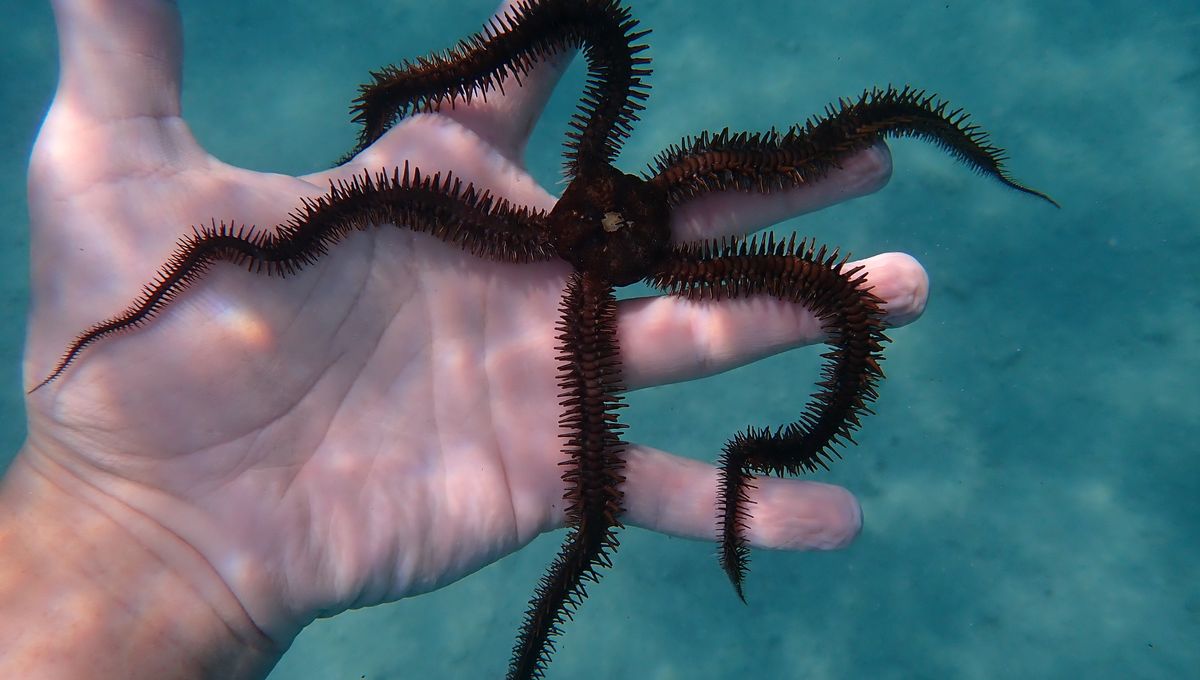
Some animals have big brains – humans, for one. Some have large heads. Some, we recently learned, are almost entirely heads. But what if we told you that one animal is able to learn without either a head or a brain? Meet the brittle star, a five-armed bundle of nerves that has shown itself to be a surprisingly quick study.
Classical conditioning is a type of learning whereby an animal forms associations between different stimuli. The discoverer of this phenomenon was a Russian-Soviet scientist called Ivan Pavlov, who conducted numerous experiments on dogs. By ringing a bell immediately prior to feeding the dogs, Pavlov caused them to start associating the sound of the bell with the imminent arrival of food. After a few repeats of this, the dogs would start salivating as soon as they heard the bell, whether or not food was later provided.
If you think humans would be above such things, think again. Some ethically questionable experiments in the early 20th century showed that humans can absolutely be classically conditioned. The buzz or ping of someone’s smartphone can be enough to have you unconsciously reaching for your own phone, because you’ve learned to associate that sound with a new message.
So that’s dogs and humans ticked off, but what about other organisms? The team behind this latest research were interested to find out whether echinoderms, the group including starfish, sea urchins, and sea cucumbers, could learn via this process. A few studies did exist in starfish, but for the rest of this animal family, these were uncharted waters.
Sixteen black brittle stars (Ophiocoma echinata) were placed in individual tanks with cameras to record their behavior over 10 months. Half of them went through a training phase, during which the lights would be dimmed for 30 minutes each time they were fed their favorite treat: shrimp. The other half got the same amount of shrimp and also had their lights switched off for the same length of time, but crucially, these two events were not happening simultaneously.
Brittle stars do not love the limelight at the best of times. These guys mostly spent their days hiding behind the filters in their tanks, but soon a difference began to emerge between the trained and untrained groups. The trained brittle stars began to creep out from their hiding places as soon as the lights were dimmed, anticipating the prompt arrival of some tasty shrimp.
In other words, they had learned to associate darkness with food.
Most excitingly for the researchers, the animals retained their newly learned behavior even after a 13-day break from training, when the lights were dimmed repeatedly without food being provided.
“Knowing that brittle stars can learn means they’re not just robotic scavengers like little Roombas cleaning up the ocean floor,” said lead author Julia Notar in a statement. “They’re potentially able to expect and avoid predators or anticipate food because they’re learning about their environment.”
But with no head or brain, it begs the question of how they’re able to achieve such a feat.
“People ask me all the time, ‘how do they do it?’” Notar said. “We don’t know yet. But I hope to have more answers in a few years.”
What we do know is that, without a central processing hub, the brittle star’s nervous system works very differently to our own. Nerve cords run along each of its arms, joining together in a ring near its mouth, but there’s no one focal point calling the shots.
“Each of the nerve cords can act independently,” Notar explained. “It’s like instead of a boss, there’s a committee.”
The study is published in the journal Behavioral Ecology and Sociobiology.

Source Link: This Animal Has No Head Or Brain But Can Still Learn
