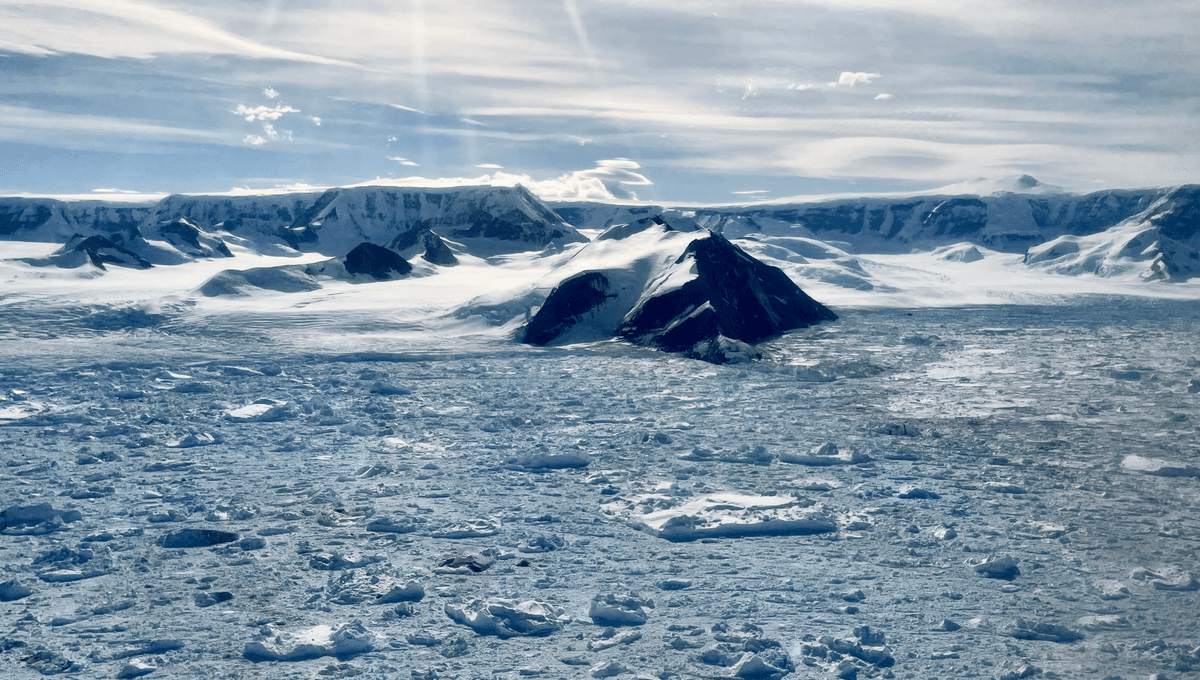
The Hektoria Glacier is disappearing at a rate that barely seems possible, losing almost half its area nearly 10 times as fast as any glacier ever observed. Although the Hektoria is small, with little direct impact on global sea levels, the processes that made this possible could happen on larger glaciers, making this a warning sign of much worse to come.
The climate scientist and vlogger Simon Clark has called October 2025 “The worst month of climate news in my entire career”. Regrettably, November is not starting any better, although the events now being revealed happened three years ago. At that time, the Hektoria Glacier retreated by at least 8.2 kilometers (5 miles) over November-December 2023. That averages 134 meters (440 feet) a day, but at the peak, it seems it was shrinking 800 meters (2,625 feet) a day. Glaciers simply aren’t meant to move that fast, but Hektoria had also shrunk almost as quickly earlier in the year.
The Hektoria Glacier is on the Antarctic Peninsula, and holds a tiny fraction of the ice of those on West Antarctica, which in turn are dwarfed by the giants of East Antarctica. However, the Peninsula has experienced some of the most steeply rising temperatures in the world for decades, so its glaciers serve as a canary in the global coalmine. There are no scientists present on a full-time basis, so Dr Naomi Ochwat of the University of Colorado, Boulder, and colleagues turned to satellite and airborne images.
From February 2022 to August 2023, they found a shocking retreat of around 25 km (15 miles) in the first 14 months, a third of that happening in just two. Although global heating almost certainly lies at the root of this event, the mechanisms through which it can cause such a rapid change need to be understood.
Like many polar glaciers, the Hektoria is a tidewater glacier. It starts on rock, and continues to rest there when it first reaches the ocean, before starting to float where the water becomes too deep or it thins sufficiently.
In this case, the authors think that the glacier retreated onto a flat area of rock known as an ice plain close to the point where it once started to float. As the ice plain section of the glacier thinned, it reached a point where it was no longer grounded, instead floating much closer to shore than previously. That allowed water to access crevasses in the glacier’s underside, which hastened warming, causing large chunks of ice to break off to become icebergs, a rapid feedback loop that operated much faster than previously seen or expected.
The authors think the calving caused local earthquakes recorded around this time.
The whole process was set off by the loss of older “fast ice”, which had served to protect the Hektoria and its neighbors. Shockingly, although it was summer in the southern hemisphere with near 24-hour sunlight, it wasn’t unusually warm in December 2022 when the retreat was fastest.
Although there is no modern counterpart for such a swift retreat, other researchers have found evidence for Norwegian glaciers retreating almost as fast at the end of the last Ice Age, 15,000 to 19,000 years ago.
The problem here is that larger glaciers than Hektoria also rest for part of their way on ice plains, and could undergo the same process. Hektoria covers just 295 square km (115 square miles), or the size of a major city, but there are Antarctic glaciers several hundred times as big. These include the infamous Thwaites “doomsday” Glacier, which also rests on an ice plain for part of its length.
“When we flew over Hektoria in early 2024, I couldn’t believe the vastness of the area that had collapsed,” Ochwat said in a statement. “I had seen the fjord and notable mountain features in the satellite images, but being there in person filled me with astonishment at what had happened.”
“Hektoria’s retreat is a bit of a shock — this kind of lighting-fast retreat really changes what’s possible for other, larger glaciers on the continent,” said co-author Dr Ted Scambos. “If the same conditions set up in some of the other areas, it could greatly speed up sea level rise from the continent.”
The study is published in Nature Geoscience.

Source Link: This Antarctic Glacier Just Broke An Unwanted Record – Fastest Retreat In Modern History
