• Email Us: [email protected]
  • Contact Us: +1 718 874 1545
  • Skip to main content
  • Skip to primary sidebar

Medical Market Report

  • Home
  • All Reports
  • About Us
  • Contact Us

This Giant Icy Planet Is Like Nothing Ever Found Before

April 29, 2025 by Deborah Bloomfield

The Kepler-10 planetary system is clearly a place of extremes. It has a small, Earth-sized world that is half scorched, the first rocky world ever discovered by the Kepler mission. That’s Kepler-10 b. Another world was also discovered in the system, Kepler-10c, but it has been more complicated to get its properties clarified. Now, new data show that this is a world like nothing seen before.

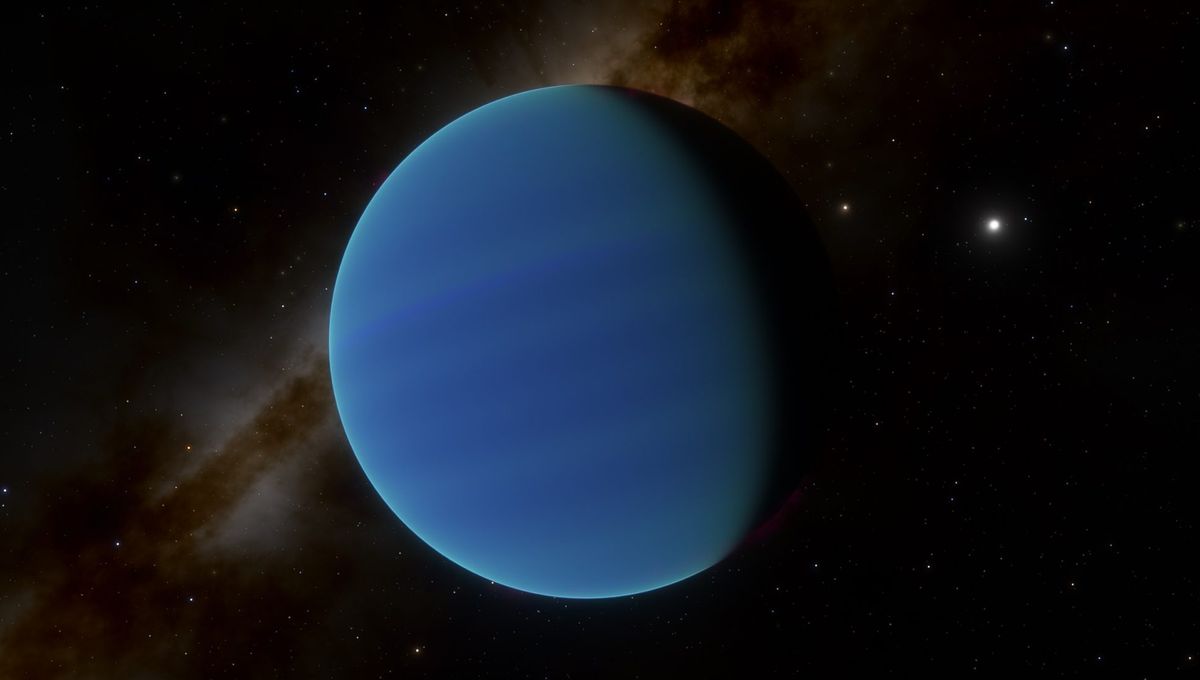
Using cutting-edge instruments on the Telescopio Nazionale Galileo in the Canary Islands, researchers were able to constrain the properties of this exoplanet. They know that it is a sub-Neptune planet with a radius 2.35 times that of our planet, and so a volume 13 times that of Earth. It also has a mass 11 times our planet’s, suggesting a lower density than a rocky world.

Based on density considerations, the team estimates that the planet is a water world, a class of hypothetical planets covered in a deep ocean with an atmosphere rich in water vapor (such as the controversial K2-18b). Kepler-10 c might be even more particular. It is not just a water world; it might be an icy water world, with differentiated layers.

Its companion is also bigger than Earth, with a radius 1.47 times that of our planet and a mass of roughly three times more – about what you’d expect for a rocky planet. It orbits much closer to its star, going around in less than a day, while 10 c goes around in 45 days.

The planets were discovered because the two worlds pass in front of their star, creating a small eclipse. However, these new estimates come from studying how the two planets tug at their star. These wobbles that the planets produce have allowed researchers to make more stringent estimates of their properties and also find something else: these two planets are not alone.

The team believes there is a third planet in the system, Kepler-10 d, orbiting further out, going around the star every 151 days. The minimum mass of this world is around 12 times Earth, so not much different from Kepler-10 c.

Researchers believe that at least Kepler-10 c formed much further away from its star, where water ice would accumulate into a planet and be blown away by the starlight and stellar wind. The planet – and maybe the other one too – over time moved inwards, keeping its rich water composition from its formation.

Migration of planets is a fascinating and important subject if we want to understand how planets and planetary systems come to be. The same is applicable to the Solar System, even though we do not have these kinds of planets here (although they are very common elsewhere).

The study is published in Astronomy & Astrophysics.

Deborah Bloomfield
Deborah Bloomfield

Related posts:

  1. Bolivian president calls for global debt relief for poor countries
  2. Five Seasons Ventures pulls in €180M fund to tackle human health and climate via FoodTech
  3. Humanity’s Journey To A Metal-Rich Asteroid Launches Today. Here’s How To Watch
  4. Unexplained And Deadly Heat Wave Hotspots Are Showing Up Across The Planet

Source Link: This Giant Icy Planet Is Like Nothing Ever Found Before

Filed Under: News

Primary Sidebar

  • The Man Who Fell From Space: These Are The Last Words Of Cosmonaut Vladimir Komarov
  • How Long Can A Bird Can Fly Without Landing?
  • Earliest Evidence Of Making Fire Has Been Discovered, X-Rays Of 3I/ATLAS Reveal Signature Unseen In Other Interstellar Objects, And Much More This Week
  • Could This Weirdly Moving Comet Have Been The Real “Star Of Bethlehem”?
  • How Monogamous Are Humans Vs. Other Mammals? Somewhere Between Beavers And Meerkats, Apparently
  • A 4,900-Year-Old Tree Called Prometheus Was Once The World’s Oldest. Then, A Scientist Cut It Down
  • Descartes Thought The Pineal Gland Was “The Seat Of The Soul” – And Some People Still Do
  • Want To Know What The Last 2 Minutes Before Being Swallowed By A Volcanic Eruption Look Like? Now You Can
  • The Three Norths Are Moving On: A Once-In-A-Lifetime Alignment Shifts This Weekend
  • Spectacular Photo Captures Two Rare Atmospheric Phenomena At The Same Time
  • How America’s Aerospace Defense Came To Track Santa Claus For 70 Years
  • 3200 Phaethon: Parent Body Of Geminids Meteor Shower Is One Of The Strangest Objects We Know Of
  • Does Sleeping On A Problem Actually Help? Yes – It’s Science-Approved
  • Scientists Find A “Unique Group” Of Polar Bears Evolving To Survive The Modern World
  • Politics May Have Just Killed Our Chances To See A Tom Cruise Movie Actually Shot In Space
  • Why Is The Head On Beer Often White, When Beer Itself Isn’t?
  • Fabric Painted With Dye Made From Bacteria Could Protect Astronauts From Radiation On Moon
  • There Used To Be 27 Letters In The English Alphabet, Until One Mysteriously Vanished
  • Why You Need To Stop Chucking That “Liquid Gold” Down Your Kitchen Sink
  • Youngest Mammoth Fossils Ever Found Turn Out To Be Whales… 400 Kilometers From The Coast
  • Business
  • Health
  • News
  • Science
  • Technology
  • +1 718 874 1545
  • +91 78878 22626
  • [email protected]
Office Address
Prudour Pvt. Ltd. 420 Lexington Avenue Suite 300 New York City, NY 10170.

Powered by Prudour Network

Copyrights © 2025 · Medical Market Report. All Rights Reserved.

Go to mobile version