For most of human history, we relied on the stars to navigate. Knowing the time and day and looking towards the polar regions where some stars appeared fixed provided us with cardinal directions. Today, we navigate using satellite information, which is used not only on maps and in traffic apps, but in countless other applications from photos to banking. We still rely on celestial navigation – but the stars are not good enough. We need supermassive black holes.
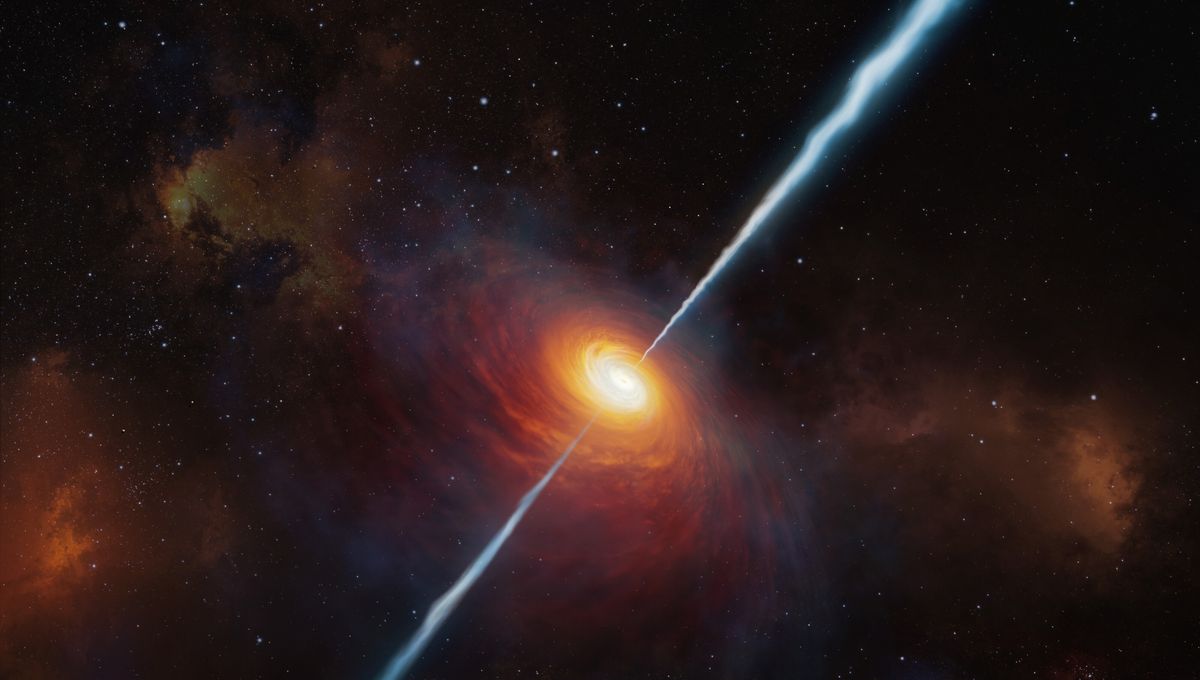
Astronomers believe that there is a supermassive black hole at the center of every galaxy. Most of the time, these black holes are quiet, but if they start actively feeding, such as in the case of a large amount of gas falling onto them, they can become extremely bright as the gas experiences incredible forces. In some cases, they will enter a quasar phase – and that is useful.
On Earth, we have the Greenwich meridian, which is where longitude starts. In space, we use quasars […] and that’s how we fix our coordinates.
Dr Christopher S. Jacobs
Quasars are extremely bright and are roughly point-source. They are also so far away that any intrinsic motion they possess doesn’t affect measurements. They appear fixed in the sky. They also emit across a variety of wavelengths so they can be tracked with radio waves, visible light, and more. The position of these quasars is used in the Celestial Reference Frame.
“What is the importance of the celestial reference frame? That’s how we know where we are in space. On Earth, we have the Greenwich meridian, which is where longitude starts. In space, we use quasars, these galaxies that send off a beam of radio static, and that’s how we fix our coordinates,” Dr Christopher S. Jacobs, from NASA’s Jet Propulsion Laboratory, told IFLScience.
The Celestial Reference Frame is important for the Global Positioning System (GPS) because the Earth is not a perfect sphere rotating in perfect periodical motion on its axis and around the Sun. To counterbalance the small deviations from the Earth’s imperfections, the GPS is calibrated against the Celestial Reference Frame. This is ideally done on a day-to-day basis.
It is estimated that it would take weeks for the accuracy to drop to a level noticeable in your daily life, and it might still be ok if you are just trying to find your way around a new city. But if you need higher precision, like for vessels or spacecraft, that might be a massive problem.
“The whole GPS system can drift around long term unless it has a fixed point to stabilize by. So when you navigate with GPS, with your phone it really ties back to the quasars. Banks use it for timing, if they’re going to send a large amount of money, they want to know where it is at a given time. If you’re out in the ocean, you’re navigating, you need to know where you are,” Dr Jacobs told IFLScience.
“My work is with interplanetary probes going to Mars and other planets. And once you get beyond Earth, there’s no GPS anymore. That’s also where the quasars and the celestial frame come into play.”
Jacobs led astrometry sessions at the 32nd International Astronomical Union General Assembly in Cape Town. Among the work presented is research led by Professor Patrick Charlot to make the celestial reference frame better.
“We can improve [the celestial reference frame] in several ways. Improving it means measuring the position of the sources more precisely. Improving also means having more sources, and better spread on the sky. We need also better coverage comparison with, for example, the optical frame built by Gaia,” Professor Charlot told IFLScience.
Some of the challenges are technical. The Southern Hemisphere is not as equally covered in the frame as the Northern, for example, or how there are a lot more sources in the optical wavelengths so to have radio counterparts, deeper radio observations are needed. The GaiaNIR mission, a proposed follow-up to the Gaia observatory, would reveal quasars in the plane of the Milky Way currently obscured by the dust of our galaxy.
There are also scientific considerations. Assumptions about the motion of the Solar System around the Milky Way and the Milky Way itself can become factors that affect the high precision this reference frame aims to achieve.
Also, quasars are assumed as point sources but they are not really. The better our telescopes get, the more extended these sources appear. So it is important to work out where the radio emission is coming from and that is among the uncertainties of the physics of supermassive black holes.
If helping us to find our way in our modern world and studying the complexity of the cosmos is not enough, the celestial reference frame also helps study the inner workings of our planets. The motion of tectonic plates and the other causes of our planet’s irregular motions are brought to light, thanks to a light cast by supermassive black holes shining 25 trillion times as bright as the Sun from billions of light-years away.

Source Link: This Is How You Are Using Supermassive Black Holes Every Day Without Even Knowing
