• Email Us: [email protected]
  • Contact Us: +1 718 874 1545
  • Skip to main content
  • Skip to primary sidebar

Medical Market Report

  • Home
  • All Reports
  • About Us
  • Contact Us

This Is What Yesterday’s Partial Solar Eclipse Looked Like From Space

October 26, 2022 by Deborah Bloomfield

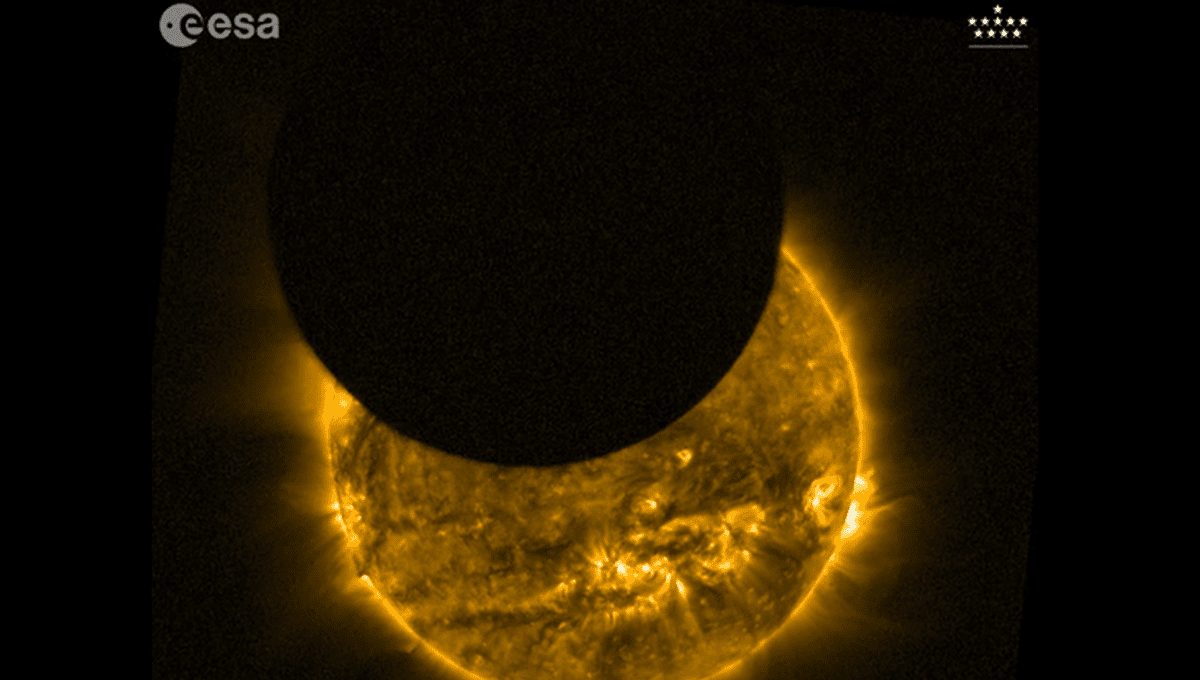
Many across Europe, North Africa, the Middle East, and West Asia saw a partial solar eclipse yesterday. The Moon covered a fair bit of the Sun as it orbited the Earth. The European Space Agency’s Proba-2 also saw the eclipse happening and, due to its orbit, saw it not once, but twice.

The mission looks at the sun in extreme ultraviolet light, allowing for visualization of the corona and the filaments that stretch out from the solar surface. This work provides precious information so that scientists can keep an eye on the Sun’s behavior and its influence on the space weather around Earth.

Advertisement


The first observation of the eclipse started around 10:30 UTC but, unfortunately, as the spacecraft started to see the Moon approaching, its SWAP instrument turned off. This is standard procedure when the spacecraft goes through the Earth’s atmosphere. The second time around was better, showing the full motion of the Moon across the Sun.

Maximum obscuration took place near the North Pole, where 82 percent of the Sun was blocked. Europe experienced at most 40 percent obscuration.

Deborah Bloomfield
Deborah Bloomfield

Related posts:

  1. Soccer – Poland level late to end England’s winning streak
  2. Mexico’s Kavak drives away with $700M in new funding, doubling its valuation to $8.7B
  3. Czech president Zeman to be released from hospital on Wednesday
  4. Soccer-Argentina to probe attendance numbers after Buenos Aires derby

Source Link: This Is What Yesterday’s Partial Solar Eclipse Looked Like From Space

Filed Under: News

Primary Sidebar

  • Did NASA’s Viking Mission Find Evidence Of Extant Life On Mars? It’s Not As Out There As It Sounds
  • World’s Oldest RNA Recovered From Baby Mammoth Beautifully Preserved In Permafrost For 40,000 Years
  • No Mining, No Machines – How The Future Of Technology Depends On Greener Mines
  • “It Was A Huge Surprise”: Dinosaur Eggs Were Speckled And Colorful, Just Like Birds’ Eggs
  • Meet The Peacock Spiders: Secretive, Small But Oh So Special
  • “Sudden Unexplained Death” In US Turns Out To Be World’s First Confirmed Death From Tick-Spread “Meat Allergy”
  • What’s The Longest Border In The World? It’s A Lot Weirder Than It Looks On A Map
  • “The Fall Of Icarus”: You Have Never Seen An Astrophotography Picture Like This!
  • Blue Origin Sends NASA Mission To Mars, Followed By First-Ever Successful Landing Of New Glenn’s Booster
  • This 4,300-Year-Old Silver Goblet May Contain Earliest Known Depiction Of Cosmic Genesis
  • Filter-Feeding Pterosaur Becomes The First Extinct Species Discovered In Fossil Vomit
  • We Jinxed It – Golden Comet C/2055 K1 (ATLAS) Has Now Broken Into Pieces
  • This Plant Hoards Rare Earth Elements That The World Desperately Needs
  • Lupus Linked To Virus That Over 95 Percent Of Us Carry – And Now We Finally Know How
  • This Whale’s Meal Plan? Over 70,000 Squid A Year, And It’ll Dive Incredible Depths To Get Them
  • There Are 23 Countries in North America: Do You Know Them All?
  • “Non-Gravitational Acceleration” Of Interstellar Object 3I/ATLAS Explained In New Study
  • Antiperspirant Before Bed, Or In The Morning? There Is A Right Answer
  • When Did Dogs Become Dogs? Familiar Forms Started To Arise Over 10,000 Years Ago
  • At 900 Meters Across, Earth’s Largest Modern Impact Crater Has Just Been Found By Scientists
  • Business
  • Health
  • News
  • Science
  • Technology
  • +1 718 874 1545
  • +91 78878 22626
  • [email protected]
Office Address
Prudour Pvt. Ltd. 420 Lexington Avenue Suite 300 New York City, NY 10170.

Powered by Prudour Network

Copyrights © 2025 · Medical Market Report. All Rights Reserved.

Go to mobile version