


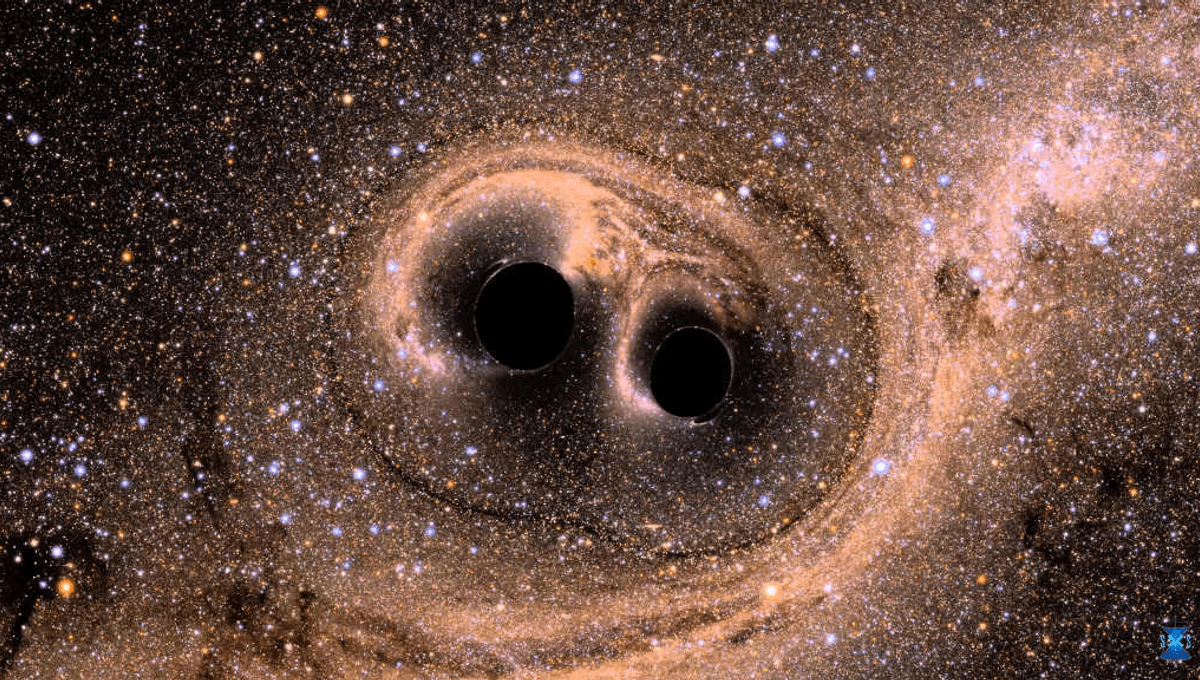
In just a decade, gravitational wave observatories have changed astronomy. In this short time, we have accumulated hundreds of detections, with many more coming. A wide variety of events have been discovered even among the sub-populations of these cosmic collisions. One record-breaking event has recently been reported, and a new yet-to-be-peer-reviewed paper argues that it might have experienced something unlike any other gravitational wave event. It was magnified.
The rest of this article is behind a paywall. Please sign in or subscribe to access the full content.
Let’s start with the detection. GW231123 was reported earlier this year as an event that defies our expectations. Based on the data, it was produced by the collision of a black hole, 103 times the mass of the Sun, with another black hole of 137 solar masses, to create a giant of 225 solar masses. The problem is that stars do not produce black holes this big, or at least not anymore.
It could be possible that these are the product of a series of black hole collisions, which raises a question about the environment of these events. The new work argues that our view might have been enhanced somewhat.
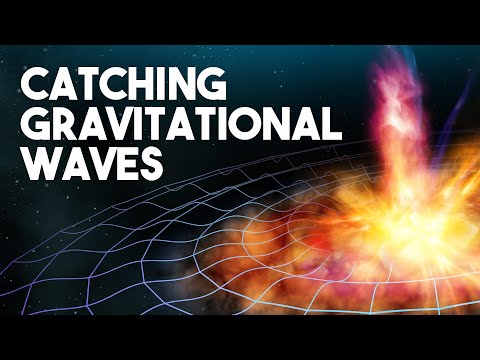
Gravity warps space-time. It does so in such a way that a massive body can act like a lens. If this body is in front of some background object, the light of this background object is magnified and warped by the space-time. This is a gravitational lens.
The new paper puts forward the idea that this gravitational wave event was gravitationally lensed by something between it and us. Just like the light of distant galaxies can be magnified by intervening galaxy clusters, so can gravitational waves.
The team found that if the signal is gravitationally lensed, then the final black hole is between 100 and 180 times the mass of the Sun. Still big, but a bit more manageable. This scenario is favored statistically, with a false alarm probability of less than one percent. This is good, but the gold standard of physics demands a much smaller probability.
Still, the first gravitationally lensed gravitational wave event is fascinating. The team estimates that if it truly was a lens, it was a small but dense object, possibly an intermediate mass black hole with a mass of up to 850 solar masses. Collisions of multiple black holes might be what produce these intermediate mass black holes, too.
The 10th anniversary of the gravitational wave discovery felt like a shift in the field. Instruments have been upgraded significantly, and the detections they make are so numerous that researchers continue to pile up new insights and more extreme events. The goal is to massively increase our understanding of black holes – and it’s happening.
The study is available on arXiv.


Source Link: This Might Be The First Time We've Ever Seen A Gravitational Wave Event Gravitationally Lensed