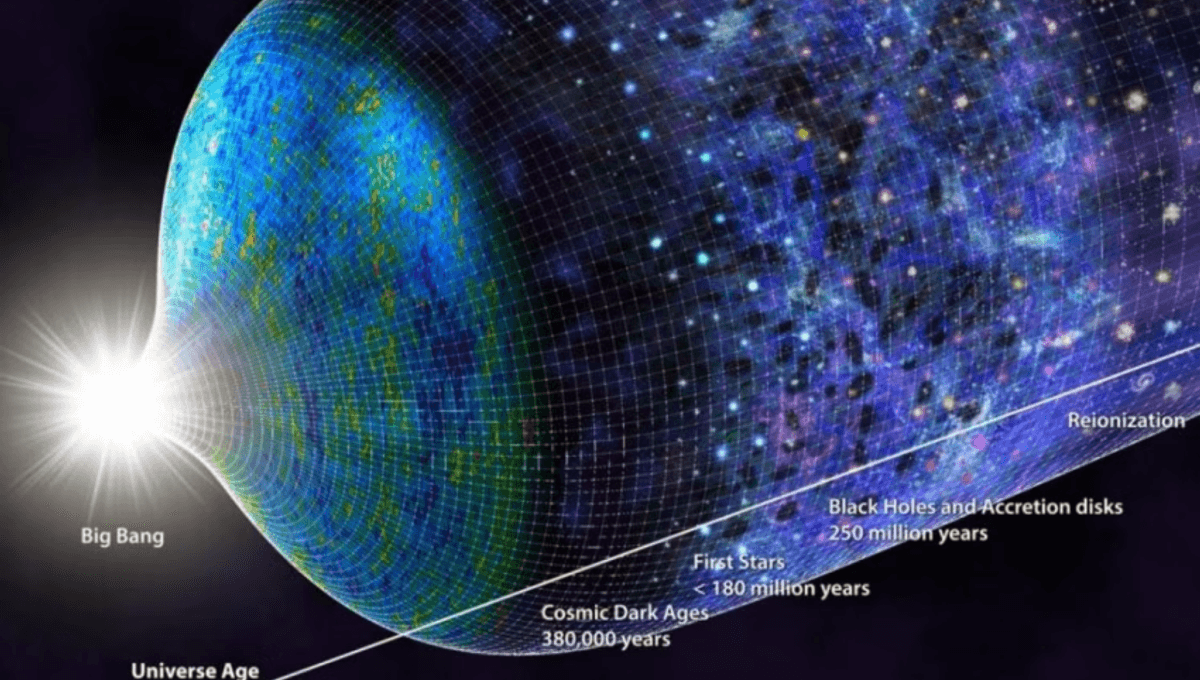
For roughly the first 100 million years of the universe, there were no stars. This is what we call the “Cosmic Dark Ages”. We have never probed this time of the universe as it is very difficult to do so. Without light from stars to trace, astronomers have to use radio waves to measure a very specific emission from hydrogen known as the 21-centimeter line. To hunt for this signal, a team is now proposing a very bold mission: sending a small radio telescope to orbit the Moon.
Telescopes are only sent to space when there is an advantage to having them there. There are many incredible radio telescopes on Earth, but they lack something to shield them from Earth radio signals. This is why the UK-led CosmoCube mission wants to put a mini-fridge-sized telescope around the Moon. Observing from the far side of the Moon would have the Moon act as a shield to all the radio noise from Earth.
“We are proposing this because the far side of the Moon is the most pristine radio environment we know of in the Solar System and it is reachable to us!” Dr Eloy de Lera Acedo, head of Cavendish Radio Astronomy and Cosmology at the University of Cambridge, told IFLScience. “There are many missions targeting the Moon, so it might be the first time in history that we are actually technologically able to put a radio telescope on the far side of the Moon, shielded from the emissions coming from Earth.”
For a period of about 100 million years, we have nothing until we estimate the first stars and the first galaxies started to form… From completely dark and simple to luminous, complex, full of stars, galaxies, and many other objects.
Dr Eloy de Lera Acedo
The proposal is being put forward for a mini-fast mission as part of the European Space Agency’s science program. These are missions with a maximum budget of €50 million and could be ready within five years. While small, this mission could be revolutionary.
“For a period of about 100 million years, we have nothing until we estimate the first stars and the first galaxies started to form,” Dr de Lera Acedo told IFLScience. “That whole process is still a mystery, and it’s probably one of the most fundamental transformations the universe ever went through. From completely dark and simple to luminous, complex, full of stars, galaxies, and many other objects.”
“What we know there must have been there is the most basic and abundant element in the universe, which is hydrogen. And we know hydrogen in its natural state can emit radio waves, which is what we are trying to detect and then use them to study this very early universe, this fundamental transition from darkness to light.”
Six years ago, a Dutch-led telescope on the Chinese Chang’e-4 demonstrated that it is possible to do radio astronomy from orbit on the far side of the Moon. A dedicated mission to probe the Cosmic Dark Ages could be a worthy investment to study an unprobed time of the universe.
This work was presented at the Royal Astronomical Society’s National Astronomy Meeting 2025 in Durham, held July 7- 11.

Source Link: This Mini Fridge-Sized Spacecraft Could Study A Time Of The Universe We've Never Seen Before
