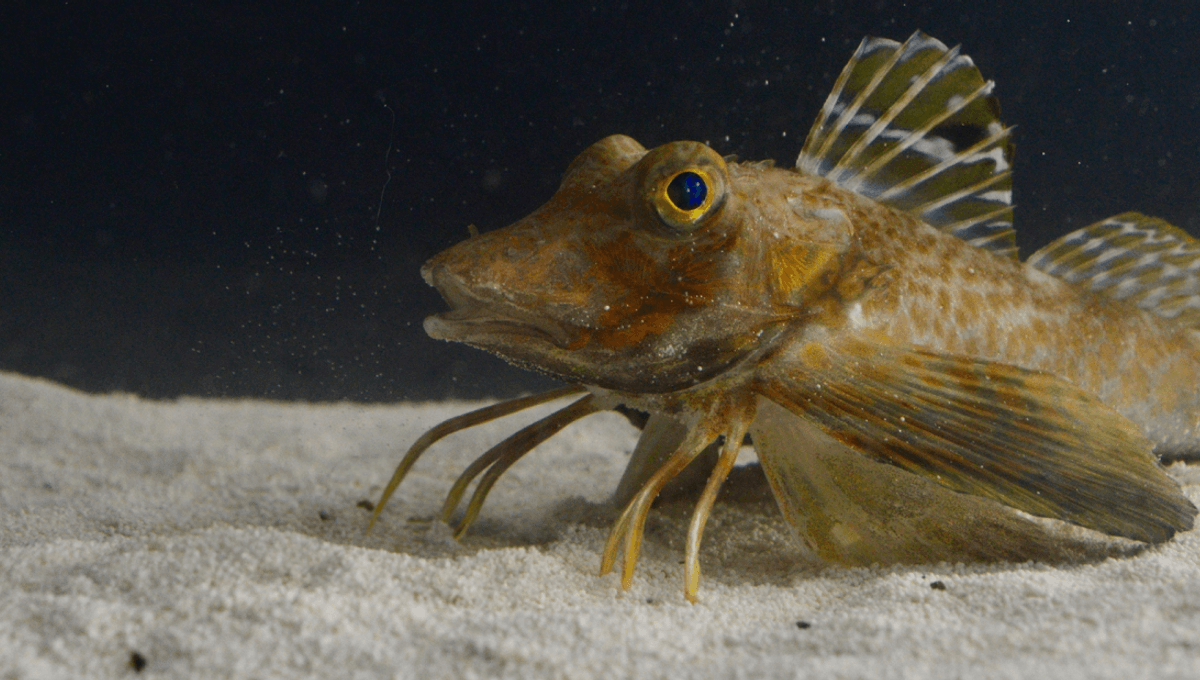
Scientists have just discovered the mechanism through which a winged fish uses its “legs” to taste the seafloor. The peculiar fish is so good at tasting the seabed, in fact, that other animals follow it for clues on where to find food. Isn’t the ocean just absurd?
Every now and then an animal comes along that really makes you question what you thought you knew about the natural world (tree-dwelling shrimp, anyone?), and in this category, may we present the sea robin. They recently became the subject of a spontaneous study, one that wasn’t planned but that the scientists found themselves powerless to resist when they saw how strange this animal is first-hand. The team were on a trip to the Marine Biological Laboratory (Woods Hole, MA) looking for squid when the chance encounter happened.
Other fish follow them around because they are so good at sensing and uncovering buried prey.
Prof Nicholos Bellono
“Scott Bennett from the Marine Resource Center has worked with me since I studied electroreception in sharks as a postdoc and knows I appreciate weird creatures, so he showed us sea robins, or ‘walking’ fish with legs as he called them,” said study co-author Professor Nicholas Bellono of the Department of Molecular and Cellular Biology at Harvard University to IFLScience. “He told us the stories about how other fish follow them around because they are so good at sensing and uncovering buried prey on the seafloor.”
“Our group is always open to studying new animals so we decided to bring back some sea robins, together with our squid, and see if they could uncover buried prey. To our surprise, they were very, very good at it and could even uncover ground up and filtered mussel extract, and single amino acids.”
A close look at the six leg-like appendages on certain sea robins revealed that they’re covered in sensory papillae, just like our tongues. These papillae are densely innervated and are touch- and taste-sensitive, enabling them to seek out food in the seabed.
The sea robins that can taste like this are contained to a small clade of specialists (including Prionotus carolinus pictured at the top of this article) who use their sensory appendages to dig and taste. Other sea robins also have these leg-like structures, but they don’t seem to dig and the appendages aren’t covered in papillae. The authors therefore conclude that these specialist sea robins’ papillae represent a novel sensory organ that enabled them to expand their niche on the sea floor.
Following one’s curiosity is the great joy of doing science and can lead to unexpected discoveries.
Dr David Kingsley
“This is a fish that grew legs using the same genes that contribute to the development of our limbs and then repurposed these legs to find prey using the same genes our tongues use to taste food,” Bellono said in a statement. “Pretty wild.”
Pretty wild indeed, and a wonderful demonstration of the strange rabbit holes science can take you down when you open yourself up to curiosity, spontaneity, and following the weird fish where it takes you.
“We went from making our own personal observation that there’s a crazy fish with legs to deciding to study it because it’s weird, fun, and interesting just for the sake of learning more about the world around us,” said study co-author Dr David Kingsley, Stanford University, to IFLScience. “To me, following one’s curiosity is the great joy of doing science and can lead to unexpected discoveries that influence our understanding of fundamental principles in nature.”
The discovery is published in two papers in the journal Current Biology: paper one, paper two.

Source Link: This Winged Fish Uses Strange Tongue-Like "Legs" To Taste The Seafloor – Yes, Really
