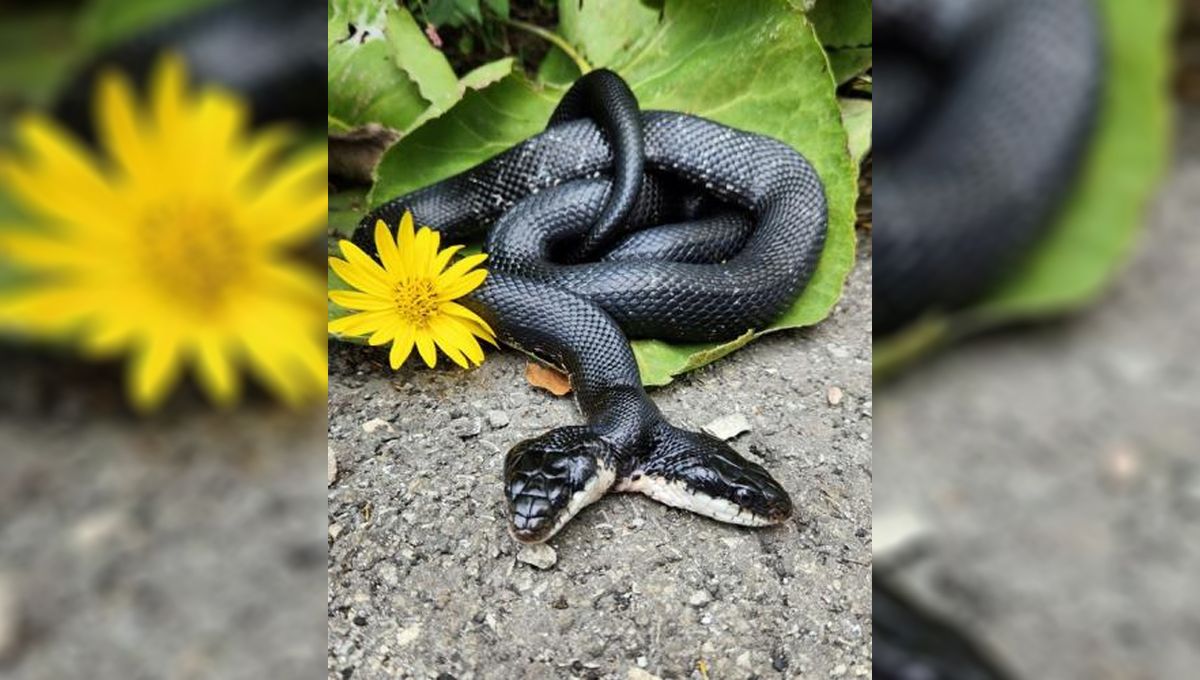
Tiger-Lily, the incredibly rare two-headed western rat snake, is recovering well after undergoing critical surgery earlier this month which, surprisingly, had nothing to do with the snake’s many heads.
Despite the western rat snake (Pantherophis obsoletus), also known as a black rat snake, being a common, nonvenomous species across much of central North America, this pair is a rare 1-in-100,000 case of polycephaly. Polycephaly is a form of conjoined twins where one body has two independent heads. In this snake’s case, each head was named Tiger and Lily by the family who found the pair in 2017.
After celebrating their sixth birthday in October of last year, the 1.5-meter (5-foot) long twins were set to continue their statewide tour of the Missouri Department of Conservation’s (MDC) sites on March 18, but, after sneezing up traces of blood during a feeding, the tour was put on hold a week before their intended departure.
“This immediately raised a red flag with our staff, and we quickly got her an appointment with the Animal Health Team at the Saint Louis Zoo,” MDC Naturalist Lauren Baker said in a statement.
Upon investigating Tiger-Lily’s condition, the Saint Louis Zoo’s veterinary team found that the twins’ ovaries were in pre-ovulation stasis.
Dr Michael Warshaw, Staff Veterinarian at the Saint Louis Zoo, explained, “Under normal circumstances, the ovary would grow follicles, then ovulate them as eggs to eventually be laid. In Tiger-Lily’s case, she began the reproductive cycle, but the follicles did not ovulate and instead continued to grow and remain static in her ovary. Over time this led to inflammation and the risk of infection.”
The procedure to remove the twins’ ovaries was successfully carried out on March 11 at the Saint Louis Endangered Species Research Center and Veterinary Hospital, and they are currently recovering well.
“The Saint Louis Zoo and MDC have a long history of partnering together for the care of Missouri’s native wildlife and we are happy to have played a part in caring for this exceptional animal,” Dr Chris Hanley, Director of Animal Health at the Saint Louis Zoo, said.
The snakes’ home at Shepherd on the Hills Conservation Center is closed for construction, but after the twins’ recovery period is over, which could take around a month, they will continue on their statewide tour until they can return to their swanky new digs.
Despite being a rare condition, there are a handful of snakes with polycephaly currently living in captivity, however, survival rates are low for these animals in the wild. Polycephalous snakes are particularly vulnerable to predation as they struggle to escape and hide in small holes.
Additionally, the physical act of eating is compromised when both heads are fighting to eat the same bit of prey. While much of polysepalous animals’ eating abilities are determined by their unique anatomy, with some two-headed snakes able to eat a meal at the same time, in Tiger-Lily’s case, they only have one esophagus between them.
“We have to keep the heads separate when they are eating,” MDC Interpretive Center Manager Alison Bleich said in a statement. “Since they share the same throat, it wouldn’t be good for them to both eat a mouse at once or to try to swallow the same mouse.”
To feed these twins, a small cup is placed over the head of one to prevent it from taking the other’s food, then the cups are switched so both twins have a chance to eat. Both meals travel down the same esophagus and into the same stomach.
If you want to catch a glimpse of this rare celeb, Tiger-Lily’s tour will continue in the coming months with a trip to MDC’s Anita B. Gormon Discovery Center in Kansas City.

Source Link: Tiger-Lily The Two-Headed Snake Recovering Well From Critical Surgery
