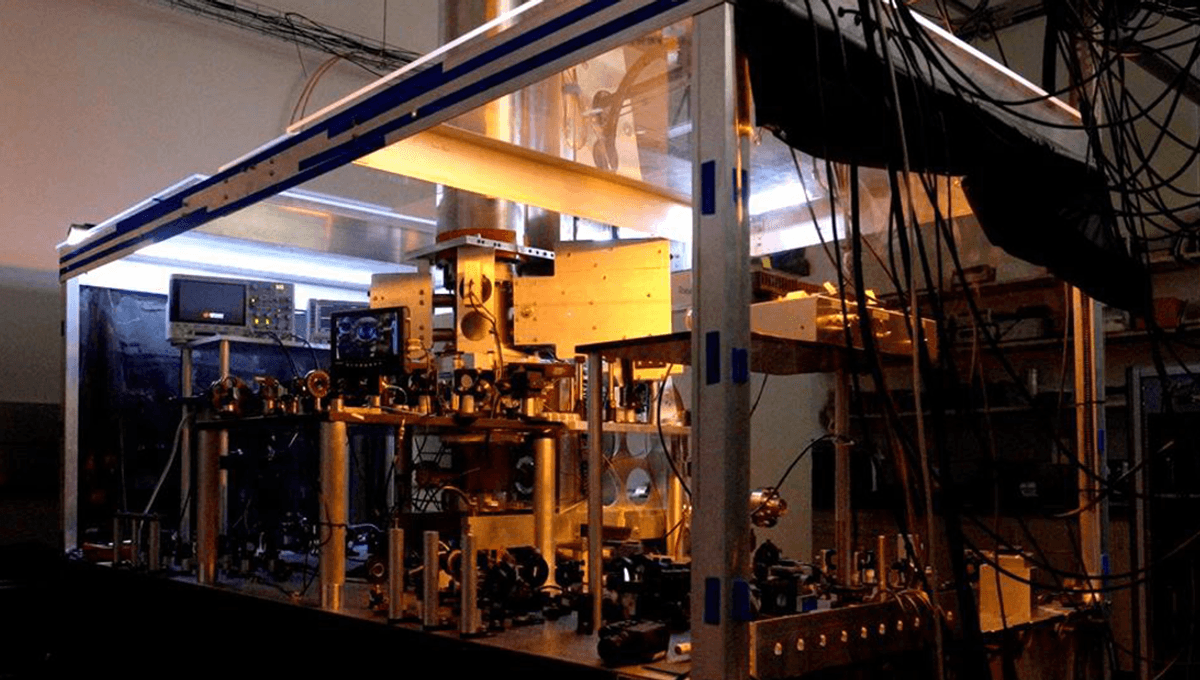
The National Institute of Standards and Technology (NIST) has assured the country that “time is not broken”, after a power outage in Boulder, Colorado, caused official US time to drift by around 4.8 milliseconds over the last week.
From 2007 onwards, the official US time (known as NIST UTC) has been set by NIST. It currently does so by using an average of 16 atomic clocks located at the NIST laboratory in Boulder, measured using “the duration of 9,192,631,770 periods of the radiation corresponding to the transition between two hyperfine levels of the ground state of the cesium-133 atom”.
“A weighted average, rather than a simple arithmetic average, is used,” NIST explains. “This means that some clocks – specifically the clocks with the best frequency stability – are given more ‘weight’ and contribute more to the average than others.”
On Wednesday a particularly destructive storm knocked out power supply to the laboratory. While this may not be a huge problem, a switchover to backup generators meant that US time drifted, slowing down ever so slightly.
“At initial power loss, there was no immediate impact to the NIST atomic time scale or distribution services because the projects are afforded standby power generators. However, we now have strong evidence one of the crucial generators has failed. In the downstream path is the primary signal distribution chain, including to the Boulder Internet Time Service,” Jeff Sherman, group leader for the Time Realization and Distribution Group at the National Institute of Standards and Technology, explained in an email.
“Another campus building houses additional clocks backed up by a different power generator; if these survive it will allow us to re-align the primary time scale when site stability returns without making use of external clocks or reference signals.”
The time is not out by much, and in general US citizens will not notice a difference. As NIST spokesperson Rebecca Jacobson explained to CBS News, “time is not broken”.
“To put a deviation of a few microseconds in context, the NIST time scale usually performs about five thousand times better than this at the nanosecond scale by composing a special statistical average of many clocks. Such precision is important for scientific applications, telecommunications, critical infrastructure, and integrity monitoring of positioning systems. But this precision is not achievable with time transfer over the public Internet; uncertainties on the order of 1 millisecond (one thousandth of one second) are more typical due to asymmetry and fluctuations in packet delay,” Sherman added in a further update.
“NIST provides high-precision time transfer by other service arrangements; some direct fiber-optic links were affected and users will be contacted separately. However, the most popular method based on common-view time transfer using GPS satellites as ‘transfer standards’ seamlessly transitioned to using the clocks at NIST’s WWV/Ft. Collins campus as a reference standard. This design feature mitigated the impact to many users of the high-precision time signal.”
For certain systems who rely on these high-precision provisions of the time, who have been contacted by the NIST, problems like this can cause a bit of a headache.
“NIST UTC drifted by about 4 microseconds, which is 4 millionths of a second. For comparison, it takes about 350,000 microseconds to blink or 150,000 microseconds to snap your fingers,” Jacobson told CBS.
“For most NIST time users, this drift would not even register. For those users in industries such as telecommunications and aerospace, or other laboratories where such a drift could be noticeable, we always provide access to other networks in other locations to ensure uninterrupted service. We had notified those high-end users of a potential power outage so they could be prepared to access those networks as a precaution.”
In a final update on the situation, Sherman added that assessment and further repairs were continuing, but that they were satisfied that the Boulder Internet Time Service is now providing accurate time.
“As the typical uncertainty of time transfer over the public Internet is on the order of one millisecond (1/1000th of a second), we can say in retrospect that the accuracy of the Internet Time Service was not compromised and that users were not impacted by the time deviation,” he added.

Source Link: "Time Is Not Broken": US Officials Work To Correct Time, After Discovering It Is 4.8 Microseconds Out
