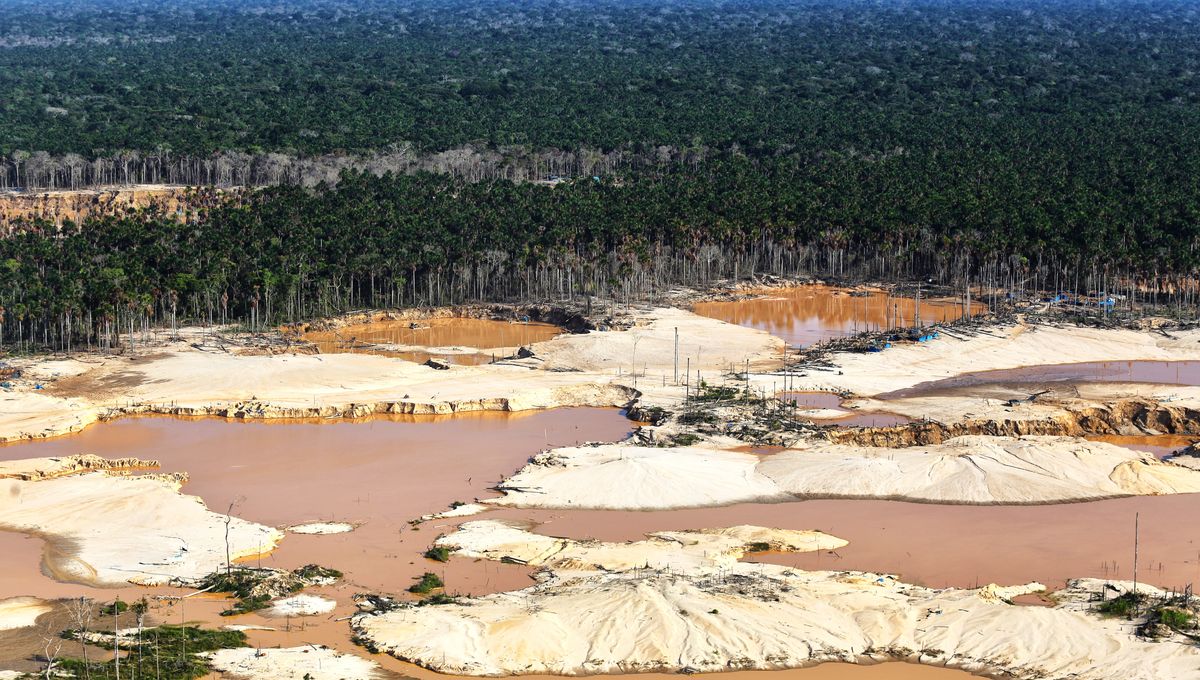
Gold mining is putting an immense strain on the Amazon rainforest, but the trees might have a secret weapon up their bark. Just as tree rings can record the passage of time and shifts in climate, new research shows they can also help to track down destructive gold mining practices.
Here’s how it works: human-made emissions of mercury are produced by artisanal and small-scale gold mining, much of which occurs deep in the rainforest where it is unregulated, undocumented, and illegal.
Miners mix mercury with soil and mud that has gold in it. The mercury sticks to the gold and forms a soft mixture called an amalgam. This makes it easy to separate the gold from the rest of the dirt. After they collect the amalgam, they heat it up to remove the mercury, turning it into a gas and leaving behind raw gold. These emissions are then absorbed by the trees where they become embedded in the wood in distinct layers, capturing a record of contamination over time.
In a new study, scientists at Cornell University, the University of Toronto, and collaborators explain how tree cores can be used to accurately detect the presence of gold mining by chronicling the emissions of mercury.
The researchers collected tree cores from wild fig trees (Ficus insipida) at three mining-impacted sites and two remote locations in the Peruvian Amazon. They found that mercury concentrations were significantly higher near the mining towns compared to remote sites, suggesting the method was a reliable way to identify whether the area was being impacted by artisanal gold miners.
“We show that Ficus insipida tree cores can be used as a biomonitor for characterizing the spatial and potentially the temporal footprint of mercury emissions from artisanal gold mining in the neotropics,” Dr Jacqueline Gerson, an assistant professor in biological and environmental engineering at Cornell University and first author of the study, said in a statement.
The Peruvian Amazon is a hotbed of unregulated gold mining. In recent years, there have been ongoing troubles in the region of Madre de Dios where a modern-day gold rush has seen makeshift cities pop up and recklessly exploit the environment for rare metals.
Agricultural land clearing and logging are the biggest drivers of tropical deforestation, but gold mining has become increasingly prolific, especially since the 2008 global financial crisis, which drove up the price of gold and made mining even more lucrative.
Along with causing extensive deforestation, rampant gold extraction has introduced floods of polluted water into the surrounding ecosystem. Reckless miners have also come into violent conflict with Indigenous tribes that live in the area, even seizing their settlements and killing their leaders.
While this is no small problem to solve, the researchers of this latest study hope their work could be used to help get a hold of the issue.
“Trees can provide a widespread and fairly cheap network of biomonitoring, by archiving a record of mercury concentration within tree bolewood,” Gerson added.
“Ficus insipida can be used as a cheap and powerful tool to examine large spatial trends in Hg emissions in the neotropics,” she concluded.
The study is published in the journal Frontiers in Environmental Science.

Source Link: Trees Store The Memory Of Reckless Gold Mining In The Peruvian Amazon Rainforest
