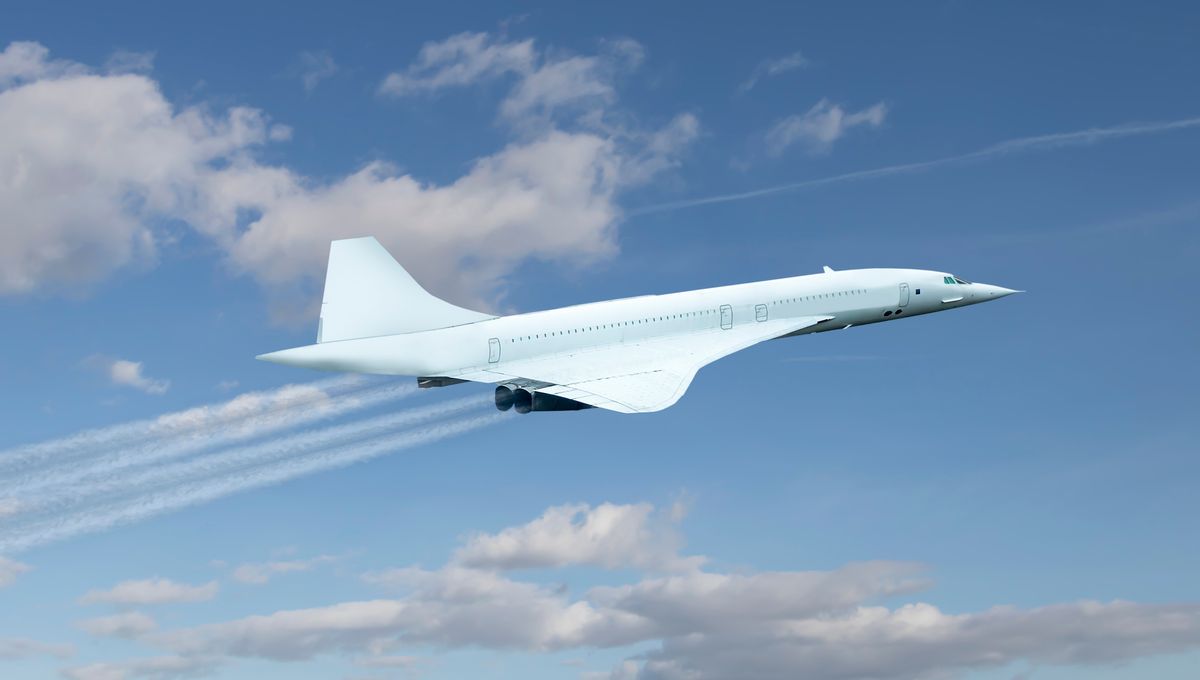
President Trump has issued an executive order that allows commercial flights across America to fly faster than the speed of sound. The order overturns what it refers to as “outdated and overly restrictive regulations”. It comes as companies are working on quieter supersonic aircraft, and instructs the Federal Aviation Administration (FAA) to create standards to govern such flights, but the capacity to deliver remains to be seen.
In a world where most things are getting faster, long-distance commercial flights have been an exception for a long time. It’s quicker now to get from one side of the world to the other than it was in the 1970s because modern planes can travel further. The journey from Melbourne to London or New York typically only involves one stop instead of two as it did a few decades ago, for example. However, the time spent cooped up in a metal tube has barely shifted. Many routes now travel slower.
The reason for that is the sound barrier (1,235 kilometers per hour or 767 miles per hour). Flying above it produces a sonic boom that has a way of making people on the flight path deeply unhappy, and can even shatter windows beneath. This led to the restrictions passed in 1973 that the executive order overturns.
Even flying close to the speed of sound brings problems, although more for safety and fuel efficiency than for those on the ground. Above Mach 0.8, some of the air flowing around the aircraft is supersonic, while some is subsonic. This drastically increases drag and creates shockwaves that add to instability. Consequently, commercial flights tend to stick to speeds below 1,000 km/h (621 mph), unless they get lucky with a tailwind.
Advances in aerodynamics have inspired companies like Boom Supersonic and Lockheed Martin to believe they can achieve supersonic flight with much less ground noise, by bending the sound waves upwards or canceling them out. It’s this work the executive order refers to in stating that the previous ban has been “stifling American ingenuity, weakening [its] global competitiveness, and ceding leadership to foreign adversaries.”
The order directs the Administrator of the FAA to “repeal the prohibition on overland supersonic flight … within 180 days of the date of this order and establish an interim noise-based certification standard.” More than a third of those days have passed since the order was made. In other times, such a ruling would probably have attracted widespread attention, but the order has been overshadowed by other actions from the White House with more immediate implications.
The interim rules will last for a year, with the FAA directed to produce a standard for supersonic noise within 18 months of the order being issued, including “thresholds for takeoff, landing, and en-route supersonic operation.”
Those thresholds will undoubtedly be hotly contested. Just because we have, or may soon have, the technology to make supersonic flight quieter than in the 1970s doesn’t mean it will be truly quiet. The Trump administration justifies its war on wind power in part based on the noise of a spinning turbine half a mile away. Will supersonic jets be quieter than that?
However, that may not be the biggest obstacle to the executive order meeting its goals. The order reads: “Advances … make supersonic flight not just possible, but safe, sustainable, and commercially viable.” It’s the last of these that will be the real challenge.
What the order ignores is that from 1976 to 2003, there were supersonic flights in the form of British Airways and Air France operations of Concorde, unhindered by these restrictions. The flights were made across the Atlantic Ocean, on the basis that whales and other occupants of the sea lacked political muscle if the sound bothered them. Concorde stayed below the speed of sound while near enough to land to affect humans.
What Concorde couldn’t do was recoup the costs of development. Everyone wanted shorter trans-Atlantic flights, but there was a limit to how much they would pay. Although generally recognized as an engineering masterpiece, the operational costs were immense. A crash in 2000 that killed all on board didn’t help marketability, but plans to scrap it began long before, its survival dependent on novelty flights for tiny numbers and national pride.
Designed in an era when oil was cheap, Concorde never recovered from the 1973 oil shock, when prices rose to $12 a barrel. Chewing up around five times as much fuel per passenger mile as its competitors of the day (let alone modern, more efficient aircraft), you didn’t have to care about the planet to see the problem.
Nor was this a uniquely Concorde problem. The other supersonic commercial aircraft, the USSR’s Tupolev Tu-144, was even worse, carrying just 55 times. Boeing canceled their version in 1971.
We can’t predict what the break-even price of tickets on future supersonic aircraft will be. Nevertheless, it’s almost certain they will come at an enormous price premium, even if damage to the Earth’s temperature (and possibly ozone layer) isn’t priced in. Concorde also came with much higher maintenance costs and staffing ratios to ensure the faster flying times were reflected on the ground as well. New supersonic aircraft will face similar challenges.
Companies betting on success reason that their products will be competing in a world where the number of super-rich individuals unaffected by price will be far higher than in the Concorde era. On the other hand, today, the richest often have their own jets.
If there’s a market for supersonic travel, it’s likely on intercontinental flights long enough to make time savings count more, and which many private jets can’t handle. That’s not something the executive order can help with much.
[H/T: Space.com]

Source Link: Trump Removed Ban On Commercial Supersonic Flight, But That Might Not Be Enough
